
Gate code management for a luxury estate means treating access as a lifecycle, not a one-time setup: issue time-bound, role-based credentials, monitor who used them and when, and revoke them the moment a purpose ends. The best-practice posture pairs that lifecycle discipline with quarterly audits and documented backup procedures. Estate managers who run this well borrow from firms like 30apropertycollective, whose weekly inspection model already builds credential review into the household routine.
TL;DR:
- Proper gate code management involves role-based, time-bound credentials with automatic expiries, not shared or static codes that persist over years.
- Maintaining a documented, regularly updated log of all credentials, with at least 60 days of retention and remote revocation, can reduce insurance costs and increase security.
- Vetting third-party vendors and contractors with verified credentials, escorts, and short-term codes minimizes security risks from transient access.
- Implementing physical backup methods and testing emergency protocols twice a year ensures estate access during system failures caused by power outages or disasters.
- Automating code distribution with expiration and establishing clear staff training and legal privacy protocols prevents accidental leaks and unauthorized use.
Table of Contents
- What Does Gate Code Management Actually Involve?
- Access Credential Lifecycle: Map, Issue, Limit, Revoke
- How Should Vendors, Contractors, and Guests Be Vetted for Gate Access?
- What Happens When the Gate System Fails?
- How Long Should You Keep Gate Access Logs?
- Quick-Start Checklist for Estate Managers
- Where Does Security End and Estate Management Begin?
- What Makes a Gate Code Actually Secure?
- Should You Use More Than a Gate Code for Estate Access?
- How Should You Train Staff and Vendors on Gate Code Rules?
- What Legal and Privacy Issues Come Up With Gate Codes?
- How Should Automated Systems Handle Code Distribution?
- What Should Happen After a Failed or Suspicious Gate Attempt?
- Fitting Gate Code Management Into a Weekly Estate Rhythm
- Let 30apropertycollective Manage Your Estate's Access, Not Just Your Codes
- Sources
What Does Gate Code Management Actually Involve?
Most estate owners think of gate code management as picking a number and handing it to whoever needs in. That framing is how estates end up with a landscaper, a pool tech, and a former nanny all sharing the same four-digit code from three years ago.
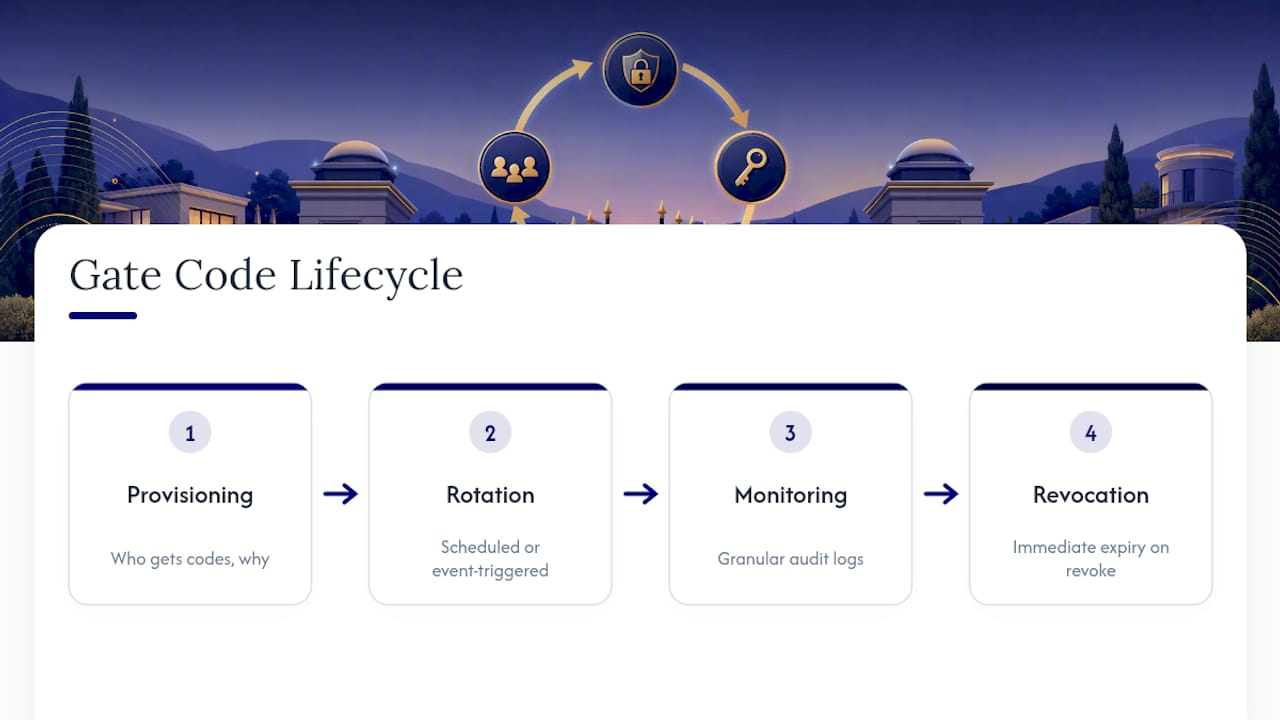
The real discipline covers four moving parts: provisioning (who gets a code and why), rotation (how often codes change and on what trigger), monitoring (what gets logged and reviewed), and revocation (how fast access dies when it should). Security researchers who study residential access point to role-based, time-bound permissions with expiration dates and granular audit logs as the baseline for gate access control on private estates. That means a housekeeper's code looks different from a landscaper's code, which looks different from a one-day delivery code, and each one has a built-in shutoff date.
Skip that structure and you get what security consultants call access accumulation: dozens of active credentials with no clear owner, no expiration, and no one who remembers issuing half of them. It's the single most common vulnerability in private estate security assessments, and it builds up gradually enough that most households don't notice until something goes wrong.
Access Credential Lifecycle: Map, Issue, Limit, Revoke
Every credential on your property, whether it's a gate code, a mobile access link, or a physical key, needs a documented life story: who has it, why, and when it expires. Estate managers who run this well treat credentials the way a hospital tracks medication: nothing goes out without a name attached, and nothing stays active past its purpose.
Start with a full inventory. List every entry point (main gate, service gate, garage, side doors) and every credential type tied to it. Then apply four rules consistently:
- Assign a named owner to every credential, not just a category like "cleaning crew."
- Default every non-permanent code to automatic expiry rather than manual deactivation.
- Offboard access the same day a staff member or vendor relationship ends, not at the next convenient audit.
- Purge inactive or unused credentials on a quarterly schedule, even if nothing seems wrong.
That last habit matters more than people expect. Credential creep rarely looks dangerous in the moment. It's the pool guy's code still working eight months after you switched services, or the code you gave a house sitter two summers ago that nobody ever turned off. Left unmanaged, these codes pile up until nobody, including your estate manager, can say with confidence who actually has access to your property.
Pro Tip: Keep a single master log (digital or paper, but never both) that records every credential issued, its owner, its expiration date, and the date it was revoked. If a code doesn't appear in that log, it shouldn't work.
How Should Vendors, Contractors, and Guests Be Vetted for Gate Access?
Third-party access is where most estates leak security, because it's the category everyone wants to move fast on. A refrigerator repair, a landscaping crew, a one-off furniture delivery. The urge is to just give them a code and move on. Resist it.
- Standardize vendor vetting before anyone gets a code: verify licenses, confirm active insurance, check references, and document the scope of work in writing.
- Assign escorts for higher-risk contractors, meaning anyone entering the home's interior unsupervised or working near safes, offices, or private wings.
- Issue temporary, single-use credentials for short jobs rather than reusing a standing vendor code across multiple visits.
- Build a vendor-freeze window into any travel calendar, pausing new access issuance while the principal is away, with a documented exception process for genuine emergencies.
- Route deliveries off the grounds where practical, using roadside lockers or concierge acceptance instead of granting couriers gate access at all.
That last point solves a problem most owners don't think about until it bites them: every delivery driver who gets a one-time code is a data point someone could exploit if your logging is sloppy. Estate managers already handling package theft prevention know that removing the delivery vehicle from the equation entirely often beats trying to manage it. For contractor management specifically, a documented remote oversight process for contractors keeps scope creep from turning a one-day repair into open-ended access.
Clear operational boundaries between vetting and issuance prevent the friction that happens when security and household staff work from different playbooks, a coordination gap that estate security specialists flag as a recurring failure point.
What Happens When the Gate System Fails?
Power outages, hurricanes, and dead phone batteries don't care how sophisticated your access system is. A gate code management plan that only works when everything is functioning normally isn't a plan, it's a hope.
The fallback layer needs to be low-tech, documented, and tested. A secured lockbox with a physical override gives your estate manager a way in when digital systems go dark, and a pre-authorized trusted-person protocol means someone specific, not "whoever's around," knows the full emergency sequence.
- Keep a documented physical override or lockbox with access limited to two or three named people.
- Maintain a short list of pre-authorized trusted contacts for emergency entry, reviewed annually.
- Test the entire fallback sequence at least twice a year, and always before hurricane season or an extended absence.
- Log every use of a backup method the same way you log a normal gate code, so redundancy never becomes an unmonitored side door.
Household-standard guidance backs semiannual testing specifically, paired with clear rules about who's allowed to know the full backup procedure so nobody improvises during an actual storm.
Pro Tip: Schedule your fallback rehearsal on the same calendar trigger as your storm-prep walkthrough. Bundling the two means neither gets skipped when things get busy.
How Long Should You Keep Gate Access Logs?
An audit log is only useful if it captures the right fields and survives long enough to matter. At minimum, every entry needs an identity, a timestamp, the specific entry point used, and a record of when that credential was later revoked. Anything less leaves gaps your estate manager can't answer for later.
Insurance carriers are starting to price this. Homeowners with stronger access-control postures, including audit logs retained for at least 60 days and systems with remote-revocation capability, can qualify for premium discounts in the range of 3% to 8% on their policy.
That's a real financial incentive layered on top of the security case. To capture it, your access setup needs to check a few boxes:
- Granular entry and exit logging on every gate, not just the main one.
- At least 60 days of retained log history, matching common insurer thresholds.
- Remote revocation, so a lost phone or a fired contractor doesn't wait on a physical fix.
- Quarterly access audits with a written remediation step for anything the review flags.
The audits matter as much as the logs themselves. A log nobody reviews is just data sitting idle, and the audit trail requirement that security guides recommend only pays off when someone actually walks through it every quarter.
Quick-Start Checklist for Estate Managers
If your current setup has never been formally audited, here's where to start this week rather than next quarter.
- Build a full credential inventory across every gate, door, and mobile access point on the property.
- Set expiry defaults on every non-permanent code and assign a named owner to each one.
- Draft a written vendor-access rule set, including escort thresholds and freeze-window triggers.
- Run an initial purge within 30 days, removing every credential without a clear current purpose.
- Complete your first formal audit within 60 days and rehearse the fallback access sequence within 90.
- Assign one person, typically the estate manager, as the ongoing owner of quarterly reviews and change logs.
Three templates are worth drafting immediately rather than waiting for a crisis to expose the gap: a written visitor protocol, a vendor vetting checklist, and an emergency access authorization form naming who can approve backup entry.
Pro Tip: Put the 30/60/90 dates on a recurring calendar reminder tied to your estate manager's existing quarterly inspection schedule. New systems fail from neglect, not design.
Where Does Security End and Estate Management Begin?
The friction on most properties isn't bad security or bad management. It's the seam between them, where nobody's quite sure who owns a decision.
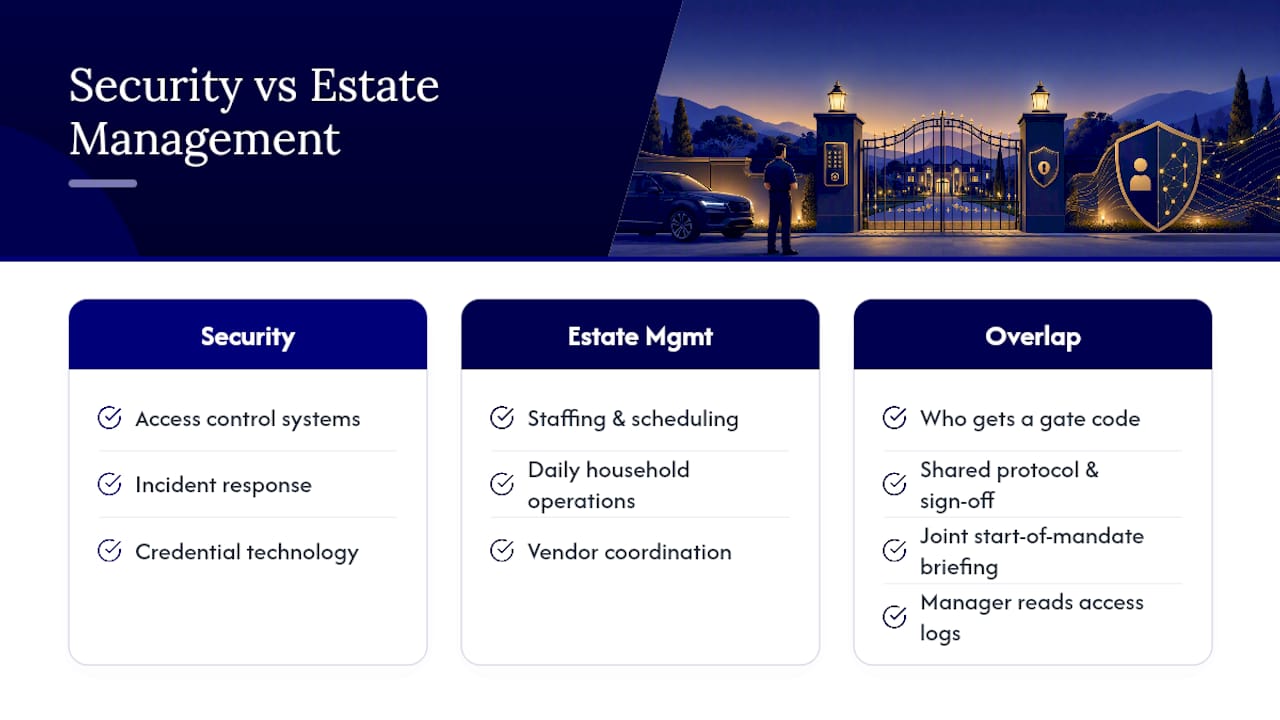
Draw the line explicitly. Security ownership typically covers access control systems, incident response, and credential technology. Estate management ownership covers staffing, vendor scheduling, and daily household operations. The overlap, deciding who gets a gate code and when, needs a shared protocol both sides sign off on, not an assumption that the other party has it handled.
A documented joint briefing at the start of any estate manager's mandate, one that walks through exactly this division of labor with existing security staff, sets the tone for everything that follows. It's a small step that estate security integration research identifies as a differentiator between estates that run smoothly and ones that generate constant friction over who's responsible for what.
Practically, this means your estate manager needs enough technical fluency to read an access log and translate it into an operational decision, not just forward it to a security contractor and wait. The best estate managers can operate household smart platforms like Crestron or Control4 directly, which is increasingly listed as a core expectation in estate manager job descriptions rather than a specialized add-on. When that fluency exists in-house, security stops being a separate department and becomes part of how the household runs day to day, the same way weekly inspections already fold maintenance oversight into broader estate management.
What Makes a Gate Code Actually Secure?
A four-digit code with your address's last digits reversed is not a security measure. It's a formality that happens to slow down nobody who's paying attention.
Complexity standards for gate codes follow the same logic as any access credential: length and randomness matter more than memorability. A code should never map to anything guessable from public information, house number, street name, birth year. Longer codes (six digits minimum where the hardware supports it) reduce brute-force risk substantially over a standard four-digit sequence.
But complexity alone doesn't solve the real problem, which is reuse. The single biggest operational mistake on luxury properties isn't a weak code, it's a shared code. One string of digits handed to a landscaper, a house sitter, and three delivery services because it's easier than tracking separate ones. That habit, along with letting temporary codes live far longer than the job they were issued for, drives most access exposures on private estates.
The fix is structural, not just technical: generate a unique code per role or per visit rather than per property, and never reuse a retired code for a new purpose. Random generation, handled through whatever access platform your estate uses, beats any code a person invents, because people default to patterns even when they think they're being random. Pair generation with the expiry defaults covered earlier and complexity stops being the weak link.
Should You Use More Than a Gate Code for Estate Access?
A gate code alone answers one question: does this person know the number? It doesn't confirm who they actually are. That's the gap multi-factor approaches close.
For higher-sensitivity entry points, main residence doors, home offices, safe rooms, pairing a code with a second factor meaningfully raises the bar. That could be a mobile credential that pings a registered device, a biometric reader for staff who need daily interior access, or simply a callback confirmation for one-time vendor entries before a code activates.
The practical version for most estates doesn't require exotic hardware. It means: gate codes get you onto the property, but a second, separate credential (a key fob, a verified mobile app, a staff badge) gets you into the house itself. Layering access this way means a leaked gate code, and gate codes leak more often than owners assume, doesn't automatically translate into interior access. It's the same layered logic that advanced estate security programs rely on: no single credential should be a skeleton key to the entire property.
How Should You Train Staff and Vendors on Gate Code Rules?
The best access policy on paper fails the moment a housekeeper texts the gate code to her sister to let a delivery in while she's running late. Training closes that gap, and it needs to happen before day one, not after an incident.
Every person who receives a credential should get a short, direct briefing: what the code is for, who it can be shared with (nobody), how long it's active, and who to contact if something feels off. Put it in writing, even if it's a single page. Verbal-only policies get forgotten or reinterpreted within weeks.
Communication protocols matter just as much as the initial training. When a code changes, everyone who needs the new one should get it through a single, consistent channel, not a scramble of texts and phone calls that leaves someone locked out or, worse, someone outside the loop improvising a workaround. Estate managers who run a tight ship typically designate one person as the sole point of contact for code changes, which also creates a natural checkpoint for logging who was notified and when.
What Legal and Privacy Issues Come Up With Gate Codes?
Access logs contain personal data: names, timestamps, patterns of who comes and goes and when. That data deserves the same care you'd apply to any sensitive household record, particularly for staff and frequent visitors who might reasonably expect some privacy around their movements.
Practically, that means limiting who can view raw access logs to the estate manager and, when necessary, insurance or legal counsel, rather than treating them as casual household information. It also means being explicit with staff and regular vendors about what's being logged and why, since surprise monitoring tends to erode trust faster than the security benefit justifies.
There's a liability angle too. If an incident occurs and your logs are incomplete, inconsistent, or missing entirely for the relevant window, that gap can complicate both insurance claims and any legal follow-up. Documented, consistent record-keeping protects the household as much as it protects any individual's privacy.
How Should Automated Systems Handle Code Distribution?
Manually texting out gate codes doesn't scale past a handful of trusted regulars, and it's exactly the kind of process that produces the shared-code problem covered earlier. Automated distribution, where a system generates a unique, time-bound code and sends it directly to the recipient, removes the estate manager as a manual bottleneck and closes the sharing loophole at the same time.
The expiration piece is what makes automation actually valuable rather than just convenient. A code generated for a one-time vendor visit should expire automatically at the end of that visit window, no manual step required. That single feature eliminates the most common real-world failure: someone forgetting to deactivate a temporary code weeks after the job wrapped.
What Should Happen After a Failed or Suspicious Gate Attempt?
An unauthorized access attempt, a wrong code entered repeatedly, an expired credential still being tried, needs a defined response, not an ad hoc reaction from whoever happens to see the alert first.
The sequence should run roughly like this: the system flags the attempt and notifies the estate manager immediately; the estate manager reviews the log entry to identify the credential and entry point involved; if the attempt came from a revoked or unfamiliar code, the incident gets documented with timestamp and details; and if the pattern suggests something beyond a simple mistake, repeated attempts, unusual hours, an unfamiliar vehicle, local authorities get notified per the household's existing security protocol.
Speed matters here more than most owners realize. A revoked contractor code that gets tried once and ignored is very different from one that keeps getting tried, and the second scenario needs escalation within hours, not at the next quarterly review.
Fitting Gate Code Management Into a Weekly Estate Rhythm
At 30apropertycollective, gate code management isn't a separate security task bolted onto a property. It's woven into the same weekly inspection rhythm that catches a slow roof leak before it becomes a ceiling collapse. When our team walks a property, credential review happens alongside every other proactive check.
That shows up in practical ways: confirming vendor codes deactivate on schedule ahead of a storm, coordinating discreet credential handoffs for arriving guests without a principal needing to manage it personally, and folding access checks into pre-arrival readiness so a homeowner's return never involves a lingering question about who still has a way in. The result for our clients is straightforward: fewer overlooked credentials, smoother guest and vendor arrivals, and access records clean enough to stand behind if an insurer or attorney ever asks for them.
— Zackary
Let 30apropertycollective Manage Your Estate's Access, Not Just Your Codes
30apropertycollective is the difference between owning a security policy and actually running one, week after week, without lifting a finger yourself. Where a standalone access system leaves you as the person remembering to purge old codes and chase vendor compliance, our estate management team folds that work into the same weekly inspections and vendor oversight we already provide.

Our Concierge and Estate Management memberships build credential review, vendor vetting, and storm-season fallback rehearsals into a single coordinated service, tailored to your specific property rather than a generic template. Clients across Florida's Emerald Coast rely on us for the same discretion and anticipatory care we bring to arrival readiness and pantry stocking, applied now to who gets in your gate and when. If your current access setup has more gaps than answers, request a consultation on Concierge services and we'll walk your property's access posture with you before the next storm season arrives.
Sources
- Emergency access plan: safe account recovery guide — Passlock
- Estate manager security integration — FFGR Security