Luxury estate management is the full-spectrum supervision and coordination of high-value residential properties, covering preventative maintenance, financial administration, security, and concierge services to protect the asset and support the owner's lifestyle. The industry term used by estate professionals is "private estate management," though "luxury estate management" describes the same discipline for residential portfolios. 30apropertycollective delivers this level of care along Florida's Emerald Coast, where the stakes of deferred maintenance and reactive oversight are especially high. For homeowners and investors who treat their properties as both personal sanctuaries and long-term assets, professional estate management is not a luxury. It is a risk management strategy.
What does luxury estate management actually include?
Luxury estate management covers far more than scheduling a plumber. The full scope of services spans property inspections, contractor coordination, security monitoring, financial administration, and arrival preparation, all managed through a single point of accountability.

Weekly inspections and preventative maintenance
Weekly property inspections maintain insurance validity and catch problems before they become expensive. A small roof leak found during a routine walkthrough costs a fraction of the water damage claim it would become after six weeks undetected. Estate managers document every finding, photograph conditions, and track repair timelines so owners receive a clear record rather than a surprise invoice.
Contractor and vendor coordination
Centralizing vendor management under a single estate advocate prevents blame-shifting between contractors and closes the accountability gaps that cause maintenance breakdowns. A dedicated manager verifies contractor insurance, negotiates preferred pricing, and holds every vendor to a defined standard of work. Owners who rely on a rotating cast of independent contractors often discover that no single party takes responsibility when something goes wrong.
Financial administration
Bill payment, utility management, and property bookkeeping fall within the estate manager's scope. This function matters because high-value properties carry high fixed costs, and missed payments or untracked expenses erode both cash flow and property condition. Detailed financial reporting also supports capital improvement planning, giving owners the data they need to make informed decisions about upgrades and renovations.
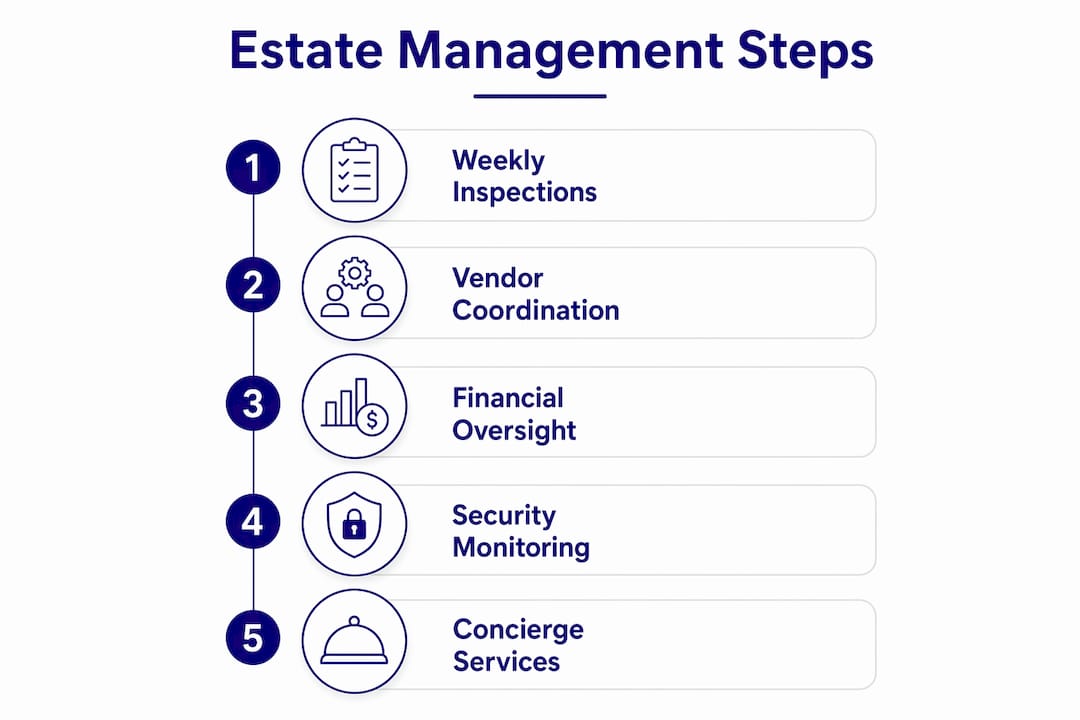
Security monitoring and emergency response
Estate managers maintain rapid-response protocols for emergencies including storms, security breaches, and mechanical failures. Along Florida's Gulf Coast, storm preparedness is not optional. A property without a designated manager to board windows, document pre-storm conditions, and coordinate post-storm repairs faces both physical damage and insurance complications.
Concierge and arrival preparation
Concierge integration covers travel arrangements, event access, and personalized home stocking so owners arrive to a property that feels lived-in rather than dormant. Arrival and departure preparation is one of the most visible services in bespoke estate service plans because it directly shapes the owner's experience. A well-stocked refrigerator, a properly cooled home, and fresh linens signal that someone has been paying attention.
Pro Tip: Ask any prospective estate management company to walk you through their arrival preparation checklist. The specificity of that answer tells you more about their operational standards than any marketing brochure.
| Service category | What it delivers |
|---|---|
| Weekly inspections | Insurance compliance, early problem detection, documented property condition |
| Vendor coordination | Contractor accountability, verified insurance, preferred pricing |
| Financial administration | Bill payment, bookkeeping, capital improvement reporting |
| Security and emergency response | Storm preparedness, breach response, rapid repair coordination |
| Concierge and arrival prep | Home stocking, climate control, personalized arrival readiness |
What management models do luxury estate management companies offer?
Luxury home management companies structure their services in three primary models. Each suits a different ownership profile, and choosing the wrong one creates either overspending or gaps in coverage.
-
Full-time on-site management. This model places a dedicated manager or management team at the property. It suits large estates with full-time staff, complex mechanical systems, or owners who spend significant time in residence. The trade-off is cost. Full-time on-site management carries the overhead of employment, payroll, and HR administration.
-
Monthly retainer with non-resident oversight. Non-resident management models deliver oversight equivalent to full-time staff while eliminating employer liability and payroll complexity. This model works well for owners with one or two properties who need consistent, professional attention without the cost of a full household staff. Some providers manage up to two residences starting at approximately $5,000 monthly, though pricing varies by property size, location, and service scope.
-
Hybrid and customized packages. Bespoke estate service plans combine elements of both models. An owner might retain a non-resident manager for year-round oversight and activate on-site coordination during peak season or before major events. This structure gives portfolio owners the flexibility to scale services without committing to a fixed staffing model.
Pro Tip: Before signing any agreement, request a written scope of services that defines response times, inspection frequency, and escalation protocols. Vague contracts are the single biggest source of dissatisfaction in luxury property management services.
The right model depends on three factors: how often you visit the property, how complex the estate's systems are, and how much direct involvement you want in day-to-day decisions. Owners who visit seasonally and prefer a hands-off experience are best served by the retainer model with a strong reporting cadence.
How does professional management protect and enhance property value?
Well-managed estates experience fewer emergencies and maintain higher long-term market value than properties managed reactively. That outcome is not accidental. It results from a specific operational structure.
Preventative maintenance is the most direct value driver. Catching a failing HVAC system before summer, replacing a deteriorating roof section before hurricane season, and servicing pool equipment on schedule all cost less than the emergency alternatives. The savings compound over time and show up in the property's condition when it matters most, whether at sale, rental, or insurance renewal.
Detailed reporting on capital improvements and maintenance status supports owner decision-making in a way that reactive management never can. Owners who receive monthly condition reports can plan major expenditures, prioritize upgrades, and demonstrate documented care to insurers and buyers. That documentation has real monetary value.
Viewing estate management as overhead rather than risk mitigation is the most common and costly misconception among high-net-worth property owners. A single undetected water intrusion event in a Gulf Coast home can produce six-figure remediation costs. The annual cost of professional oversight is a fraction of that exposure.
Absolute discretion is the fourth pillar of value protection. Estate managers serve as trusted extensions of the owner's household, handling sensitive information about schedules, security systems, and personal preferences. A manager who treats discretion as a core professional standard protects the owner's privacy and reduces the risk of security vulnerabilities created by loose information management.
How to choose and work with a luxury estate management company
Selecting the right partner from among luxury estate management companies requires evaluating qualifications, communication standards, and cultural fit, not just price.
- Verify experience with comparable properties. A manager who has overseen beachfront estates understands the specific maintenance demands of salt air, humidity, and storm exposure. General property management experience does not transfer directly to high-value estate care.
- Assess communication protocols before signing. Ask how often you will receive inspection reports, how emergencies are communicated, and who your primary contact is. Owners who discover these details after onboarding often find the relationship frustrating.
- Treat the onboarding phase as the foundation. The initial consultation sets communication cadence, defines scope, and confirms discretion policies. Owners who invest time in a thorough onboarding process report smoother ongoing management and fewer misunderstandings.
- Watch for weak vendor oversight. A manager who cannot name their preferred contractors or explain their vetting process is likely to default to whoever is available rather than whoever is qualified.
- Prioritize discretion as a non-negotiable. Estate managers act as silent advocates beyond their maintenance duties. If a prospective company cannot articulate how they handle owner privacy, that is a clear red flag.
Building a long-term relationship with a single trusted manager produces better outcomes than switching providers frequently. Continuity means the manager knows the property's quirks, the owner's preferences, and the vendor relationships that actually work. That institutional knowledge has real operational value and cannot be replicated quickly. Owners can review membership options that formalize this kind of ongoing partnership.
Key Takeaways
Professional luxury estate management protects property value, prevents costly emergencies, and delivers the operational structure that high-value properties require to remain in peak condition year-round.
| Point | Details |
|---|---|
| Preventative maintenance saves money | Weekly inspections catch problems early, reducing repair costs and insurance complications. |
| Vendor centralization prevents failures | A single manager accountable for all contractors eliminates blame-shifting and ensures quality. |
| Model selection matters | Match the management model to your visit frequency, property complexity, and budget. |
| Onboarding sets the standard | Define scope, communication cadence, and discretion policies before management begins. |
| Discretion is a core service | Estate managers protect owner privacy as actively as they protect the physical property. |
Why most owners get estate management wrong from the start
I have seen the same pattern repeat across high-value properties from the Gulf Coast to the Carolinas. Owners hire a manager after something goes wrong, not before. A storm causes damage that a pre-season inspection would have prevented. A contractor dispute costs months of delays because no one was managing the relationship. The property sits unvisited for six months and returns to the owner in a condition that requires a week of remediation before it feels like home again.
The industry is shifting from reactive repair to proactive operational structure. That shift is real, but it has not reached every provider. Many luxury home management companies still operate on a break-fix model dressed up with premium branding. The distinction between genuine proactive management and reactive management with a concierge veneer is visible in one place: the inspection schedule. If a company cannot tell you exactly how often they walk your property and what they document, they are not managing your estate. They are waiting for you to call.
The other mistake I see consistently is treating discretion as a soft value rather than an operational standard. The best estate managers I have encountered treat owner information with the same discipline a law firm applies to client confidentiality. That standard protects owners in ways that go well beyond keeping a spare key secure.
My practical advice: interview at least two providers, ask for sample inspection reports, and request references from owners with comparable properties. The right partner will welcome that scrutiny.
— Zackary
How 30apropertycollective serves Florida's luxury estate owners
30apropertycollective was built specifically for the demands of Florida's Emerald Coast, where salt air, hurricane season, and seasonal occupancy patterns create a management challenge that generic property services cannot meet.
Their approach centers on weekly inspections, anticipatory care, and absolute discretion, the same pillars that define professional estate management at its best. Owners benefit from dedicated concierge services that cover everything from arrival preparation to personalized home stocking, so every visit begins exactly as it should. For owners who want full visibility into their property's condition and service history, the client portal provides secure, real-time access to reports and communications. 30apropertycollective functions as a dedicated estate partner, not a vendor, and that distinction shows in every interaction.
FAQ
What is luxury estate management?
Luxury estate management is the professional, full-spectrum oversight of high-value residential properties, covering maintenance, security, financial administration, and concierge services. It functions as a risk management and lifestyle support system for property owners.
How much does luxury estate management cost?
Pricing varies by property size, location, and service scope. Some providers offer non-resident retainer models starting at approximately $5,000 monthly for up to two residences, with full-service packages priced higher.
What is the difference between estate management and standard property management?
Standard property management focuses on tenant relations and basic maintenance. Estate management provides proactive, owner-focused oversight including vendor coordination, financial reporting, security, and personalized concierge services for non-income-producing luxury properties.
How often should a luxury estate be inspected?
Weekly inspections are the professional standard for luxury estate management. That frequency maintains insurance validity, catches developing problems early, and ensures the property is always ready for the owner's arrival.
What should I look for when hiring a luxury estate management company?
Prioritize documented inspection protocols, clear communication standards, verified vendor relationships, and an explicit discretion policy. The onboarding consultation is the best indicator of how a company will perform over time.