The core of absentee owner security is three layers working together: a monitored smart security system with cellular backup and local recording, water and temperature sensors on high-risk plumbing, and weekly on-site inspections or a managed estate partner who handles both. Miss any one layer and the other two are just expensive backup for a problem no one caught in time.
Before you leave the property, do these three things:
- Arm a monitored system that includes cellular backup and local recording so an internet outage doesn't blind your cameras.
- Turn on automated lighting schedules and set time-limited access codes for any cleaner, contractor, or guest.
- Write a one-page emergency contact list and hand it to a neighbor, your alarm monitoring company, and local responders.
Key Takeaways
Absentee owner security works best as three layers stacked together: monitored detection with cellular backup, environmental sensors on plumbing, and weekly human verification that catches what cameras cannot.
| Point | Details |
|---|---|
| Layer your protection | Combine monitored cameras with cellular backup, water/temperature sensors, and weekly inspections rather than relying on one system alone. |
| Cellular backup is mandatory | Internet outages can last days, so local recording and LTE failover prevent recording gaps during exactly the wrong moments. |
| Place sensors at risk points | Put water sensors under sinks, near water heaters, and behind washing machines, integrated with your security app. |
| Verified response beats more devices | A monitoring center or local partner who confirms and acts on alerts matters more than adding another camera. |
| Managed estate care fills the gap | 30apropertycollective's weekly inspections, digital reporting, and concierge services cover the on-site verification tech alone can't provide. |
Table of Contents
- What Makes Absentee Owner Security Different From Regular Home Security
- Which Devices Actually Protect a Property You're Not Living In
- Why Weekly Inspections Still Beat a Camera Feed Alone
- DIY, Local Home Watch, or Managed Estate Partner?
- Building Your Arrival and Emergency Response Plan
- What Most Absentee Owners Get Wrong About Security
- How 30apropertycollective Handles the Work You Can't Do From Afar
- Sources
What Makes Absentee Owner Security Different From Regular Home Security
An occupied home has a built in alarm system: a person who notices the smell of gas, the drip under the sink, the window that won't latch. An absentee property has none of that until someone shows up, sometimes weeks later.
Homes without a security system get burglarized at meaningfully higher rates, and a large share of homeowners’ insurance claims trace back to water damage or freezing pipes, according to Housefacts' research on absentee homeownership. Both risks hit absentee owners harder for the same reason: small failures compound when nobody is around to catch them on day one.
That's why the priority order matters. Rank your protections like this:
- Exterior detection covering entry points and approach paths, since burglary is the most immediate and visible loss.
- Water and temperature monitoring near plumbing fixtures and HVAC systems, since freeze damage and slow leaks generate the costliest claims.
- Verified response capability, because a camera that records an intruder without anyone acting on it in real time is just evidence for a police report you'd rather not file.
Detection alone is half a system. A sensor that fires an alert at 3 a.m. while you're 900 miles away only helps if a monitoring center, a neighbor, or a property manager can act on it before the water reaches the hardwood floors.
Which Devices Actually Protect a Property You're Not Living In
Skip the residential starter kit built for people who sleep in the house every night. Absentee properties need a different configuration, and two features are non-negotiable rather than nice to have.
Cellular backup and local recording matter more here than almost anywhere else. Vacation and absentee properties can sit offline for days or weeks at a time, and systems that rely purely on home Wi-Fi risk extended recording gaps exactly when you need footage most, according to ShieldScore's testing of vacation home security systems. A local NVR paired with LTE failover means your cameras keep working even when the router doesn't.
Build the rest of the stack around that foundation:
- Exterior cameras covering the driveway, main entry, and any secondary door or gate.
- Zone-based motion detection tuned to reduce false alarms from wind, wildlife, or passing cars.
- Smart locks with scheduled, time-limited codes for cleaners, landscapers, and contractors instead of physical keys that never get collected back.
- Water and temperature sensors at the water heater, under sinks, behind the washing machine, and in the basement or crawl space, integrated into the same app as your security alerts, per Abode's guidance on vacation home systems.
- An LTE-capable alarm hub as the backbone that ties cameras, locks, and sensors into one monitored feed.
Professional monitoring closes the loop. Video verified alerts let a monitoring center or a real person confirm what's happening on screen before dispatching police, which cuts down both false alarms and wasted response trips. A well-configured setup combining cameras, smart access, automated schedules, and monitoring keeps a second home feeling occupied even when it isn't, according to Alarm.
Rotating access codes also solves a privacy problem most owners overlook: every cleaner or contractor who's ever had a key becomes a standing vulnerability. Time-based codes expire on their own, so nobody needs to track down a spare key that walked off two seasons ago.
Pro Tip: Set access codes to expire automatically the same day a job is scheduled to finish, not the day you remember to check. A code that lingers for a month after the painters left is a door you forgot was unlocked.
For more on matching hardware to an estate-scale property, see this breakdown of security systems built for luxury estates.
Why Weekly Inspections Still Beat a Camera Feed Alone
Cameras tell you what's happening at the front door. They tell you nothing about the slow leak behind the water heater, the HVAC filter that's been clogged for two months, or the shingle that came loose in last week's storm. That's the gap on-site checks close, and it's why modern absentee security blends high-tech detection with high-touch human verification, according to The Safe House NP's guide for remote owners.
A thorough weekly inspection should cover:
- Exterior walkthrough checking doors, windows, roofline, landscaping, and any storm damage.
- Interior common areas checked for leaks, pest activity, HVAC performance, and general condition.
- Utility checks confirming water pressure, electrical panels, and any smart-home devices are online.
- A digital report with photos delivered after every visit, not a phone call you have to remember to ask for.
- Vendor and contractor coordination so repairs get scheduled without you playing middleman from another time zone.
When an alarm fires or a sensor detects water, someone local needs to act fast: shutting off the main water valve, tarping a roof breach, boarding a broken window, and dispatching a contractor before minor damage becomes a claim.
When a home is checked by the same set of trained eyes every week, small problems get caught while they're still cheap to fix. That consistency is the difference between a $200 repair and a $20,000 remediation.
This is the exact gap 30apropertycollective's weekly inspections are built to close, pairing anticipatory storm preparation and concierge-level oversight with the digital reporting that keeps owners informed without requiring them to be present. Read more in this guide to home watch services and this regional estate care guide for absentee owners.
DIY, Local Home Watch, or Managed Estate Partner?
The right delivery model depends on a handful of factors you can weigh honestly in five minutes:
- Property value and rebuild cost. Higher value properties justify more redundancy, not less. A $2 million estate and a $200,000 rental shouldn't run the same protection plan.
- Occupancy cadence and distance. A property you visit monthly and one you visit twice a year need different response speeds, and so does a home three hours away versus one across the country.
- Climate and contractor risk. Coastal and freeze-prone regions raise the stakes on storm prep and pipe protection specifically.
- Budget shape. DIY hardware plus optional monitoring is a one-time cost with a small monthly add-on; a managed estate partner is a recurring subscription that bundles inspection, reporting, and vendor coordination into one relationship.
Professional monitoring plans with video verification often cost roughly the price of a single tank of gas per month, a modest premium for materially faster verified response, according to ShieldScore's cost analysis.
Three signs it's time to stop managing this yourself and bring in a managed estate partner: the property sits vacant more than half the year, you've had a claim or near miss in the past two years, or you simply can't guarantee a trusted local contact will answer the phone at 2 a.m.
Building Your Arrival and Emergency Response Plan
Every departure should follow the same short routine: arm the system, verify each camera is streaming, confirm no visible leaks under sinks or near the water heater, reset access codes, and set HVAC to the appropriate away setting for the season.

Video verification earns its keep here. When a monitoring center can see the alert in real time, they confirm whether it's a real intrusion or a curious raccoon before anyone gets dispatched, which speeds genuine emergencies and cuts down false alarm fatigue.
Keep a written protocol on hand so nobody has to improvise:
| Trigger | Who to call | Immediate action |
|---|---|---|
| Alarm triggered | Monitoring center, local responder | Verify via video, dispatch if confirmed |
| Water leak detected | Plumber, property manager | Shut off main valve, begin mitigation |
| Power outage | Utility company, property manager | Check generator/backup, monitor freeze risk |
| Storm damage | Contractor, insurer | Tarp/board exposed areas, document damage |
A written protocol with a short list of local contacts, your insurer's non-emergency line, and a trusted plumber speeds every one of these responses, according to The Safe House NP's guide. For seasonal prep beyond the emergency basics, this seasonal maintenance checklist covers the tasks that keep small issues from becoming emergencies in the first place.
What Most Absentee Owners Get Wrong About Security
Most advice on this topic treats security like a shopping list: buy the right cameras, add water sensors, done. That misses the actual failure pattern I keep seeing in claims data and case write ups. Systems fail absentee owners not because the hardware is bad, but because nobody verifies the alerts or acts on them fast enough. A camera that records a break in at 2 a.m. is worthless if the footage sits unwatched until you fly in three weeks later.
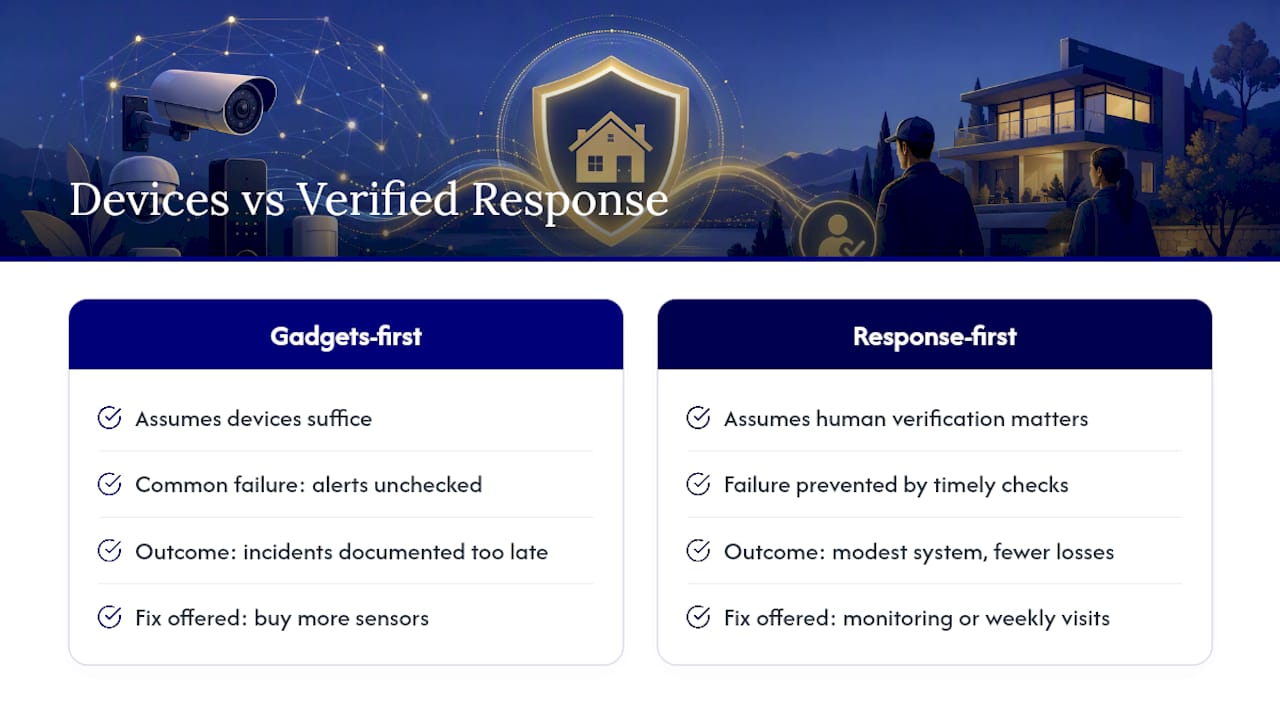
The overrated fix is more gadgets. The underrated fix is a person, whether that's a monitoring center with video verification or a local partner who walks the property every week and knows what "normal" looks like. Technology without a verified response plan is a very expensive way to document losses after the fact.
If you take one thing from this: prioritize verified response over device count. A modest system paired with weekly human eyes on the property will outperform a sprawling smart home setup that nobody's watching. For legal exposure, most homeowner policies also expect reasonable ongoing maintenance, and an unmonitored, unvisited property can complicate a claim regardless of how many sensors it has.
— Zackary
How 30apropertycollective Handles the Work You Can't Do From Afar
You can buy every sensor on this list and still miss the leak that started behind a wall nobody checked. That's the gap 30apropertycollective closes for absentee owners along Florida's Emerald Coast: weekly inspections with digital reports, anticipatory storm preparation, vendor oversight, and arrival readiness handled before you ever board a flight.

Every visit maps directly to the checklist in this article: exterior and interior walkthroughs, utility checks, smart home monitoring, and mail and package collection so nothing piles up as a signal that the house is empty. Concierge services extend that same anticipatory care to grocery stocking, housekeeping coordination, and holiday decorating, all handled with the discretion high-value estates require and documented in the same weekly reporting you already rely on for security peace of mind.
If your current setup is cameras and hope, take the next step: explore concierge and estate management services built for exactly this problem, or get started with a membership plan that puts weekly human eyes on your property starting this month.
Sources
- Absentee Homeownership 101: What It Means, Risks to Avoid, and How to Manage a Property From Afar
- Alarm
- Best security for vacation homes 2026: Remote monitoring, cellular backup & guest access tested
- Vacation Home Security System 2026: How to Protect a Second Home From Anywhere