
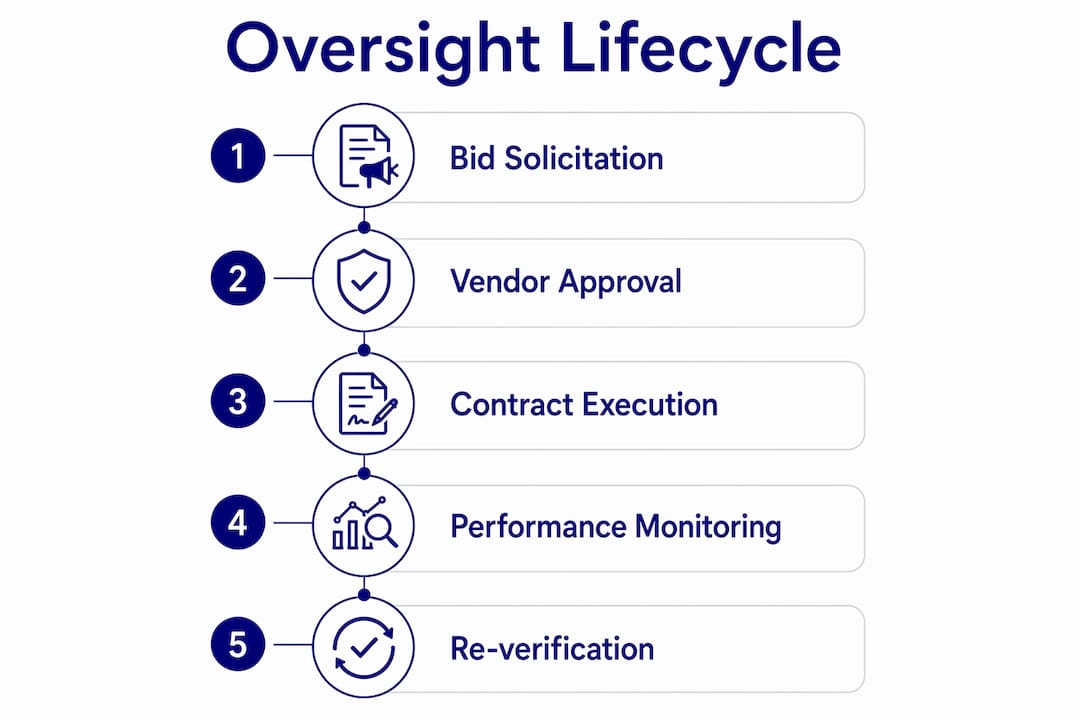
Vendor and contractor oversight is the full lifecycle management of every third-party service on your property, from bid solicitation through final closeout. Start today by issuing a standardized prequalification form (PQF) to every active vendor and requesting a current certificate of insurance (COI) from each one. That single sweep will surface more liability gaps than most homeowners expect.
- Oversight covers: bid solicitation, vetting, contracting, onboarding, performance monitoring, corrective actions, and closeout or renewal.
- Minimum documents to collect now: COI, active trade license, W-9, and signed contract with SLAs.
- Standards to reference: OSHA safety records, ISO compliance frameworks, and Community Associations Institute (CAI) guidelines for managed properties.
- 30apropertycollective administers this entire lifecycle on behalf of Emerald Coast estate owners who prefer discreet professional management.
Table of Contents
- What does vendor and contractor oversight actually cover?
- Why rigorous oversight protects your estate's value
- What to verify before you hire any vendor
- What every vendor contract must include
- How to monitor vendor performance without losing your mind
- When should you hire a professional estate manager?
- How to start this week
- Key Takeaways
- The part most homeowners skip until it's too late
- 30apropertycollective: discreet, high-touch oversight for Emerald Coast estates
What does vendor and contractor oversight actually cover?
Vendor and contractor oversight is a structured process, not a one-time event. Each stage produces documents that protect you if a dispute, insurance claim, or property assessment arises later.
| Lifecycle Stage | Homeowner's Minimum Deliverable | Re-Verification Cadence |
|---|---|---|
| Bid solicitation | Scope of work document, bid comparison | Per project |
| Vetting / prequalification | Completed PQF, COI, license copy | Before any new engagement |
| Contracting | Signed contract with SLAs and change-order clause | Per contract term |
| Onboarding | Site orientation record, subcontractor list | At start of each engagement |
| Performance monitoring | Inspection report with photos | Weekly to quarterly by risk level |
| Corrective actions | Written corrective-action notice, vendor response | As triggered |
| Closeout / renewal | Final inspection sign-off, scorecard, renewal decision | At contract end |
The homeowner sets standards and approves vendors. An estate manager handles daily coordination, document collection, and inspections. Vendors execute and submit required documentation. When those roles blur, documentation debt accumulates fast: missing insurance certificates, unverified licenses, and undocumented change orders that surface at the worst possible moment.
Why rigorous oversight protects your estate's value
A signed contract is only the start. Real protection comes from continuous oversight that catches service drift before it leads to major repair costs or a denied insurance claim.
Proactive vendor management is a strategic investment in risk mitigation. Identifying small issues early saves major repair or replacement costs later.
Contractor management reduces operational risk by centralizing compliance checks and scheduling, which removes the daily coordination burden from the homeowner. Expired insurance is the most common gap: a vendor who was fully compliant at hiring can have a lapsed policy the following month, leaving you exposed on any work performed in that window. Vendor compliance is a dynamic state, not a checkbox.
For tech-integrated estates, the exposure extends further. Smart home systems, security networks, and AV infrastructure involve vendors who handle sensitive data, and third-party vendor data breaches are a documented risk across industries. A vendor compliance program that includes data-handling requirements closes that blind spot.
What to verify before you hire any vendor
A prequalification form is the non-negotiable starting point. It captures everything you need to make an informed hiring decision and creates a defensible record.
PQF must-have fields:
- Legal entity name and business structure
- W-9 / tax identification
- OSHA logs and Experience Modification Rate (EMR)
- Insurance limits and COI with expiration dates
- Active trade license numbers and issuing authority
- Subcontractor use and how subs are vetted
- Safety program documentation and training records
- Three references with recent, comparable projects
Red flags to act on immediately:
- COI that names a different entity than the contract
- Unusually low bids with vague or missing scope
- Refusal to accept change-order or lien-waiver clauses
- No OSHA logs or a high EMR without explanation
- References that cannot confirm specific project details
Onboarding step-by-step:
- Issue the PQF before any site visit or proposal review.
- Verify the COI directly with the issuing insurer, not just the vendor's copy.
- Confirm trade license status through the relevant state licensing board.
- Run background checks on all personnel who will have unsupervised property access.
- Collect a signed contract before any work begins.
What every vendor contract must include
The single most important clause is an explicit, measurable scope of work with defined acceptance criteria. "Landscaping maintained" is not a scope. "Lawn cut to 3 inches, edged, and blown clean every Friday by 5 PM, confirmed by photo report" is.
Critical clauses for every agreement:
- Scope and deliverables with acceptance criteria
- SLAs: response times for routine and urgent issues
- Insurance requirements with COI endorsement naming your estate as an additional insured
- Indemnity and limitation of liability
- Warranty terms and defect-correction timelines
- Change-order process with written approval required before any out-of-scope work begins
- Payment milestones tied to inspection sign-off, not calendar dates
- Termination rights for non-performance or lapsed compliance
Pro Tip: Require vendors to provide automated COI renewal notifications and name 30apropertycollective (or your estate) as a certificate recipient so you are never caught off-guard by a lapse.
Response times matter as much as the clauses themselves. Define what "urgent" means in writing: a roof leak during a storm is not the same category as a broken gate latch. Escalation paths and dispute resolution procedures belong in the contract, not in a text thread.
How to monitor vendor performance without losing your mind
Scheduled inspections plus event-triggered checks are the backbone of continuous oversight. The cadence depends on risk level, not convenience.

| Monitoring Type | Recommended Frequency | Key Output |
|---|---|---|
| Visual site check | Weekly (high-risk systems) | Photo log, pass/fail notes |
| Operational review | Monthly | Performance scorecard update |
| Compliance audit | Quarterly | COI/license re-verification |
| Full re-qualification | Annually or at renewal | Updated PQF, new COI, reference check |
Every inspection report should capture: vendor name, date, inspector, work performed, photos, acceptance status, any corrective actions required, invoice reference, and next scheduled inspection date. That field set is what transforms a walkthrough into a defensible record.
Scorecards track four metrics that matter: on-time rate, defect rate, emergency response time, and safety incidents. A vendor with a declining scorecard gets a written corrective-action notice before the relationship ends, not after a costly failure.
Pro Tip: A centralized CRM portal that stores contracts, inspection reports, and COIs, and automatically flags expirations, turns a full-time coordination burden into a manageable dashboard.
When should you hire a professional estate manager?
Hire a professional when the property's value, the number of active vendors, or your time constraints make DIY oversight a genuine liability risk. That threshold arrives sooner than most owners expect.
Clear triggers for outsourcing:
- Three or more active vendors running simultaneously
- High-value specialty trades: pool systems, solar, electrical, HVAC
- Frequent guest arrivals requiring arrival-readiness coordination
- Storm season with pre- and post-storm assessment needs
- Owner is not local or cannot respond to issues within hours
A signed contract is only the start; real value comes from continuous oversight to prevent service drift over the life of the agreement.
What a professional estate manager actually delivers: full bid solicitation, PQF administration, contract negotiation, on-site inspections with photo reports, COI and license tracking, vendor scorecards, and escalation management. 30apropertycollective provides exactly this model for Emerald Coast estates, with weekly inspections, digital reports, and storm-preparedness coordination built into every engagement.
Cost drivers include inspection frequency, number of active vendors, project scale, emergency response coverage, and concierge service level. A membership-based model, like 30apropertycollective's Essential, Signature, and Estate plans, gives you predictable costs without per-incident billing surprises.
How to start this week
Gather every existing contract, COI, and license on file and put them in one folder, physical or digital. That audit alone will show you where the gaps are.
- Run a PQF for every active vendor, even long-standing ones.
- Request current COIs and verify expiration dates and coverage limits.
- Confirm trade license status for each vendor through the state licensing board.
- Schedule an initial site inspection and photo report to establish a baseline.
- Prioritize high-risk vendors (electrical, roofing, pool) for immediate re-verification.
Questions to ask on a first call with any vendor or estate manager:
- What is your COI expiration policy and how do you notify clients of renewals?
- Who is the primary on-site contact and what is your emergency response time?
- Do you use subcontractors, and how are they vetted and insured?
- How do you document completed work and handle change orders?
Onboarding a new vendor typically takes one to two weeks when all documents are in order. A full estate audit with multiple active vendors runs two to four weeks. Budget for the time, not just the fee.
Key Takeaways
Effective vendor and contractor oversight requires lifecycle management from bid to closeout, continuous re-verification of compliance documents, and a centralized record system to prevent costly documentation gaps.
| Point | Details |
|---|---|
| Start with a PQF sweep | Issue a prequalification form to every active vendor and collect current COIs before anything else. |
| Contracts need measurable scope | Define acceptance criteria explicitly; payment milestones should tie to inspection sign-off, not calendar dates. |
| Compliance is never static | A vendor compliant at hiring can have a lapsed policy next month; schedule regular re-verification. |
| Scorecards prevent surprises | Track on-time rate, defect rate, response time, and safety incidents to catch drift before it becomes a failure. |
| 30apropertycollective handles it all | For Emerald Coast estates, 30apropertycollective manages the full oversight lifecycle, from PQF to weekly inspections and storm prep. |
The part most homeowners skip until it's too late
The conventional wisdom says get a good contract and you're protected. That's wrong, and the gap between a signed agreement and actual protection is where most estate problems live.
What I see consistently is homeowners who have solid contracts on file but haven't verified a COI in two years, haven't walked the property with the vendor present in months, and have no scorecard to show whether performance has slipped. The contract is a starting point. The inspection cadence, the photo record, the re-verification schedule, those are the actual protection.
The other thing people underestimate is how quickly vendor relationships drift when no one is watching. A landscaping crew that was meticulous in month one is cutting corners by month six if no one is checking. That's not a character flaw; it's human nature under no accountability. Weekly visual checks and a monthly scorecard review change that dynamic completely. The vendor knows someone is paying attention, and the work reflects it.
For a high-value estate, the math is simple: the cost of professional oversight is a fraction of one deferred maintenance failure or one denied insurance claim.
30apropertycollective: discreet, high-touch oversight for Emerald Coast estates
Most homeowners along Florida's Emerald Coast don't need another vendor to manage. They need someone to manage all the vendors they already have, with the documentation, inspections, and compliance tracking that actually protects the property.

30apropertycollective handles the full oversight lifecycle: PQF administration, contract negotiation, weekly on-site inspections with photo reports, COI and license tracking, vendor scorecards, storm preparation and post-storm assessments, and arrival-readiness coordination. Every engagement is built around your estate's specific vendor roster and risk profile, not a generic checklist. The concierge services extend to grocery stocking, housekeeping coordination, private chef scheduling, and smart home monitoring, so the property is ready when you are, every time. To see the full service offerings or schedule a private consultation, reach out directly. No obligation, no generic pitch.