
For a luxury estate on Florida's Emerald Coast, the best home security systems are professionally installed, enterprise-grade, multi-zone platforms monitored by a UL-listed central station and coordinated by a managed estate partner like 30apropertycollective. Brand name alone means almost nothing at this scale. What actually determines whether your property is protected is whether the system covers every zone (gates, outbuildings, boathouse, perimeter), integrates with your estate automation platform, and has a human response chain that works when you're not on-site.
Quick verdict:
- Managed estate security (professional integrator + estate management partner) is the right class for Emerald Coast properties with multiple structures or seasonal occupancy
- UL-listed central station monitoring is the non-negotiable baseline, and most insurers will ask for documentation of it
- 30apropertycollective coordinates with integrators, conducts weekly inspections, and handles arrival/departure prep so your security program runs without you managing it
- DIY platforms like SimpliSafe or Ring work well for single-family homes; they scale poorly across multi-structure estates with gates, docks, and outbuildings
Table of Contents
- What are the best home security systems for a luxury estate?
- How do you evaluate proposals for estate-scale security?
- What each solution class actually delivers for an estate
- What does installation actually cost, and how long does it take?
- Which active-protection features actually reduce risk at a luxury estate?
- How do you integrate security with your estate's smart-home systems?
- Why these recommendations hold up
- Key Takeaways
- The part most estate owners get wrong about security
- 30apropertycollective: your estate security partner on the Emerald Coast
- Useful sources for further research
What are the best home security systems for a luxury estate?
The honest answer is that no single brand wins across every estate. The right solution class depends on property size, automation infrastructure, and how much operational involvement you want. The table below maps the four realistic options.
| Solution class | Best for | Installation | Monitoring | Smart-home integration | Camera/sensor tier | Scalability | Cost shape | Privacy/storage | Enterprise features |
|---|---|---|---|---|---|---|---|---|---|
| Enterprise AV integrator (Crestron/Control4 + Axis/Bosch/Verkada) | Large multi-structure estates, full automation | Professional only | UL-listed, guard dispatch | Native Crestron/Control4 | AI detection, thermal, 4K | Unlimited zones | High upfront, low monthly | On-prem NVR option | Gate, dock, access control, staff credentials |
| National professional (ADT, Vivint, Brinks Home) | Mid-size estates, existing smart-home | Professional | UL-listed | Google, Alexa, some HomeKit | HD, AI outdoor, two-way audio | Multi-zone, limited | Mid upfront, mid monthly | Cloud-primary | Guard dispatch, some access control |
| Premium smart-home platform (Google Nest, Arlo, Ubiquiti UniFi Protect) | Tech-forward owners, secondary properties | Hybrid or DIY | Self or third-party | HomeKit, Google, Alexa | HD to 4K, AI, ONVIF | Moderate | Low-mid upfront, low monthly | Cloud + local NVR (Ubiquiti) | Limited; no gate/dock native |
| Managed hybrid (local integrator + estate management partner) | Seasonal Emerald Coast owners, absentee principals | Professional | UL-listed | Flexible, integrator-dependent | Integrator-specified | Full estate | Mid-high upfront, bundled monthly | On-prem or cloud | Full, coordinated with estate manager |
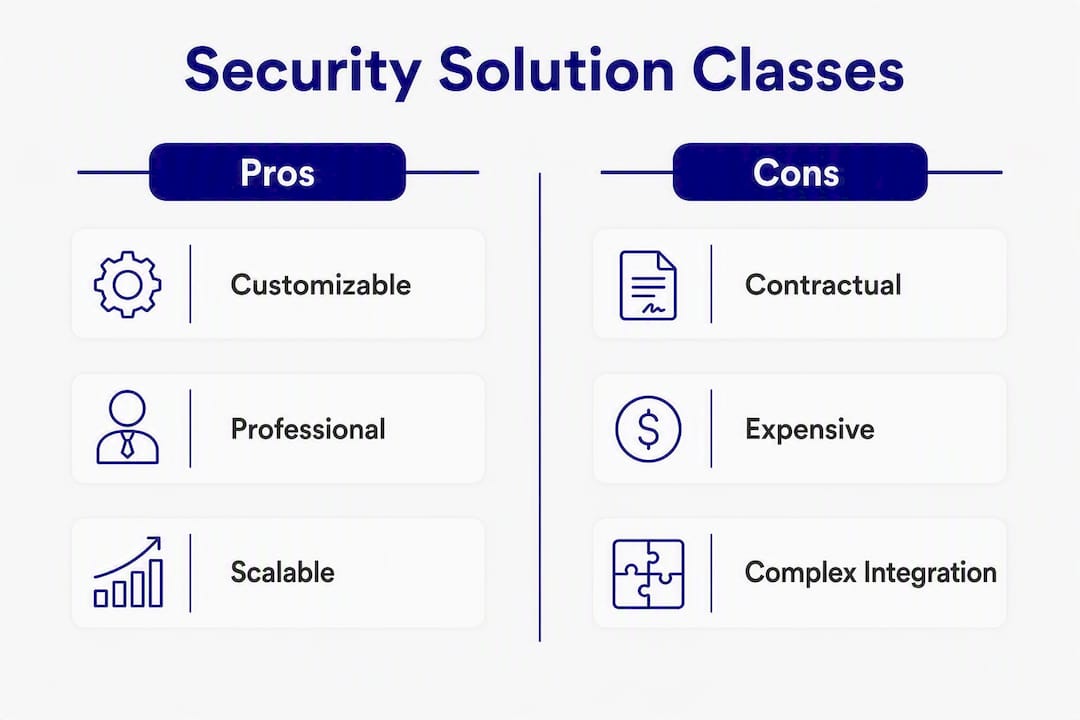
Consumer Reports flags that many professional systems tie hardware to multi-year monitoring contracts. For estate owners, the managed hybrid class often delivers the best long-term flexibility because the estate management partner handles vendor oversight independently of any single security brand.
How do you evaluate proposals for estate-scale security?
Before you sign anything, run every proposal through this checklist. Vendors who can't answer these questions clearly are telling you something.
- Full perimeter mapping: Does the proposal cover every structure, gate, dock, and outbuilding? A proposal that scopes only the main residence is incomplete.
- Redundancy: Does the system run on both cellular and broadband, with automatic failover? A single-path system is a single point of failure.
- Gate and dock integration: Confirm native support for your gate controller and any marina or boathouse access points.
- Camera coverage and night capability: Verify thermal or low-light cameras for perimeter zones where standard HD cameras lose detail after dark.
- Access control for staff and vendors: The system should issue and revoke credentials per person, not per door. Household staff, contractors, and vendors should have separate access profiles.
- Environmental sensors: Flood, temperature, and CO sensors belong in the scope for any coastal estate.
- Installer certifications: Ask for manufacturer certifications (Crestron, Control4, Axis, Bosch, Verkada) and proof of prior estate installs.
- UL-listed monitoring center: Request the monitoring center's UL certificate number. If they hesitate, move on.
- SLA documentation: Ask for a sample SLA with response time guarantees, escalation matrix, and maintenance visit frequency.
- API and software access: Confirm the platform exposes open APIs or native drivers for Crestron or Control4. Proprietary-only systems that can't export video or integrate with your automation platform create long-term lock-in.
Red flags: proprietary hardware with no exportable video, multi-year contracts where the vendor retains equipment ownership, missing maintenance SLAs, and any monitoring center that can't produce UL documentation.
Pro Tip: For multi-zone estates, schedule a calibration walk-through 30 days after commissioning. Motion zones on large properties almost always need adjustment after the first month of real occupancy patterns, and catching false alarms early prevents alarm fatigue among your monitoring center and household staff.
What each solution class actually delivers for an estate
Enterprise AV integrators building on Crestron or Control4 with cameras from Axis Communications, Bosch Security, or Verkada give you the deepest integration and the most control over data. Video stays on an on-premises NVR. Access credentials sync with estate automation. The trade-off is cost and complexity: these installs require significant upfront investment, a skilled integrator relationship, and ongoing maintenance. They're the right choice for estates above roughly 5,000 square feet with multiple structures, a gate system, and an existing automation platform.
National professional providers like ADT, Vivint, and Brinks Home sit in the middle. Expert rankings consistently show ADT leading on monitoring track record, Vivint on smart-home automation depth, and Brinks on pricing flexibility. All three offer UL-listed monitoring and guard dispatch. The limitation for estate owners is scalability: multi-zone estate configurations often push against what their standard packages support, and contract terms deserve close scrutiny.
Premium smart-home platforms, including Google Nest, Arlo, and Ubiquiti's UniFi Protect, work well for tech-forward owners managing a secondary property or a smaller coastal home. Ubiquiti stands out here because UniFi Protect stores video locally on a network video recorder, which matters for owners who won't send footage to a vendor's cloud. The gap is enterprise features: none of these platforms natively integrate with gate controllers, dock access, or Crestron/Control4 without middleware.
For absentee owners on the Emerald Coast, the most reliable configuration pairs a professional integrator handling hardware and UL-listed monitoring with an estate management partner handling weekly inspections, vendor coordination, and real-time reporting. Neither role substitutes for the other.
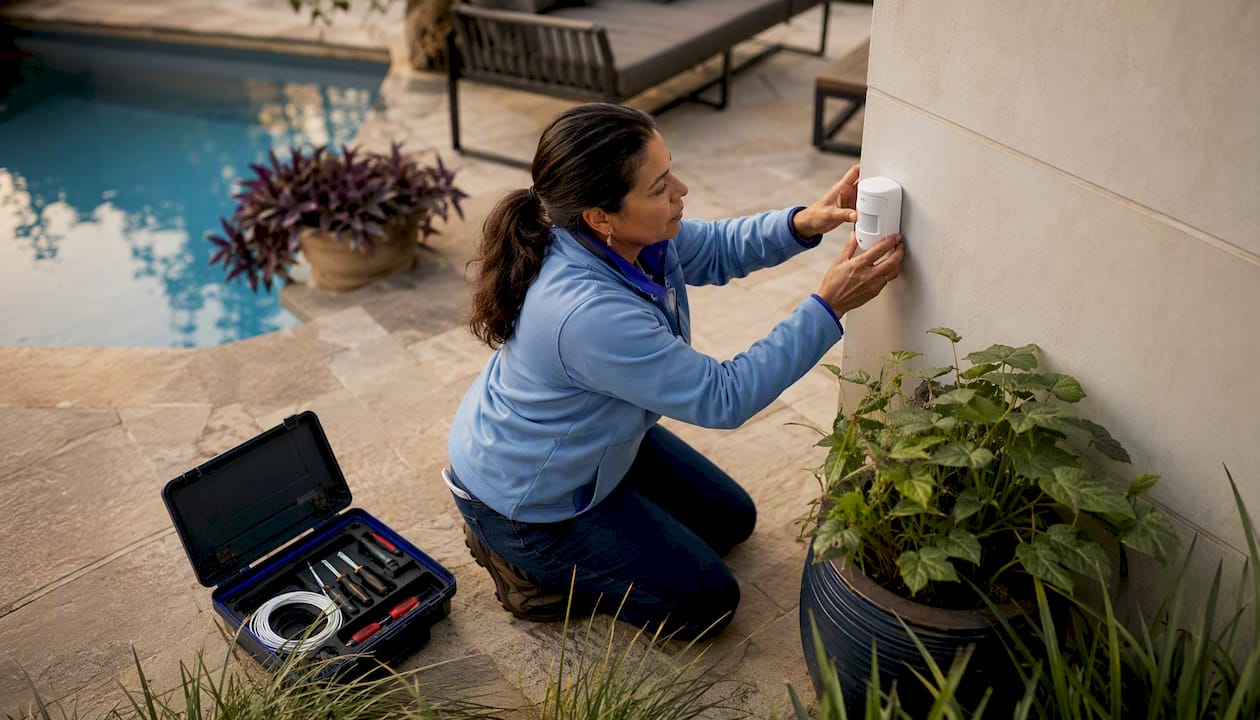
Professional installation remains the industry standard for multi-zone systems precisely because sensor placement and calibration on large properties require technical judgment that DIY workflows can't replicate at scale.
What does installation actually cost, and how long does it take?
| Phase | Small estate (main house + 1 outbuilding) | Large multi-structure estate |
|---|---|---|
| Site survey and scoping | 1–2 days | 3–5 days |
| Design and integration planning | 1 week | 2–3 weeks |
| Civil work (gate/driveway sensors) | 1–3 days | 1–2 weeks |
| Equipment install and wiring | 1–2 weeks | 3–6 weeks |
| Calibration and testing | 2–3 days | 1 week |
| Handover and staff training | 1 day | 2–3 days |
Upfront costs for a professionally installed estate system can be substantial, especially for large multi-structure properties with full Crestron/Control4 integration, reflecting significant investment. Monthly monitoring fees for UL-listed professional monitoring depend on response tier and guard dispatch options, varying widely with no specified range. Maintenance contracts add a separate annual or monthly fee and are worth negotiating into the original agreement.
On insurance: most carriers offering high-value home policies ask for documented UL-listed monitoring, and some require certified installer credentials before extending premium discounts. A written SLA and active maintenance contract can further support your broker's case for lower premiums. Consumer Reports advises reviewing termination fees and equipment ownership clauses before signing, since these terms directly affect your flexibility if you change providers.
- Confirm your insurer's specific documentation requirements before commissioning
- Request a certificate of installation from your integrator for your insurance file
- Negotiate maintenance visits into the original contract rather than as an add-on
Which active-protection features actually reduce risk at a luxury estate?
Reactive alarms are table stakes. What separates estate-grade security from a standard home system is the shift toward active prevention.
AI perimeter detection filters motion by object class (person, vehicle, animal) so your monitoring center receives verified alerts rather than a stream of false positives from wind-blown palms. Axis Communications and Bosch Security both offer camera lines with on-device AI analytics that work without sending footage to a cloud server.
Deterrent lighting integrated with detection changes the calculus for anyone approaching a perimeter. When a camera triggers a flood light and a two-way audio challenge simultaneously, most intrusion attempts stop before they start. Vivint's outdoor camera line and several Verkada models support this combination natively.
Vehicle and license plate analytics matter for gated estates with regular vendor traffic. Plate recognition lets you log every vehicle entry and flag unrecognized plates automatically, without a staff member monitoring a screen.
Thermal cameras for low-light perimeter zones are worth the cost on waterfront properties. Standard HD cameras lose useful detail in the dark conditions common along the Gulf Coast at night. Thermal imaging detects body heat regardless of lighting.
Active guard intervention, where a monitoring center agent speaks directly through an outdoor speaker when an alert triggers, has been shown to deter intruders before entry in a significant share of verified intrusion events. The key is pairing AI-verified detection with a monitoring center that supports live audio response, not just alarm dispatch.
Pro Tip: For sensitive interior areas (primary suite, home office, art storage), configure on-premises video retention with no cloud upload. Most enterprise NVR platforms support zone-level retention policies, so you can keep exterior footage in the cloud for remote access while keeping interior footage strictly local.
How do you integrate security with your estate's smart-home systems?
Integration depth determines whether your security platform becomes part of your estate's operating system or sits as a separate alarm that nobody checks. Before selecting a platform, verify:
- Native protocol support: Z-Wave, Zigbee, ONVIF, and RTSP are the standards that allow cameras and sensors to talk to third-party platforms. A system that supports only proprietary protocols is a silo.
- Crestron/Control4 drivers: Ask for the driver version and whether it's manufacturer-supported or community-built. Manufacturer-supported drivers get updated when the security platform updates.
- Automation triggers: Confirm that security events (motion detected, door opened, alarm triggered) can fire automation rules in your estate platform (lights on, HVAC adjusted, gate locked).
- Unified dashboard: Owners managing a property remotely benefit from a single interface that shows security status, camera feeds, and access logs alongside climate and lighting controls.
- Cloud vs. local retention: Cloud-only systems send all footage to vendor servers. For estate confidentiality, on-premises NVR storage (Ubiquiti UniFi Protect, enterprise Axis/Bosch configurations) keeps footage under your control.
Refer to smart home management systems guidance for a deeper look at platform compatibility across Crestron, Control4, HomeKit, and Google Home.
Why these recommendations hold up
This article prioritized estate-fit criteria over consumer convenience metrics: multi-zone architecture, UL-listed monitoring, SLA quality, integration depth with professional automation platforms, and privacy controls. Those criteria reflect what high-value property insurers, professional integrators, and estate managers consistently identify as the factors that determine real-world security outcomes.
The evaluation framework here draws on independent testing from Security.org and Consumer Reports, expert rankings from SafeHome.org and CNET, and professional integrator guidance on Crestron/Control4 and enterprise camera platforms. UL-listed monitoring is treated as a baseline requirement, not a differentiator, because insurers and professional standards bodies treat it that way.
30apropertycollective's estate management services include smart home system monitoring, weekly inspections with digital reports, vendor and contractor oversight, and storm preparation and response. That operational layer is what makes a professionally installed security system function reliably for an absentee owner rather than sitting dormant between visits.
Key Takeaways
Enterprise-grade, professionally installed security integrated with a managed estate partner and UL-listed central station monitoring is the right configuration for luxury Emerald Coast properties with multiple structures or seasonal occupancy.
| Point | Details |
|---|---|
| UL-listed monitoring is baseline | Demand documented UL certification from any monitoring center before signing a contract. |
| Integration determines value | A system that doesn't connect to Crestron, Control4, or your smart-home platform operates as a silo, not an estate asset. |
| Professional install is non-negotiable | Multi-zone estates require certified installers for correct sensor placement, calibration, and false-alarm avoidance. |
| Review contract terms carefully | Evaluate termination fees, equipment ownership clauses, and SLA specifics before committing to any provider. |
| 30apropertycollective as estate partner | 30apropertycollective coordinates integrator oversight, weekly inspections, and digital reporting so your security program runs year-round without your direct involvement. |
The part most estate owners get wrong about security
Most owners focus on the hardware decision and treat the operational layer as an afterthought. They spend weeks comparing ADT vs. Vivint or debating whether Verkada or Axis cameras are better, then sign a contract and assume the system will run itself. It won't.
A security system on a large estate is a living infrastructure. Cameras need firmware updates. Motion zones need recalibration after landscaping changes. Staff credentials need to be revoked when employees leave. Environmental sensors need testing before hurricane season. None of that happens automatically, and none of it is the monitoring center's job.
The owners who get the most out of estate-grade security are the ones who treat it as part of a managed property program rather than a one-time purchase. That means weekly eyes on the system, documented inspection reports, and a clear escalation path when something needs attention. The technology is the easy part. The operational discipline is where most programs fail.
30apropertycollective: your estate security partner on the Emerald Coast
Most estate owners on the Emerald Coast have the hardware conversation handled. What they're missing is the operational layer that makes it work year-round when they're not on-site. 30apropertycollective fills that gap directly.
Through Luxury Home Watch, Estate Management, and Concierge Services, 30apropertycollective conducts weekly property inspections with digital reports, coordinates with your security integrator, manages vendor access and credentialing, and handles storm preparation and post-storm assessments. Smart home system monitoring is part of the standard estate management scope, not an add-on. For absentee owners, that means your security program has a dedicated point of contact who knows your property, your integrators, and your preferences.
Schedule a consultation to discuss a security-focused estate management plan tailored to your Emerald Coast property.
Useful sources for further research
Use these sources to validate vendor claims, compare monitoring standards, and prepare for integrator conversations:
- Consumer Reports: How to Pick a Home Security System — covers monitoring contract terms, UL-listed standards, and equipment ownership considerations
- Security.org: Best DIY Home Security Systems — useful for understanding where DIY platforms like SimpliSafe and Ring reach their limits for large properties
- SafeHome.org: Best Home Security Systems — aggregated expert rankings by category (monitoring, automation, price) for national professional providers
- CNET: ADT vs. Vivint — detailed comparison of integration depth and smart-home compatibility between the two largest national providers
- NerdWallet: ADT vs. Vivint — contract terms, pricing structure, and professional installation standards
Recommended next steps:
- Contact 30apropertycollective to discuss how estate management integrates with your security program