
Estate management services are defined as the integrated, professional oversight of a high-value residential property across five operational domains: property maintenance, staff and vendor management, finance and administration, lifestyle coordination, and asset risk management. These five distinct domains work as a single coordinated system, not as separate functions. For homeowners and property investors managing luxury estates, that coordination is the difference between a property that runs smoothly year-round and one that generates constant, costly surprises. 30apropertycollective delivers this integrated model along Florida's Emerald Coast, where the demands of coastal ownership make proactive, professional oversight non-negotiable.
What are the core estate management services that protect your property?
Property maintenance is the foundation of any professional estate management program. Without it, every other domain suffers. A neglected HVAC system leads to mold. A missed roof inspection becomes a six-figure repair after a storm. The goal of professional maintenance is not to react to problems but to prevent them entirely.

Recurring property inspections, often conducted weekly, are the standard method for catching issues before they escalate. These inspections verify that mechanical systems are operational, that the property meets insurance compliance requirements, and that seasonal wear is addressed before it becomes structural damage. On Florida's Gulf Coast, where salt air and hurricane season create year-round stress on buildings, weekly inspections are not a luxury. They are a baseline requirement.
Core property maintenance tasks covered by professional estate management include:
- Routine inspections of HVAC, plumbing, electrical, and roofing systems
- Preventative maintenance scheduling to replace components before failure
- Seasonal preparation including storm shuttering, pool winterization, and landscaping adjustments
- Vendor coordination for licensed contractors, specialty tradespeople, and emergency repair crews
- Insurance compliance documentation to satisfy policy requirements and support claims
Pro Tip: Keep a digital maintenance log with dates, photos, and contractor invoices for every service visit. This record reduces insurance disputes and gives any new service provider an accurate picture of the property's condition from day one.
Vendor coordination deserves special attention. Estate managers maintain pre-vetted networks of contractors, which means faster response times and consistent quality. A homeowner calling a plumber cold during a burst pipe emergency pays premium rates and gets unknown quality. An estate manager with an established vendor relationship gets priority scheduling and accountable workmanship.
How does estate management coordinate staff and vendors effectively?
Staff and vendor management is the operational backbone of a well-run estate. Hiring, scheduling, vetting, payroll, and supervision all fall within this domain, and professional oversight of these functions maintains operating standards while reducing risk for the property owner.
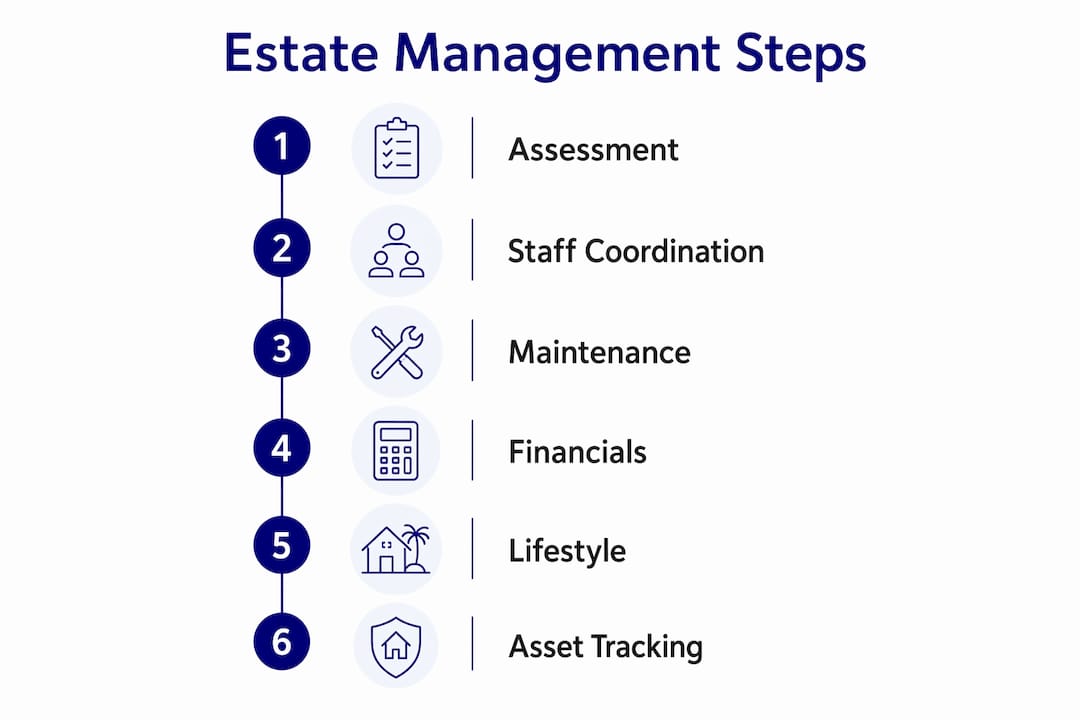
Household staff at a managed estate typically includes a range of roles, each requiring different vetting standards, scheduling structures, and performance expectations. Estate managers handle the full employment cycle, from recruitment and background checks through ongoing supervision and, when necessary, termination. This removes the homeowner from the uncomfortable position of being both employer and resident.
Typical staff roles and vendor categories managed under this domain include:
- Household staff: housekeepers, groundskeepers, chefs, personal assistants, and security personnel
- Maintenance vendors: HVAC technicians, electricians, plumbers, roofers, and pest control specialists
- Lifestyle vendors: florists, pool service companies, window cleaners, and art restoration specialists
- Administrative contractors: accountants, attorneys, and insurance brokers coordinating with the estate manager
The administrative side of staff management is often underestimated. Payroll processing, benefits administration, tax withholding, and labor law compliance all require consistent attention. An estate manager handles these functions so the property owner never faces an employment compliance issue from a household hire.
Professional oversight also creates accountability. When a contractor knows their work is being reviewed by an experienced estate manager, quality standards rise. When household staff know their schedules and performance are actively managed, reliability improves. The result is an estate that operates with the consistency of a well-run business.
How do estate management services handle finances and administrative duties?
Financial administration in estate management covers budgeting, bill payment, contractor invoicing, payroll, and record keeping. Centralized documentation ties all of these functions to the family's or investor's broader accounting structure, enabling transparency, control, and clean audits.
Budget forecasting is one of the most valuable financial functions an estate manager provides. Rather than reacting to unexpected expenses, a skilled estate manager projects annual costs across maintenance cycles, staffing, utilities, and capital improvements. This gives property owners a clear financial picture and eliminates the shock of large, unplanned bills.
Key financial and administrative functions include:
- Annual budget forecasting across all operational categories
- Bill payment and utility management to prevent service interruptions
- Contractor invoice review and approval to verify work completion before payment
- Payroll administration for all household staff
- Record keeping and reporting linked to family or investor accounting systems
Pro Tip: Use a property management platform that integrates financial tracking with maintenance records. When a repair invoice links directly to the inspection report that identified the issue, your documentation is audit-ready and your accountant spends less time reconstructing history.
Centralized record keeping also protects the property owner during ownership transitions, insurance claims, and tax filings. An estate with five years of organized financial records is far easier to sell, insure, or refinance than one with scattered invoices and verbal agreements. The administrative discipline that estate managers apply creates long-term asset value, not just operational convenience.
What lifestyle and event coordination do estate managers provide?
Lifestyle coordination is the domain that separates estate management from traditional real estate management. A standard property manager handles leases, repairs, and rent collection. An estate manager handles the full experience of living in a high-value property, including travel arrangements, event planning, household requests, and concierge-type services.
Lifestyle and event coordination covers travel logistics, entertaining support, and the day-to-day requests that make a residence function at a high standard. When a homeowner arrives at their Florida estate after months away, the estate manager has already coordinated fresh provisions, confirmed all systems are operational, adjusted the climate controls, and arranged any requested services. The property is ready. The owner simply arrives.
This domain also covers event execution. A dinner party for 40 guests requires vendor coordination, staffing adjustments, catering logistics, and post-event cleanup. An estate manager handles all of it, working with the homeowner's preferences and the property's specific capabilities. The concierge services that 30apropertycollective provides reflect this model, treating each client request as an operational task with a clear owner and a defined outcome.
The contrast with traditional property management is significant. A traditional manager's job ends when the physical asset is maintained. An estate manager's job extends to the quality of life inside that asset. For homeowners who use their properties as primary residences, vacation homes, or entertainment venues, that distinction matters enormously.
Why is asset record keeping and risk management critical in estate management?
Asset record keeping and risk management protect estate value over time. Knowing what the family owns, its current condition, and whether it carries proper documentation and insurance coverage reduces surprises during claims and preserves the property's financial integrity.
A complete asset inventory covers the property itself, all mechanical systems, furnishings, art, vehicles, watercraft, and any other valuables on the estate. Each item should carry a condition record, a valuation, and an insurance reference. When a hurricane damages a $40,000 outdoor kitchen, the claim process moves quickly if the documentation already exists. Without it, the homeowner negotiates from a weak position.
| Asset category | Risk management action |
|---|---|
| Real property and structures | Annual inspection reports, insurance compliance review |
| Mechanical systems | Preventative maintenance logs, warranty tracking |
| Furnishings and art | Appraisal records, scheduled condition assessments |
| Vehicles and watercraft | Registration, insurance, and service history files |
| Outdoor and recreational equipment | Seasonal inspection, storage protocols |
Risk identification extends beyond physical assets. Estate managers assess vendor reliability, staff conduct, access control, and emergency preparedness as ongoing risk factors. On Florida's Gulf Coast, storm preparedness is a formal protocol, not an afterthought. 30apropertycollective builds storm readiness into its standard operating procedures, so clients are never caught unprepared when a named storm approaches.
Integrated systems that track assets, maintenance cycles, and vendor history are the standard for avoiding costly oversights. When staff turnover occurs, those systems preserve institutional knowledge. The next estate manager inherits a complete operational record, not a blank slate.
Key Takeaways
Professional estate management succeeds when property maintenance, staffing, finances, lifestyle coordination, and asset records operate as one integrated system rather than five separate tasks.
| Point | Details |
|---|---|
| Integrated oversight is the standard | Operating all five domains as one system prevents costly gaps and reactive management. |
| Weekly inspections prevent emergencies | Regular property checks catch issues early and satisfy insurance compliance requirements. |
| Financial administration creates transparency | Centralized budgeting and record keeping supports audits, claims, and ownership transitions. |
| Lifestyle coordination goes beyond maintenance | Estate managers handle travel, events, and arrival readiness that traditional managers do not cover. |
| Asset records protect estate value | Documented inventories and risk protocols reduce losses during claims and staff transitions. |
Why visibility matters more than effort in estate management
The most common failure I see in estate management is not laziness or incompetence. It is fragmented information. An estate can have a dedicated groundskeeper, a reliable housekeeper, and a responsive contractor network, and still operate in chaos if no one has a complete picture of what is happening across all five domains.
Poor visibility and fragmented information cause more operational failures than understaffing. When the maintenance log lives in one place, the vendor invoices in another, and the staff schedule in someone's head, the estate manager cannot make good decisions. They are always catching up instead of staying ahead.
Technology platforms that serve as a single source of truth change this entirely. Estate management platforms complement skilled managers by preserving records, tracking maintenance cycles, and maintaining vendor history across staff transitions. They do not replace judgment. They give judgment something solid to work with.
My advice for any homeowner selecting an estate management provider: ask how they document what they do. Ask what happens to your property's records if your primary contact leaves. If the answer is vague, the operation is more fragile than it appears. A provider with clear documentation protocols and a technology backbone is a provider you can trust with a multi-million dollar asset.
The best estate managers I have worked with share one trait. They treat visibility as a professional obligation, not a preference. They know where every dollar goes, what every contractor has done, and what every system needs next. That discipline is what separates a well-run estate from one that is always one missed inspection away from an expensive problem.
— Zackary
Professional estate management along Florida's Emerald Coast
Owning a luxury property on Florida's 30A corridor means managing a high-value asset in one of the most demanding coastal environments in the country. Salt air, hurricane season, and the expectations of a premium residence require more than occasional check-ins.

30apropertycollective provides full estate management services tailored to the specific demands of Emerald Coast properties. From weekly inspections and storm preparedness to arrival readiness and vendor coordination, every function is handled proactively. Clients also have access to concierge services that cover lifestyle coordination, household requests, and event support. If you want your property maintained to the same standard whether you are present or not, 30apropertycollective operates as your dedicated estate partner year-round.
FAQ
What does estate management include?
Estate management covers property maintenance, staff and vendor oversight, financial administration, lifestyle coordination, and asset risk management. These functions operate together as a single system to protect and maintain high-value residential properties.
How often should a managed estate be inspected?
Weekly inspections are the professional standard for luxury estates. Regular visits catch mechanical failures, insurance compliance issues, and seasonal wear before they become costly repairs.
How is estate management different from property management?
Traditional property management focuses on the physical asset, including repairs and leasing. Estate management extends to staffing, financial administration, lifestyle coordination, and asset documentation, covering the full experience of owning and living in a high-value property.
Why does financial administration matter in estate management?
Centralized budgeting, bill payment, and record keeping tie property operations to the owner's accounting structure. This supports clean audits, accurate tax filings, and faster insurance claims.
What role does technology play in estate management?
Estate management platforms provide a single source of truth for maintenance records, vendor history, and asset inventories. They preserve operational knowledge when staff changes occur and improve accountability across all service providers.