
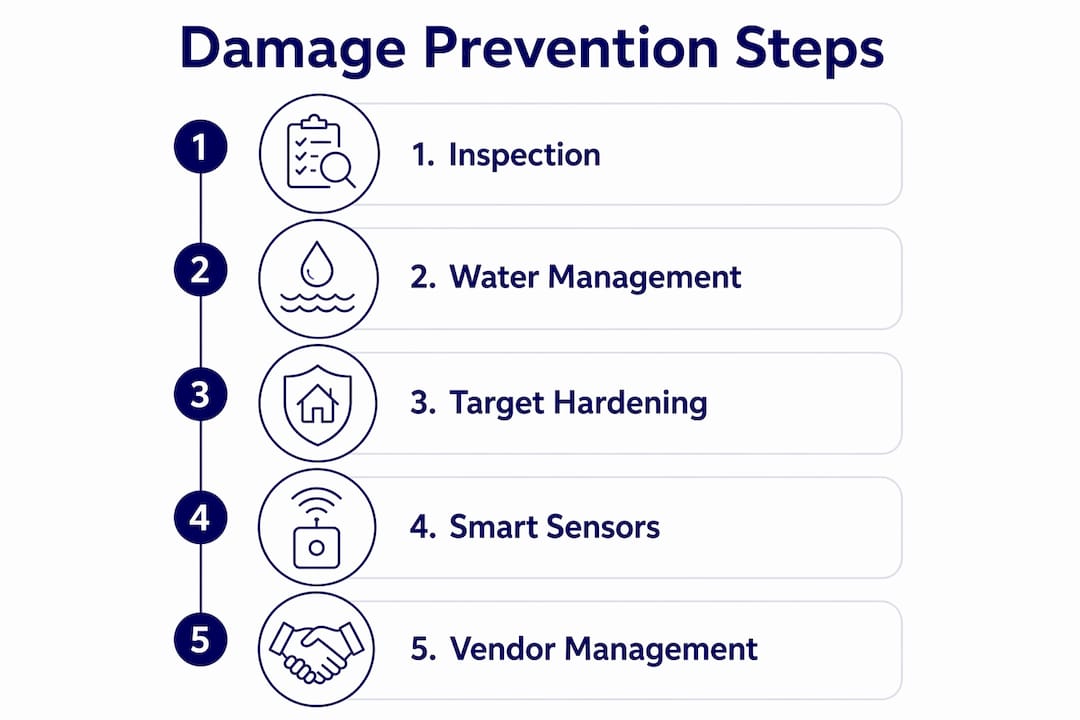
A proactive, layered estate-management program combining physical hardening, water management, routine inspections, integrated monitoring, and vendor oversight prevents the vast majority of costly property damage at a luxury estate. One inch of water in a typical home can cause up to $25,000 in damage alone — and that figure doesn't account for mold remediation, structural repairs, or displaced art and furnishings. Start here:
Immediate actions to reduce near-term risk:
- Locate and test your main water shutoff valve today
- Clear gutters and extend downspouts several feet from the foundation
- Verify all exterior entry points are secured with grade-appropriate locks
- Schedule a professional security audit within 30 days
- Confirm a weekly inspection plan is in place, whether through staff or a professional estate manager
Table of Contents
- How to prevent property damage with a layered defense strategy
- Where estates lose the most money, and the single fix for each
- What does a luxury estate inspection schedule actually look like?
- Target hardening: how to secure every entry point on your estate
- Which smart sensors actually prevent damage at a luxury estate?
- Storm preparedness and post-storm response for high-value properties
- Managing vendors so small repairs never become large ones
- When does hiring a professional estate manager make sense?
- Key Takeaways
- The case for anticipatory care over reactive repairs
- 30apropertycollective: estate protection built into every week
- Useful sources and references
How to prevent property damage with a layered defense strategy
Layered prevention consistently outperforms any single measure because it forces a would-be intruder or an undetected leak to defeat multiple independent systems. The four layers that matter most for a luxury estate:
- Physical hardening: Grade-appropriate locks, reinforced frames, laminated glass, perimeter gates
- Environmental design (CPTED): Landscaping that eliminates blind spots, lighting that removes concealment, grading that directs water away from the foundation
- Procedural controls: Weekly inspection cadence, documented vendor oversight, written maintenance schedules
- Integrated monitoring: Water-leak sensors, smart smoke/CO systems, perimeter cameras, and human-in-the-loop review
Prioritize by impact-to-cost ratio. Gutter maintenance and proper foundation grading cost almost nothing relative to the water damage they prevent. Door and window reinforcement costs a few hundred dollars per opening and dramatically increases forced-entry resistance. Weekly inspections catch what sensors miss. Build the physical and procedural layers first; layer technology on top.
Pro Tip: Schedule a luxury property needs assessment before investing in any monitoring system — knowing your property's specific vulnerabilities tells you exactly where to spend.
Where estates lose the most money, and the single fix for each
- Water (internal leaks, roof, foundation): Maintain gutters twice annually, extend downspouts, and slope soil away from the foundation at roughly 1 inch per foot for the first 5 feet. Add a battery-backed sump pump.
- Storm and wind damage: Trim branches to a safe clearance from the roofline and reinforce roof flashings. Strategic landscaping and grading are primary defenses against both water intrusion and wind-related branch damage.
- Fire: Hardwired smoke and CO detectors on every level, a monitored suppression system, and annual chimney and vent cleaning.
- Theft and vandalism: Homes with visible security measures are considerably less likely to be burglarized. ANSI/BHMA-grade deadbolts and perimeter lighting are the highest-return investments.
- Pests: Annual termite and pest inspections, sealed foundation penetrations, and moisture control (pests follow water).
- HVAC and electrical failure: Annual professional inspections of both systems; replace aging wiring and HVAC components on a documented schedule rather than waiting for failure.
- Landscaping and tree failures: Remove dead or structurally compromised trees before storm season; consult a certified arborist annually.
- Appliance and plumbing leaks: Run major appliances only when someone is present to intervene immediately if a hose fails. Inspect all appliance hoses and replace them every 5–7 years.
Pro Tip: Install a smart water shutoff valve on the main supply line. If a sensor detects a leak, the valve closes automatically — a $200–$400 device that can prevent tens of thousands in damage.
What does a luxury estate inspection schedule actually look like?
| Task | Frequency | Responsible Party |
|---|---|---|
| Perimeter walk, doors/windows check, log anomalies | Weekly | Estate manager / home watch |
| Pool equipment and alarm check | Weekly | Estate manager |
| Mail and package collection | Weekly | Estate manager |
| Gutter cleaning and downspout inspection | Spring and fall | Licensed vendor |
| Sump pump test | Monthly | Estate manager / vendor |
| Exercise main water shutoff valve | Monthly | Estate manager |
| Irrigation system inspection | Pre-summer and pre-freeze | Licensed vendor |
| Roof inspection after major storms | Post-storm | Licensed roofing contractor |
| Professional roof inspection | Annual | Licensed roofing contractor |
| Full electrical inspection | Annual | Licensed electrician |
| Chimney and vent cleaning | Annual | Certified chimney sweep |
| Termite and pest inspection | Annual | Licensed pest control |
| Insurance policy review | Annual | Owner / broker |
| HVAC system service | Annual (pre-season) | Licensed HVAC technician |
Weekly inspections are non-negotiable for estates that sit vacant for extended periods. A documented inspection record also serves as strong proof in insurance claims, reducing both dispute risk and settlement time.
Target hardening: how to secure every entry point on your estate
Physical hardening is where prevention starts, not ends. Most break-ins exploit the simplest weakness available.
- Doors: ANSI/BHMA Grade 1 deadbolts, 3-inch screws on all strike plates, reinforced door frames on every exterior door
- Windows: Pin locks or keyed locks on all accessible windows; laminated glass or 3M security film on ground-floor and garage-adjacent windows
- Sliding doors: Anti-lift pins, a solid bar in the track, and a secondary lock at the top of the frame
- Garage: Commercial-grade padlock on the manual release cord, electronic access control with audit logs, and secured overhead door tracks
- Outbuildings: Treat every detached structure as part of the main security perimeter — perimeter gates, commercial padlocks, and motion-activated lighting
A professional security audit should include blind-spot mapping, door-and-frame stress tests, and a prioritized remediation plan scored by cost-to-risk reduction ratio. Schedule one every two to three years, or after any significant landscaping or construction change.
Pro Tip: The due diligence process for luxury investment properties covers structural and security assessments that translate directly into a hardening checklist for existing estates.

Which smart sensors actually prevent damage at a luxury estate?
Technology works best as a force multiplier for human oversight, not a replacement for it.
| Device Type | Primary Function | Key Feature to Require |
|---|---|---|
| Water-leak sensors with auto shutoff | Detect and stop leaks before flooding | Automatic main-line shutoff capability |
| Smart sump-pump monitor | Alert on pump failure or high water | Battery backup with cellular alert |
| Hardwired smoke/CO system | Fire and gas detection | Central monitoring station connection |
| Glass-break sensors | Intrusion detection | Wide-area acoustic coverage |
| Perimeter and discrete cameras | Surveillance and evidence | Local storage + cloud redundancy |
| Temperature sensors (attic/HVAC) | Detect HVAC failure, freeze risk | Configurable alert thresholds |
| Vibration sensors (safes, art rooms) | Detect tampering | Tamper-evident logging |
Integration best practices:
- Route all alerts to a central monitoring platform with cellular backup so a power outage doesn't silence the system
- Set automated shutoff rules for water and HVAC anomalies
- Require human verification before dispatching for high-value alerts — false alarms erode response urgency over time
Storm preparedness and post-storm response for high-value properties
Before a storm
- Secure or store all loose exterior objects (furniture, planters, decorative items)
- Trim any branches that could reach the roofline in high winds
- Test sump pumps and confirm battery backups are charged
- Move valuables and irreplaceable items above potential flood zones
- Document pre-storm condition with timestamped photos of every exterior surface
- Confirm vendor availability (roofer, water extraction, structural contractor)
During a storm
- Keep staff off-site unless safety is confirmed
- Monitor critical systems remotely via the smart home platform
- Log all incidents with timestamps and photos as they occur
Post-storm response
- Conduct a safety-first triage: electrical hazards, gas leaks, structural compromise
- Document all damage with photos before any cleanup
- Deploy emergency vendors in priority order: water extraction first, then structural, then cosmetic
- Notify your insurer immediately and submit the pre-storm photo documentation alongside damage photos
Vendor roster template: Maintain a contact sheet for each specialty (roofing, water extraction, structural, electrical, tree removal) that includes license number, insurance certificate, confirmed response-time SLA, and a 24-hour emergency contact. Verify credentials annually.
Managing vendors so small repairs never become large ones
- Verify license and current insurance certificate before any vendor sets foot on the property
- Require a written scope-of-work estimate with line-item pricing before approving work
- Include a holdback clause — retain 10–15% of payment until a post-work inspection confirms quality
- Require workmanship warranties in writing for all structural, roofing, and plumbing work
Documentation standard: Keep photos, invoices, inspection reports, and all communications for a minimum of seven years. A timestamped digital log for every repair protects you in insurance disputes and supports resale value.
| Document Type | Retention Period | Storage Format |
|---|---|---|
| Repair invoices and contracts | 7 years minimum | Digital, cloud-backed |
| Pre/post-work photos | 7 years minimum | Timestamped, cloud-backed |
| Inspection reports | 7 years minimum | PDF with date stamp |
| Vendor license and insurance | Current + 2 years | Digital file per vendor |
| Warranty documents | Duration + 3 years | Digital, indexed |
Use a vendor scorecard for recurring contractors: rate response time, work quality, communication, and adherence to scope. A low-scoring vendor costs more in follow-up repairs than the savings on their initial bid.
When does hiring a professional estate manager make sense?
The trigger is usually one of four situations: frequent or extended absences, a property with multiple structures or complex systems, a pattern of recurring minor incidents that never quite get resolved, or simply the desire for anticipatory care rather than reactive repairs.
A best-in-class estate manager delivers:
- Weekly inspections with timestamped digital reports
- Pre- and post-storm assessments with documented vendor dispatch
- Vendor oversight, including license verification and post-work inspection
- Prioritized preventive maintenance scheduling
- Smart home system monitoring integrated with human review
- Discreet concierge services (arrival preparation, grocery stocking, housekeeping coordination)
Pro Tip: In your introductory conversation with any estate manager, ask specifically how they document inspections, how they escalate an issue at 2 AM, and what their vendor verification process looks like. The answers tell you whether the service is truly anticipatory or just reactive with a nicer name.
30apropertycollective operates exactly this model along Florida's Emerald Coast, with membership tiers designed around the complexity of your estate and the frequency of your visits.
Key Takeaways
Preventing property damage at a luxury estate requires layering physical hardening, water management, weekly documented inspections, integrated monitoring, and professional vendor oversight into a single anticipatory program.
| Point | Details |
|---|---|
| Water management is the highest-ROI layer | Gutters, downspouts extended 4–6 feet, and proper foundation grading prevent the majority of preventable water damage. |
| Physical hardening deters opportunistic crime | ANSI/BHMA Grade 1 deadbolts, 3-inch strike-plate screws, and reinforced frames are the highest-return security investments. |
| Weekly inspections are non-negotiable | Documented weekly checks catch issues before they escalate and serve as strong evidence in insurance claims. |
| Technology amplifies but doesn't replace human oversight | Smart sensors and auto-shutoff valves work best when paired with regular onsite inspections and human-in-the-loop verification. |
| 30apropertycollective delivers this model | Weekly inspections, storm protocols, vendor oversight, and concierge services operationalize every layer of this guide along Florida's Emerald Coast. |
The case for anticipatory care over reactive repairs
Most estate owners I speak with have the same story: they discovered the leak, the break-in, or the pest damage after the fact. The damage was already done. The contractor was already needed. The insurer was already involved. What they didn't have was someone who had walked the property seven days earlier, noticed the flashing pulling away from the dormer, and dispatched a roofer before the next rain.
That gap between "we noticed something" and "it became a crisis" is exactly where professional estate management lives. A weekly inspection isn't a luxury — it's the operational mechanism that converts a $400 flashing repair into a prevented $40,000 water intrusion. The documentation that comes with it isn't paperwork; it's the evidence that speeds your insurance claim and protects your resale value.
The owners who get the most value from a managed estate relationship aren't the ones with the most problems. They're the ones who stop having problems because someone is always looking.
30apropertycollective: estate protection built into every week

30apropertycollective is the alternative to hoping nothing goes wrong while your Emerald Coast estate sits vacant. Every membership tier, from Luxury Home Watch to full Estate Management, is built around the same core principle: weekly eyes on your property, documented and timestamped, with vendor relationships already in place before you ever need them.
The Estate Management and Concierge services cover weekly inspections with digital reports, pre- and post-storm assessments, vendor oversight, smart home monitoring, arrival preparation, and the full range of concierge care your property requires. You don't manage the vendors, chase the contractors, or wonder whether the sump pump is working after a storm. That's already handled.
Explore the full service tiers and membership options or reach out directly to request a property needs assessment. The conversation starts with your estate's specific profile — its systems, its vulnerabilities, and how often it sits unoccupied — and ends with a plan that fits.
Useful sources and references
- National Flood Insurance Program / agents.floodsmart.gov — Water damage cost figures and flood risk for homeowners
- FEMA: Protect Your Property from Severe Wind — Landscaping, grading, and wind-damage mitigation guidance
- Insurance Information Institute (III) — Water damage prevention, insurance coverage, and maintenance best practices
- Forbes / Forbes Tech Council — Layered prevention strategy for theft and vandalism
- PlainCrime: Property Crime Prevention — Evidence-based hardening strategies and CPTED principles
- RepairingWaterDamage.com — Gutter maintenance, foundation grading, and sump pump guidance
- SERVPRO: Water Damage Prevention Tips — Appliance safety and occupancy-based risk reduction
- The Philadelphia Inquirer: Home Security Tips — Physical hardening effectiveness and forced-entry resistance data
This article provides general property-maintenance information and is not a substitute for professional legal, insurance, or engineering advice. Confirm current codes, coverage terms, and local regulations with qualified professionals for your specific situation.