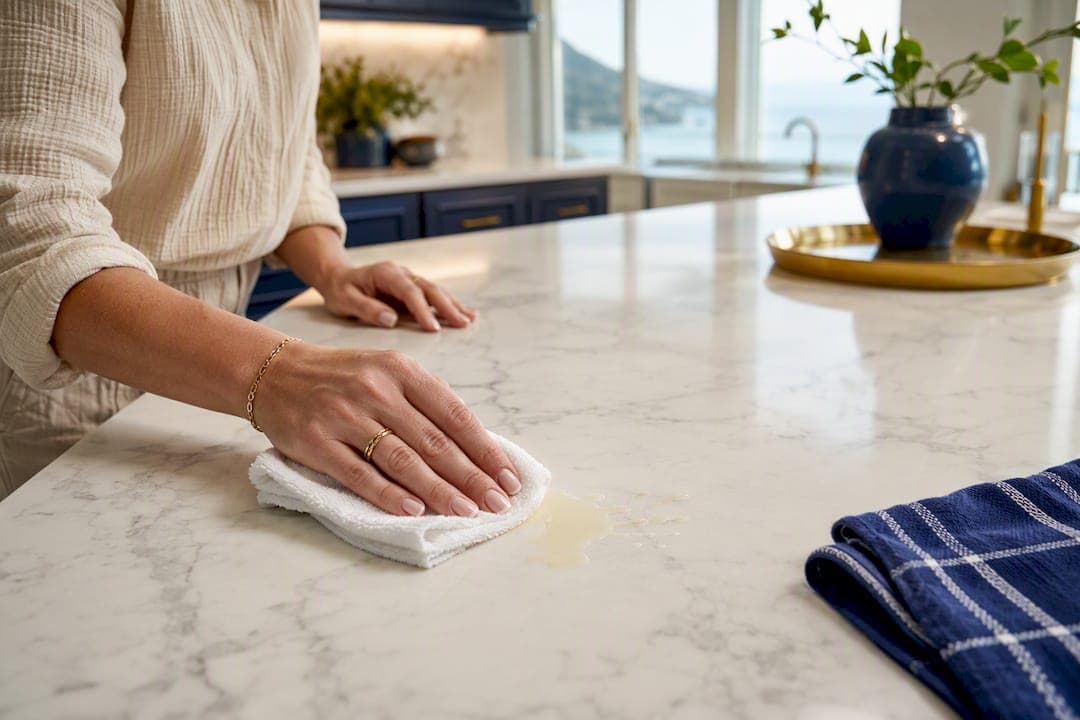
You cannot make marble etch-proof with a standard sealer. Etching is a chemical burn, not a stain, and no topical product fully blocks it. What actually works is speed and habit: wiping acidic spills within seconds, keeping barriers between food and stone, and treating any anti-etch coating as a backup, not a shield. Start with coasters, a cutting board, and a labeled spill kit near the counter.
TL;DR:
- Wiping acid spills within five seconds prevents etch marks, but no sealer fully blocks the chemical reaction that causes etching.
- Sealers stop stains but do little to prevent acid burns, so good habits and timely response are the best protection for marble surfaces.
- Using honed finishes makes etch marks less visible, but the chemical reaction still occurs regardless of surface polish.
- Implementing a routine that includes a spill kit, regular sealing checks, and avoiding acids in cleaning products dramatically reduces damage risk.
- An estate management service can uphold these practices consistently, reducing the chances of irreversible etch damage over time.
Table of Contents
- Marble Etching Prevention: A Checklist You Can Set Up Today
- How Etching Happens: The Chemistry That Changes Everything
- What Sealers, Coatings, and 'Anti-Etch' Products Actually Do
- Cleaning Routines That Won't Accidentally Cause Etching
- Repairing Existing Etches: DIY Polish or Call a Pro?
- What Managed Estate Care Adds That DIY Habits Can't
- The Advice Everyone Gives That Undersells the Real Fix
- A Managed Alternative If You'd Rather Not Run This System Yourself
- Sources
Marble Etching Prevention: A Checklist You Can Set Up Today
Most etch marks trace back to the same handful of gaps: no barrier, no plan, no cleaner within reach. Close those gaps and you eliminate the majority of incidents before they happen.
- Put coasters at every drink station, especially near wine, coffee, and cocktail setups.
- Use a cutting board for anything acidic. Lemons, tomatoes, and limes should never touch bare stone.
- Keep a labeled spill kit near prep zones: a microfiber cloth and a bottle of pH-neutral stone spray, stored where anyone in the house can grab it in under 10 seconds.
- Set trivets under hot pans and mats under bottles of oil, vinegar, or hot sauce that tend to drip.
- Test your sealer twice a year with a water-bead check, and plan to reseal every 6 to 12 months depending on how hard the counter gets used, since impregnating sealers wear down with traffic and cleaning.
None of this requires a renovation budget. It requires deciding, once, where the spill kit lives, and then actually keeping it there.
Pro Tip: Do the water-bead test on a Sunday morning, not after a party. If the drop soaks in and darkens the stone within a couple of minutes instead of sitting up in a bead, your sealer is done and it's time to reseal before the next big spill.
How Etching Happens: The Chemistry That Changes Everything
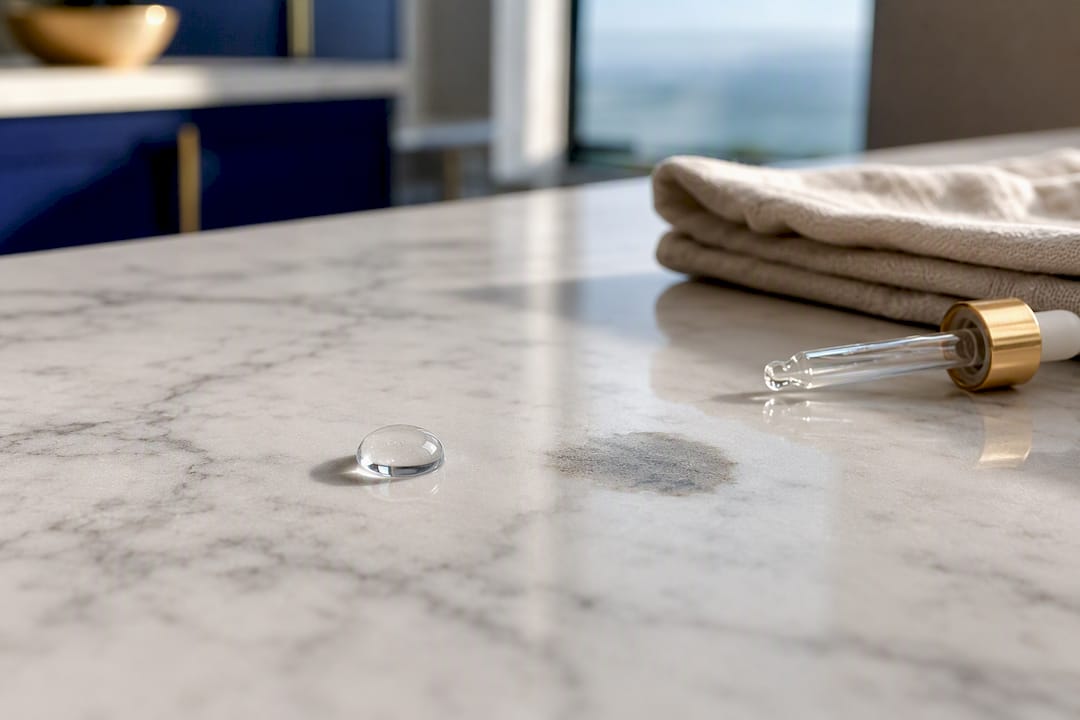
Marble is calcium carbonate. Acid touches it, reacts with it, and dissolves a microscopic layer of the surface. That's an etch: a permanent dull or rough patch where the polish used to be. Staining is a completely different mechanism. A stain is liquid soaking into the stone's pores and leaving color behind, and that's what sealers are built to stop.
This distinction is why sealing your counters gives a false sense of security. Impregnating sealers work below the surface, filling the pores so liquid can't wick in. They do nothing to the surface itself, which means they provide no protection against the acid-calcium reaction that causes etching. You can have a perfectly sealed, perfectly stain-resistant counter and still watch a lemon wedge burn a dull ring into it in seconds.
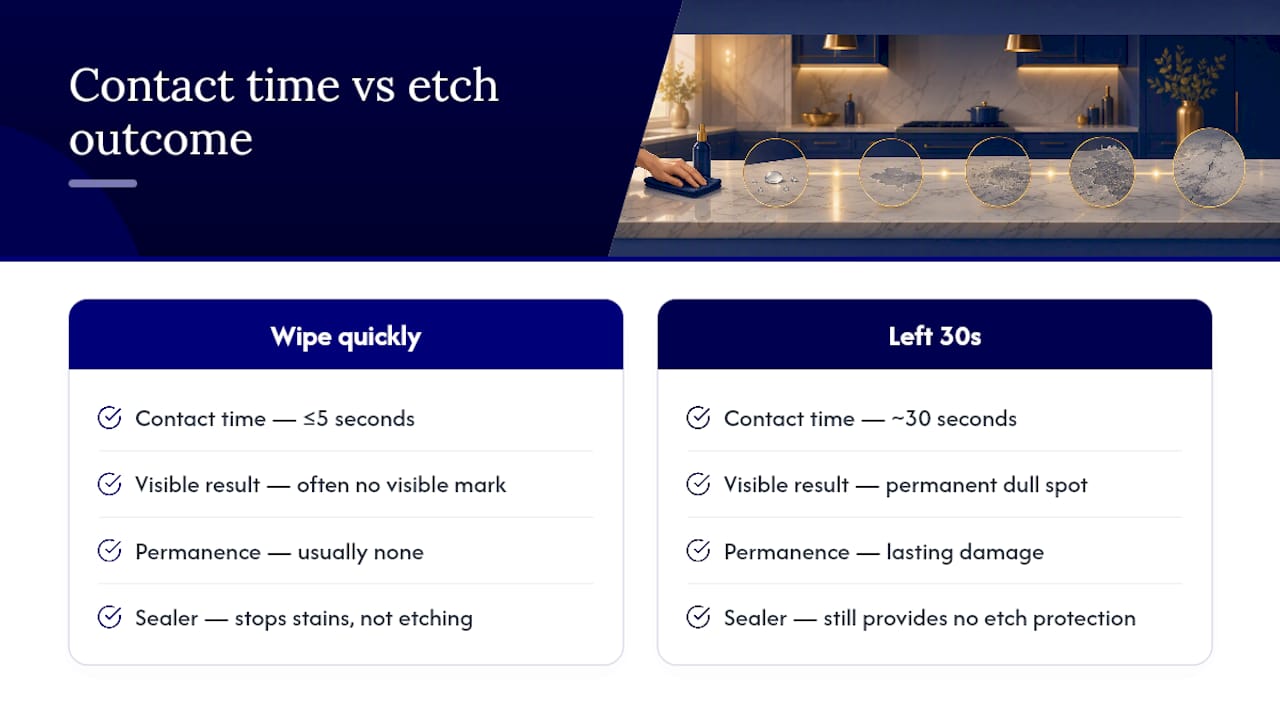
Contact time is the variable that matters most. Wiping up a splash of lemon juice within 5 seconds often leaves no visible mark at all, while letting the same splash sit for 30 seconds can leave a permanent dull spot. That's not a rounding error. That's the difference between a counter that looks fine and one you notice every time you walk into the kitchen.
Finish choice changes what you see, not what happens chemically. A honed (matte) finish hides etch marks far better than a high-gloss polish, because there's no shine to interrupt. The reaction still occurs on honed stone. It's just less visible when it does.
What Sealers, Coatings, and 'Anti-Etch' Products Actually Do
Homeowners often assume "sealed" means "protected." It means something narrower: protected from staining, not from acid burn. Three categories of product get marketed for marble care, and they behave differently enough that mixing them up leads to real disappointment.
- Impregnating sealers soak into the pores and block liquid absorption. Good for stains, irrelevant to etching.
- Topical or sacrificial coatings sit on top of the stone as a physical film, acting more like a sacrificial layer that can take an acid hit instead of the marble itself.
- Engineered consolidants, like nano-zirconia treatments tested in lab settings, show promise for reducing calcite dissolution, but results vary by the stone's grain and porosity and aren't yet a product you buy off a shelf.
The honest limitation shows up under a microscope. Conservation researchers using FIB-SEM imaging found that common inorganic coatings, including calcium oxalate and phosphate treatments, contain vertical channels, pores, or micro-cracks that limit full protection. Adjusting the formulation, lowering concentration, adding alcohol, reduces those flaws. It doesn't eliminate them.
Formulation changes to inorganic coatings reduced pores and cracking under microscopic analysis, improving protective performance, but researchers stopped short of calling any tested version a complete barrier against acid exposure.
Separate conservation testing found some topical polymer coatings, like Avalure AC 315, held up against acidic wine on polished samples in lab conditions, while wax-based coatings lost gloss or left residue on removal. If you're weighing a coating, know what you're trading: a maintenance cadence, a change in surface feel, and a product with documented gaps rather than guaranteed coverage. For most kitchens, that math favors better habits and a good finish choice over chasing a coating that promises more than the research supports.
Cleaning Routines That Won't Accidentally Cause Etching
Ironically, a lot of etch damage comes from the cleaning products people buy specifically to take care of their counters. "Natural" doesn't mean stone-safe, and plenty of citrus-scented sprays list citric or acetic acid right on the label.
- Wipe up any spill immediately with a damp cloth, then dry the spot so no residue sits on the surface.
- Clean daily with a dedicated pH-neutral stone cleaner, or a few drops of mild dish soap diluted in water.
- Disinfect occasionally with 70% isopropyl alcohol mixed with water. It won't etch the stone and it kills most household germs.
- Do a weekly walk-around inspection under raking light (a flashlight held at a low angle) to catch dull spots early, before they're permanent.
- Rinse after cleaning and buff dry. Leftover cleaner residue can dull the finish over time even if it isn't acidic.
Skip vinegar entirely, along with bleach, lemon-oil polishes, and any powder abrasive cleaner marketed for tile or grout. Many "natural" cleaning products are acidic even when the label doesn't say so plainly, so check the ingredient list, not the marketing copy, before anything touches your counter.
High-risk moments deserve a quick mental script. Hosting a dinner party: wipe wine rings the moment a glass gets picked back up, don't wait for the toast to end. Cooking with citrus: cut on a board, never on stone, even for "just a second." Kids in the kitchen: keep the spill kit somewhere they can reach too, so a dropped juice cup gets handled in seconds instead of after you notice it across the room.
Pro Tip: Keep the spill kit visible, not tucked in a cabinet. A cloth and spray bottle sitting on the counter gets used in 3 seconds. The same kit buried under the sink gets used in 3 minutes, and by then the etch has already set.
Repairing Existing Etches: DIY Polish or Call a Pro?
Run a fingernail across the mark. If it's smooth, glassy, and only visually dull, it's a light etch and a good DIY candidate. If you can feel a shallow depression, the acid ate into the surface deeper, and that's a job for a professional.
- Light etches: work a marble polishing powder (often cerium oxide or aluminum oxide based) into the spot with a damp soft pad, using small circular motions, then rinse and dry. Several rounds may be needed to match the surrounding sheen.
- Test first on an inconspicuous area, since honed and polished finishes respond differently to the same powder.
- Deeper etches you can feel need diamond polishing pads or resurfacing equipment that removes a thin, even layer of stone. That's not a weekend project. A stone restoration specialist has the tools to level the surface without leaving a visible patch.
- After any repair, reseal the spot and revisit your habits. An etch that happened once will happen again in the same spot if the same spill risk is still sitting there unmanaged.
What Managed Estate Care Adds That DIY Habits Can't
Homeowners with a lot of stone surfaces across a property, kitchen islands, wet bars, outdoor kitchens, tend to lose the thread on consistency. A weekly inspection routine catches the spill kit that's gone missing, the sealer that's overdue, and the guest habit that's quietly wearing a groove into the same spot near the sink.
An estate manager's version of marble care looks like this:
- Weekly walk-throughs that check for new dull spots before they become permanent problems.
- Vendor coordination to schedule professional sealing and polishing with contractors who actually specialize in natural stone.
- Quarterly review of "risk zones," where acidic condiments, wine, or cleaning products get stored near stone counters.
- Tracking guest and staff usage patterns during high-occupancy periods, when spill risk spikes fastest.
The value isn't a fancier cleaning product. It's that someone is watching the counter every week instead of every few months, the same prevention logic that applies to storm prep or paint upkeep on the rest of the house.
The Advice Everyone Gives That Undersells the Real Fix
Most marble care guides lead with sealing schedules, as if resealing every year is the main event. It isn't. Sealing protects against stains, and staining was never the thing that made your counter look ruined. Etching did that, and sealing has almost nothing to do with stopping it.
The habit that actually moves the needle is speed. A 5-second wipe and a 30-second wipe produce two different countertops, and that gap is entirely about attention, not product. I'd argue most etching complaints are really attention complaints: nobody was watching the counter when the lime wedge landed.
Coatings and consolidants get more airtime than they deserve given what the microstructure research actually shows. Channels, pores, cracks, these aren't marketing footnotes, they're the reason no coating on the market claims total protection. Treat them as a supplement to habits, never a replacement.
If you take one thing from this, take the placement of your spill kit. Not the brand of cleaner. Where it sits, and whether it's within arm's reach the next time something acidic hits the stone.
— Zackary
A Managed Alternative If You'd Rather Not Run This System Yourself
Running a spill kit, a sealing calendar, and a weekly inspection routine works, but it only works if someone actually does it every week, every season, without fail. That's the gap 30apropertycollective fills for homeowners along Florida's Emerald Coast: a dedicated estate partner who checks the counters, tracks the sealing schedule, and coordinates the right vendor before an etch turns into a full resurfacing job.

Membership plans range from Essential to full Estate Management, and each includes weekly inspections that catch stone wear early, plus vendor oversight so any sealing or polishing gets handled by someone who actually specializes in natural stone. When comparing plans, ask about inspection frequency, which stone-care tasks are included versus billed separately, and how vendor credentials get verified. If you'd rather have someone else own this checklist, visit the concierge services page and ask what a customized proposal for your property would include.
Sources
- Marble etching vs staining — MarbleArmour
- Marble Etching: What Causes It & How To Prevent — Connecticut Stone
- Florence Heri‑Tech – Protective coatings microstructure study (IOP Conference 2018)
- Marble etching: Causes, prevention, and DIY repair — Dynamic Stone Tools