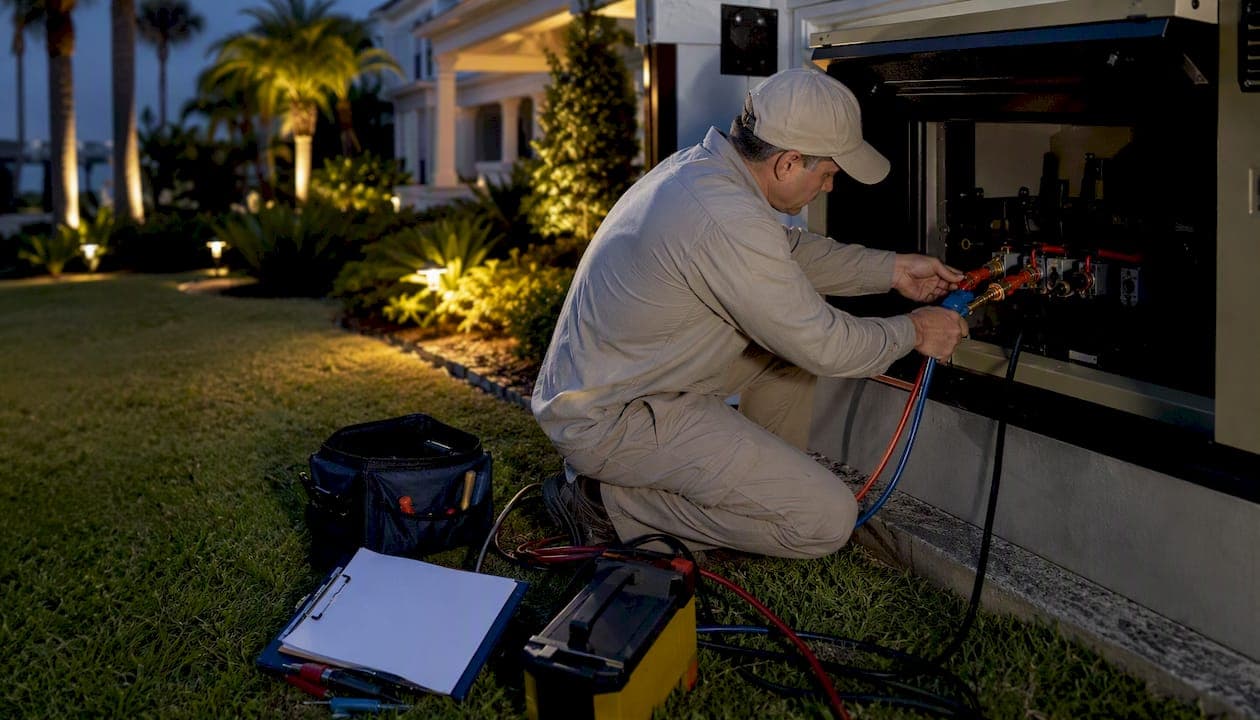
A generator maintenance checklist is a schedule-based set of visual checks, fluid and battery inspections, and run/load tests you perform on a daily-to-annual cadence to keep standby and portable generators ready when the grid fails. The short version: inspect fluids and battery weekly, run a 5–10 minute exercise cycle weekly, perform a monthly load test at ≥30% nameplate load for at least 30 minutes, and schedule a full professional service annually. Generac and Briggs & Stratton both publish model-specific owner's manuals that set the authoritative intervals for your unit. For estate owners on Florida's Emerald Coast, 30apropertycollective can fold these checks into weekly property inspections so nothing slips between visits.
Quick-reference frequency guide (print or copy this):
- After each use: wipe exterior, clear vents, check fuel and oil levels
- Daily (before expected outage): visual inspection, confirm no alarms, verify area is clear of debris
- Weekly: start/run exercise (5–10 min), inspect belts and hoses, clean battery terminals, check ATS annunciators
- Monthly: load test at ≥30% nameplate for 30+ minutes, drain water separators, inspect fuel condition, log readings
- Quarterly/biannual: replace fuel/water separators, inspect exhaust and flex joints, load-test battery, replace air filter if needed
- Annual: full professional service, oil and filter change, spark or glow plug replacement, full-load bank test, ATS inspection, and documentation
Key Takeaways
A consistent generator maintenance schedule, anchored by monthly load tests and proactive battery replacement, prevents the vast majority of no-start failures when power is needed most.
| Point | Details |
|---|---|
| Monthly load test is the priority | Run at ≥30% nameplate load for 30+ minutes every month per NFPA 110 guidance. |
| Battery replacement prevents no-starts | Replace lead-acid batteries every few years proactively, not after a failure. |
| Annual professional service | Schedule a full inspection yearly; typical residential cost runs $200–$600. |
| Fuel degrades faster than expected | Diesel can develop microbial contamination within 6–12 months; sample and polish annually. |
| 30apropertycollective | Integrates weekly generator checks, vendor coordination, and digital reporting for Emerald Coast estates. |
Table of Contents
- What does a complete generator maintenance checklist cover?
- How do you safely perform a generator load test?
- How should you store and care for generator fuel?
- What should you check on batteries, belts, filters, and spark plugs?
- How do you inspect the control panel, breakers, and transfer switch?
- When should you schedule professional generator service?
- How do you keep a generator maintenance log?
- How do you integrate generator maintenance into an estate management program?
- The maintenance task most owners skip (and why it costs them)
- 30apropertycollective keeps your generator ready year-round
- Sources
What does a complete generator maintenance checklist cover?
The checklist below is organized by frequency so you can use it as a working schedule. Time estimates are approximate for a single technician on a residential standby unit.
After each use / every 24 hours (5–10 min)
- Wipe down the exterior and clear debris from vents and louvers
- Inspect for fuel, oil, or coolant leaks around the base and connections
- Check fuel level; top off diesel or gasoline to the recommended threshold
- Verify battery float charge indicator or voltage (12.4–12.6 V at rest for a healthy 12V lead-acid)
- Portable units: drain the carburetor if storing longer than 30 days; standby units skip this step
Daily / before an expected outage (5 min)
- Confirm no active alarms on the control panel
- Verify the area around the enclosure is clear of combustibles and debris
- Check coolant and oil sight levels on liquid-cooled units
- Confirm transfer switch is in AUTO mode
Weekly (15–20 min)
- Start and run the generator for 5–10 minutes (many standby units auto-exercise on a set schedule)
- Inspect belts for cracking, glazing, or fraying; check hoses for soft spots or swelling
- Clean battery terminals; remove corrosion with a wire brush and apply terminal protector spray
- Check ATS annunciators for fault codes; log any that appear
Monthly (30–45 min)
Per NFPA 110 guidance for emergency power systems, run the generator under load at a minimum of 30% of nameplate rating for at least 30 minutes. This is the single most important monthly task.
- Drain water separators on diesel units
- Inspect fuel for discoloration or sediment
- Record voltage, frequency, oil pressure, coolant temperature, and run duration
- Log the technician's name, date, and start/stop times
Quarterly / biannual (45–60 min)
- Replace fuel/water separator filters
- Inspect exhaust system and flex joints for cracks or leaks
- Perform a load test on the battery (not just a visual check)
- Replace the air filter if operating in dusty or high-debris environments
- Inspect vibration isolation mounts and drive belts for wear
Annual (2–4 hours, often requires a technician)
- Change engine oil and filter per hours-based or calendar schedule (see Section 7)
- Replace spark plugs (gasoline units) or glow plugs (diesel units)
- Replace air filter on schedule regardless of appearance
- Perform a full-load bank test or confirm monthly tests have consistently met load thresholds
- Complete ATS inspection: contact condition, terminal tightness, transfer and retransfer times
- Document everything and file with the maintenance log
Pro Tip: On coastal properties, rodents are a persistent threat. Check wiring harnesses, insulation, and any foam seals inside the enclosure monthly. Salt air accelerates corrosion on terminals and fasteners, so a quick spray of dielectric grease on electrical connections during each quarterly visit pays for itself. The Generac owner's manual specifically flags coastal-site enclosure care as a warranty consideration.
How do you safely perform a generator load test?
Annual tests for critical systems often require higher loads, up to 100% with a load bank, to eliminate wet-stacking and validate full-power performance.
Step-by-step load test procedure
- Notify occupants and building systems. Alert anyone in the building, disable fire-alarm integrations that would trigger on a simulated outage, and confirm the BMS is in test mode.
- Verify pre-test conditions. Confirm fuel is at or above 75% capacity, oil level is within range, and no active alarms are present on the control panel.
- Start the generator and allow it to warm up for 3–5 minutes at no load before applying the load.
- Transfer the load. For standby units, simulate a utility loss via the ATS test switch or connect a portable load bank to reach the required load percentage.
- Monitor continuously. Record voltage (should hold within ±5% of rated), frequency (59.5–60.5 Hz for 60 Hz units), oil pressure, and coolant temperature every 5–10 minutes during the run.
- Watch for alarms. Any fault code, unusual smoke, or abnormal noise is a stop condition. Shut down, document the fault, and do not clear codes until a technician reviews them.
- Cool-down period. Run at no load for 3–5 minutes before shutdown to allow exhaust temperatures to drop.
- Retransfer and document. Return the ATS to utility power, log transfer and retransfer times, and sign the record.
Safety callouts: Never run a load test in a confined or poorly ventilated space. Carbon monoxide accumulates fast. Use hearing protection and gloves. Secure the fuel supply and confirm no flammable materials are within 5 feet of the exhaust. For full-load bank tests, a licensed technician should be on site.
How should you store and care for generator fuel?
For stored gasoline and diesel, the rule is simple: either drain the tank before long storage or use a fuel stabilizer and exercise the unit regularly. Propane and natural gas standby systems don't degrade in the tank, but supply valves, regulators, and connections still need periodic inspection.
Gasoline
- Stabilized gasoline stays usable for up to 12–24 months; unstabilized gasoline degrades in as little as 30 days
- Add a fuel stabilizer (STA-BIL is a widely available option) at the correct ratio before storage
- For portable generators stored more than 30 days, drain the carburetor completely after adding stabilizer and running the engine briefly to circulate it
Diesel
Diesel fuel can develop microbial contamination within months to a year, especially in humid environments. Signs include dark fuel, sediment, or a sulfur-like smell.
- Keep the tank at 75–90% capacity to minimize condensation in the headspace
- Schedule a fuel sample and lab analysis annually for diesel standby units
- If contamination is confirmed, fuel polishing (filtration and recirculation) removes water and particulates; add a biocide treatment when microbial growth is present
- Drain and replace severely degraded fuel rather than polishing it
Propane and natural gas
- Inspect supply valves, flex connectors, and regulators quarterly for leaks using a soap-and-water test or a combustible gas detector
- Confirm the utility or propane supplier has the generator on their service record
Disposal of used fuel and filters
Used oil, fuel filters, and contaminated diesel are regulated waste in most U.S. states. Take used oil to a certified recycling center (AutoZone and O'Reilly Auto Parts accept it at no charge in most locations). Contaminated fuel and filters should go to a licensed hazardous waste facility. Check your county's household hazardous waste program for drop-off schedules. Pouring used fuel down a drain or onto the ground is a federal Clean Water Act violation.
For coastal properties, keeping the area around the generator clear of standing water and vegetation also reduces fuel-system contamination risk. A well-maintained perimeter around the enclosure limits both moisture intrusion and pest access.
What should you check on batteries, belts, filters, and spark plugs?
Battery failure is the single most common cause of generator no-starts. Test monthly and replace proactively every 3–4 years for lead-acid batteries. Don't wait for a failed start to find out the battery is dead.
Battery checks
- Inspect terminals monthly for corrosion (white or blue-green buildup); clean with a wire brush and apply dielectric grease
- Test voltage with a multimeter: a fully charged 12V battery reads 12.6 V or higher at rest
- Perform a load test quarterly using a battery load tester, not just a voltage check
- Replace lead-acid batteries every few years proactively, regardless of how they test near the end of that window
Belts and hoses
- Inspect belts for cracking, glazing, fraying, or a shiny underside (glazing means slipping)
- Check belt tension: a properly tensioned belt deflects about ½ inch under moderate thumb pressure
- Squeeze hoses to feel for softness, sponginess, or brittleness; check clamps for rust or looseness
- Replace on condition, not on a fixed calendar. A belt that looks cracked at 18 months needs to go; one in perfect condition at 36 months can stay
Air filters and spark/glow plugs
Oil changes typically fall every 100–200 operating hours or once a year, and air filters and plugs follow a similar rhythm. Replace air filters annually or every 100–200 hours, whichever comes first. In dusty or coastal environments, inspect every 50 hours.
- Spark plugs (gasoline units): replace on the schedule recommended by the owner's manual; check electrode gap before installing new plugs
- Glow plugs (diesel units): replace every 2 years or when hard-starting symptoms appear in cold weather
- Always use OEM part numbers. Generac and Briggs & Stratton both publish parts lists in their owner's manuals, and using off-spec plugs or filters can void the warranty
How do you inspect the control panel, breakers, and transfer switch?
Verify the control panel shows no active alarms before every use. The ATS should be tested monthly with a simulated utility-loss transfer, and transfer and retransfer times should be logged every time.
Control panel checklist
- Check alarm history; document any fault codes before clearing them
- Confirm all indicators show normal (green or "ready" status)
- Inspect terminal connections inside the control cabinet for tightness; loose terminals cause voltage fluctuations and nuisance faults
- Check UPS or battery backups inside the control cabinet if present
ATS inspection
- Simulate a utility-loss transfer monthly and record transfer time (typically 10–30 seconds for residential ATS units)
- Inspect contacts for pitting, discoloration, or burning during annual service
- Verify contact resistance is within spec; out-of-spec resistance generates heat and accelerates wear
When to call a licensed electrician
Call immediately if you see visible arcing, smell burning insulation, find burned or pitted contacts, or experience a failed transfer test. Voltage or frequency excursions outside normal range during a run also require professional diagnosis. Commercial facilities must document ATS tests and maintain written maintenance programs to satisfy NFPA 110 and AHJ inspections.
Lockout/tagout is non-negotiable before any electrical work on the generator or ATS. De-energize both the utility feed and the generator output before touching terminals or contacts.
When should you schedule professional generator service?
Schedule a professional for annual comprehensive service, any ATS or electrical work, full-load bank tests, injector or compression tests, and whenever alarms indicate internal faults. Some tasks simply require calibrated equipment and licensed hands.
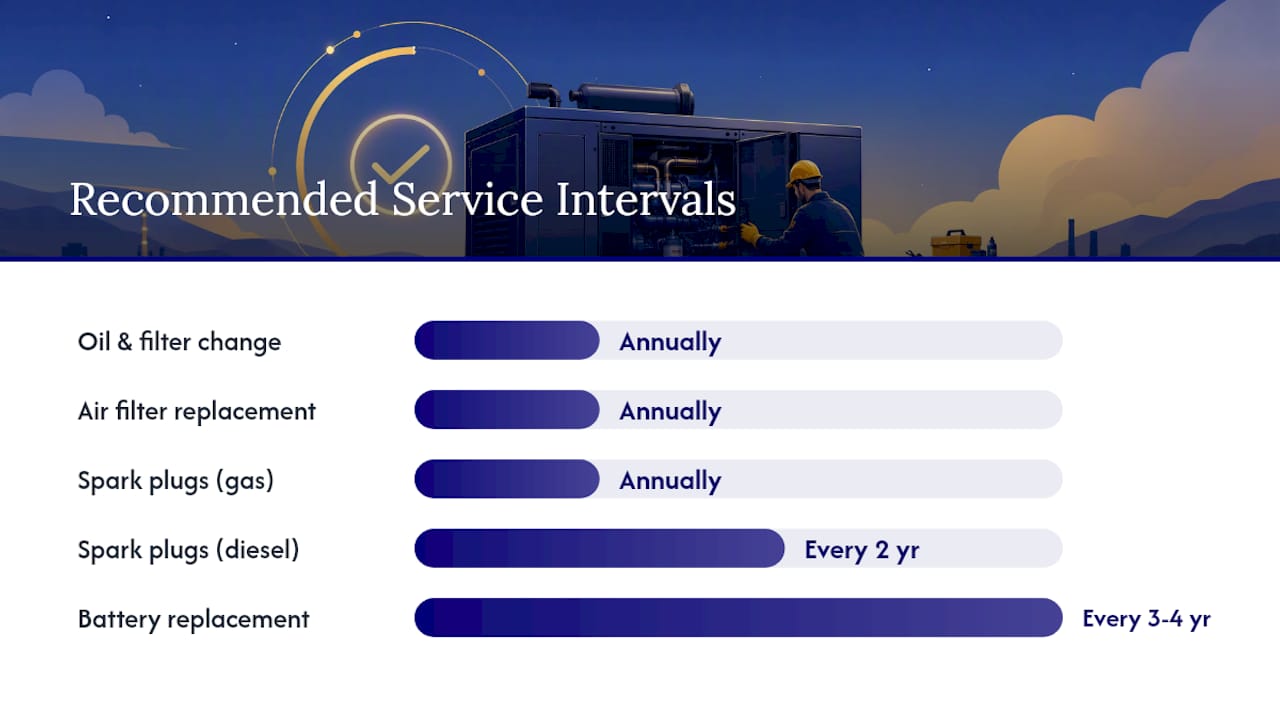
| Service item | Recommended interval | Notes |
|---|---|---|
| Oil and filter change | Every 100–200 hours or annually | First change at 30 hours on new units |
| Air filter replacement | Annually or every 100–200 hours | More often in dusty/coastal environments |
| Spark or glow plugs | Annually (gas) / every 2 years (diesel) | Per manufacturer spec |
| Battery replacement | Every 3–4 years | Lead-acid; AGM may last longer |
| Professional inspection | Annually or every 1–2 years | Depends on hours and NFPA level |
| Full-load bank test | Annually if monthly tests can't reach 30% load | Required for Level 1/2 systems |
| ATS full inspection | Annually | Contact condition, resistance, documentation |
Annual homeowner service typically runs $200–$600 depending on unit size and region, per cost guidance for residential generator maintenance. Commercial services and load-bank tests run higher. Both Generac and Briggs & Stratton offer factory-authorized service networks, and using an authorized dealer protects your warranty. Always confirm the technician follows your owner's manual intervals, not a generic schedule.
How do you keep a generator maintenance log?
Accurate records matter for warranty claims, insurance documentation, and NFPA 110 compliance. A missing log is the fastest way to lose a warranty dispute or fail an AHJ inspection.
Log fields to record every entry
- Date and time of service
- Operator or technician name and signature
- Generator run hours (cumulative meter reading)
- Start and stop times
- Load percentage during test
- Voltage, frequency, oil pressure, and coolant temperature readings
- Fuel level before and after
- Parts replaced (part number, quantity, supplier)
- Any fault codes observed and action taken
Sample log entry:
June 14, 2026 | Tech: J. ATS transfer time 14 sec.
Keep records for a minimum of three years. Many authorities having jurisdiction (AHJs) and insurance carriers require this retention period for documented commercial maintenance programs. A simple binder works for residential units; digital logs stored in a property management platform work better for multi-unit or estate-level oversight. For a printable log template, the Bob Vila generator maintenance guide includes a downloadable format you can adapt.
How do you integrate generator maintenance into an estate management program?
Add generator status to every weekly property inspection report. For estate owners who aren't on-site year-round, a missed exercise cycle or a low-fuel alert can go unnoticed for weeks without a structured check-in process.
Integration tips
- Include the generator's hour-meter reading and control panel status in every digital property report sent to the owner
- Set calendar reminders tied to both run hours and the calendar (monthly load test, quarterly filter swap, annual service)
- Before hurricane season, confirm fuel is topped off, the ATS is tested, and the enclosure is secured. A pre-storm generator check is one of the highest-value tasks an estate manager can perform
- After storm events, inspect the enclosure for water intrusion, debris, and any damage to exhaust or intake paths
Vendor management for contracted technicians
When hiring a service technician, your SLA should specify: response time for emergency calls (24–48 hours is reasonable), documentation requirements (signed logs, photos of replaced parts), and OEM-only parts for warranty-covered units. Confirm the technician is familiar with your specific model; a Generac 22kW air-cooled unit has different service points than a Briggs & Stratton liquid-cooled commercial unit.
Coastal-site specifics
On the Emerald Coast, salt air is the hidden maintenance driver. Route sprinkler heads and condensate drains away from the generator enclosure. Use corrosion-resistant fasteners when replacing hardware. Inspect electrical terminals more frequently than the standard schedule, and apply corrosion-inhibiting coatings per the Generac owner's manual guidance for coastal installations. These steps protect both the equipment and the manufacturer warranty. Pairing generator oversight with a broader property damage prevention plan keeps all the risk vectors covered in one program.
The maintenance task most owners skip (and why it costs them)
Most generator failures at the worst possible moment trace back to two skipped tasks: the monthly load test and the battery replacement. Not the oil change, not the air filter. Those two.
The monthly load test is skipped because it feels like overkill when the generator "runs fine" during the weekly exercise. But a 5-minute no-load exercise cycle doesn't stress the alternator windings, doesn't validate voltage regulation under real demand, and doesn't catch the slow fuel injector that only shows up under load.
Battery replacement gets deferred because the battery tests "okay" at 3.5 years. Lead-acid batteries can pass a resting voltage test and still fail catastrophically under the cold-cranking load of a real start. The 3–4 year proactive replacement window exists precisely because the failure mode is sudden, not gradual.
For estate properties, the stakes are higher. A failed generator during a Gulf Coast storm doesn't just mean an inconvenient outage. It means a compromised security system, a failed sump pump, spoiled food in a fully stocked kitchen, and a guest experience that no amount of apologizing fixes. Consistency and documentation aren't bureaucratic overhead. They're the difference between a property that performs and one that disappoints.
30apropertycollective keeps your generator ready year-round
Owning a luxury estate on the Emerald Coast means your generator isn't a backup plan. It's a critical system. 30apropertycollective builds generator checks directly into weekly estate inspections, so you get a photo-documented status report on fuel level, control panel alarms, and enclosure condition every single week, not just when something breaks.

The service goes beyond a visual check. 30apropertycollective coordinates with licensed generator technicians for scheduled professional service, manages parts procurement, and tracks run hours against manufacturer intervals so nothing falls through the cracks between your visits. When hurricane season arrives, pre-storm generator readiness is already on the checklist. When you arrive for a stay, the generator has been exercised, logged, and confirmed ready.
For owners who want full estate-level coverage, the concierge and estate management services include recurring maintenance coordination, vendor oversight, and digital reporting. Reach out to request a service proposal and add generator maintenance to your estate program today.
Sources
These are the primary references worth bookmarking for model-specific intervals and compliance requirements.
- Generator MaintenanceChecklist
- Commercial Generator Maintenance Checklist: The Complete Guide | OnPoint Generators
- Generator and Emergency Power System Maintenance Checklis
- Propertyliftup