
A digital property report is a secure, time-stamped, evidence-rich record of your estate's condition and stewardship — and for luxury homeowners along Florida's Emerald Coast, it's the single most important document you're probably not requiring from your property manager. It gives you verifiable proof for insurance claims, remote oversight when you're away for months, and a permanent archive that protects your asset's value. 30apropertycollective delivers these reports as part of its regular inspection cycle, making them a recommended local provider for seasonal residents who need more than a text message saying "everything looks fine."
Table of Contents
- What do digital property reports actually include?
- How are reports delivered, secured, and archived?
- What should a pre- and post-storm assessment cover?
- How does smart-home telemetry integrate into your reports?
- Who benefits most from digital property reports?
- What cadence, turnaround, and cost factors should you expect?
- How do you choose a digital property report provider?
- 30apropertycollective: weekly inspections, secure reports, Emerald Coast coverage
- Key Takeaways
- Why exception-based reporting is the standard worth demanding
- Useful sources and next steps
What do digital property reports actually include?
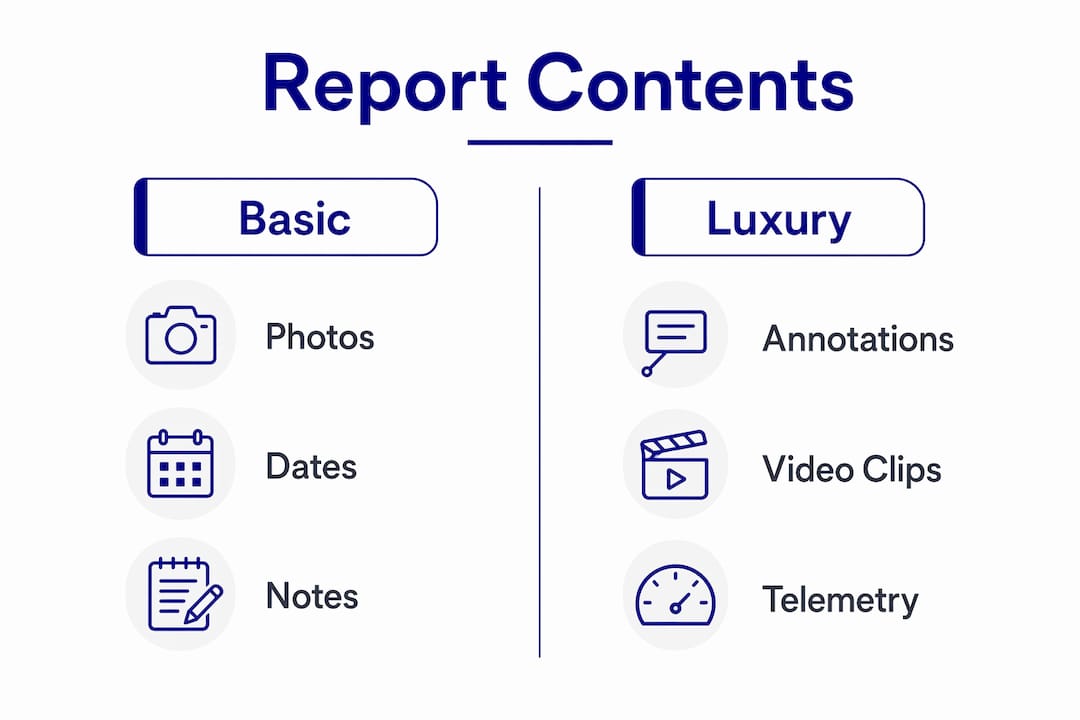
A professional digital property report goes well beyond a maintenance checklist. It's an actionable record that combines visual evidence, verified contractor documentation, and system status into a single, searchable file.
Core components every report should contain:
- Time-stamped photos and video of each room, exterior zone, and mechanical system
- Verified contractor service logs with invoice references and work-order numbers
- Condition notes per area (e.g., "master bath grout: no change," "pool deck: hairline crack noted at NE corner")
- Interior climate records: thermostat setpoints, actual readings, and HVAC runtime
- Utility snapshots: power status, water pressure, generator fuel level
- Site-visit sign-off with inspector name, staff ID, and GPS-confirmed location
Supporting elements that separate a luxury-grade report from a generic one include annotated photos with callout markers, a searchable archive organized by date and property zone, and embedded metadata (GPS coordinates, timestamp, inspector ID) on every image. Each entry links directly to the relevant vendor work order, so there's a clear chain of custody from observation to resolution.
| Report Field | What It Captures | Why It Matters |
|---|---|---|
| Time-stamped photo | Visual condition at exact date/time | Insurance evidence, trend tracking |
| Contractor log | Service performed, vendor name, invoice # | Vendor accountability, claim support |
| Climate record | Thermostat set vs. actual temp | Mold prevention, HVAC fault detection |
| Utility snapshot | Power, water, generator status | Remote operational awareness |
| Inspector sign-off | Staff ID, GPS, visit duration | Audit trail, liability protection |
Pro Tip: Ask your provider to show you a sample report entry for a single room. If it contains fewer than three of the fields above, the report won't hold up as insurance evidence.
How are reports delivered, secured, and archived?
Privacy-conscious homeowners have good reason to ask hard questions here. A report containing interior photos, security logs, and contractor invoices for a multi-million-dollar estate is sensitive material.
Delivery and security checklist:
- Secure client portal with login-protected access and receipt confirmation
- End-to-end encryption for all transmitted files and attachments
- Multi-factor authentication for portal access
- Tamper-evident timestamps that make any post-delivery alteration detectable
- Contractor verification logs confirming who entered the property and when
- Defined retention policy (minimum three years recommended for insurance purposes)
Interactive delivery matters too. Platforms that allow owners to confirm receipt and authorize follow-up maintenance directly inside the report interface keep the chain of custody clean and eliminate the ambiguity of back-and-forth email threads. Searchable archives with tamper-evident timestamps turn routine inspections into insurance-ready evidence and long-term asset records — a distinction that matters the first time you file a claim.
Pro Tip: Log into your provider's portal from a device you don't normally use. If you can access reports without being prompted for a second authentication factor, your archive isn't adequately protected.
What should a pre- and post-storm assessment cover?
The Emerald Coast sits in one of the most active hurricane corridors in the continental United States. A storm-specific assessment isn't optional — it's the document your insurance adjuster will ask for first.
Pre-storm documentation tasks:
- Perimeter security check: gates, fences, exterior furniture secured or stored
- Shutter engagement confirmed with photos of each opening
- Backup power: generator fuel level, transfer switch tested, battery backups charged
- Interior climate stabilization: thermostat set to storm mode, humidity controls active
- Baseline photos of all vulnerable areas (roof line, windows, pool equipment, dock)
Post-storm documentation tasks:
- Damage photos with time-stamps taken as soon as safe site access is confirmed
- Contractor initial triage log noting structural concerns, water intrusion, and safety flags
- Site-access notes (road conditions, access restrictions, utility outages)
- Immediate safety flags documented: gas odor, structural compromise, standing water
Understanding why contractors document storm damage with photo evidence and written logs is directly relevant here — the same standards apply to your estate manager's pre- and post-storm reports.
| Storm Phase | Inspection Trigger | Key Documentation |
|---|---|---|
| Pre-storm | — | Shutters, perimeter, climate, baseline photos |
| Immediate post-storm | First safe site access | Damage photos, safety flags, triage log |
| Follow-up | 24–72 hours after access | Contractor scopes, utility restoration, repair log |
Pro Tip: Send your insurer a copy of the pre-storm baseline report before the storm makes landfall. It establishes condition prior to the event and removes any dispute about pre-existing damage.
How does smart-home telemetry integrate into your reports?
Remote owners don't need a data dump — they need to know what changed and what requires a decision. Exception-based reporting surfaces only faults, threshold breaches, or required authorizations, keeping the report concise and genuinely useful.
Systems commonly integrated into luxury estate reports:
- HVAC runtime, fault codes, and filter-change alerts
- Security event logs: door/window sensors, motion events, alarm activations
- Power and generator telemetry: runtime hours, fuel consumption, fault alerts
- Pool chemistry readers: pH, chlorine, and temperature deviations
- Water-sensor alerts: leak detection in mechanical rooms, under sinks, and garage floors
A well-structured smart-home integration feeds these data streams directly into the report rather than requiring a separate app check. Example alert entries look like: "HVAC fault detected — fan failure, Zone 2, flagged for service call" or "Water sensor triggered — garage utility sink, inspector dispatched." Each alert links to the inspector's follow-up note and any contractor response.
Pro Tip: Set exception thresholds before your first absence. A report that flags every routine HVAC cycle is noise; one that only alerts on faults or deviations beyond a defined range is intelligence.

Who benefits most from digital property reports?
Seasonal absentee owners gain the most obvious value: weekly reports replace the anxiety of being 1,200 miles away during a Florida summer. Trustees managing an estate during settlement need a documented record of condition and vendor oversight that holds up to legal scrutiny. Pre- and post-rental handovers benefit from time-stamped condition reports that protect against damage disputes. Storm recovery documentation accelerates insurance claims by giving adjusters a clear before-and-after record.
One scenario worth understanding: a time-stamped contractor log showing a licensed roofer inspected and cleared the roof six weeks before a storm can be the difference between a paid claim and a denied one. Without that log, an insurer may argue the damage was pre-existing. With it, the timeline is unambiguous.
What cadence, turnaround, and cost factors should you expect?
Weekly inspections are the standard baseline for vacant luxury homes. Frequency increases before and after storms, during active renovation projects, or when a system fault has been flagged and is under repair.
Factors that drive cost:
- Property size and number of inspectable zones
- Number of integrated smart-home and mechanical systems
- Membership tier (Essential, Signature, or Estate level)
- Storm response requirements and emergency dispatch capacity
- Frequency of visits beyond the weekly baseline
| Scenario | Typical Cadence | Turnaround |
|---|---|---|
| Standard vacant home | Weekly | 24–72 hours |
| Active renovation | 2–3x per week | 24 hours |
| Storm response | Immediate post-access | Same day |
| Pre-arrival prep | — | Same day |
Urgent incident reports — a triggered water sensor, a post-storm triage — are typically delivered the same day. Full inspection packets with annotated media and contractor logs generally arrive within 24–72 hours depending on scope.
How do you choose a digital property report provider?
Decision checklist:
- Proof of liability insurance and background-checked staff on file
- Audit-trail capability with tamper-evident timestamps
- Membership tiers that match your inspection frequency needs
- Demonstrated local storm-response capacity (not just a policy, but a protocol)
- Sample report available before you sign
Questions to ask every provider:
- Can I see a real (anonymized) report from a comparable property?
- How is contractor identity verified on each visit?
- What encryption standard protects my portal and report files?
- Have your reports been used successfully in an insurance claim?
- What is your response protocol when a sensor alert triggers between scheduled visits?
Red flags to watch for:
- No timestamps on photos (or timestamps that can be edited after the fact)
- No contractor verification — just a name with no invoice or work-order reference
- Generic market data substituted for actual condition documentation
- No local storm-response protocol
| Trust Signal | What to Verify |
|---|---|
| Liability insurance | Current certificate, not just a verbal confirmation |
| Background-checked staff | Written policy, not assumption |
| Tamper-evident timestamps | Ask how post-delivery edits are prevented |
| Sample report | Request before signing any agreement |
| Insurance claim experience | Ask for a specific example, not a general claim |
Automated tools can speed property report generation, but they often miss the luxury-focused verification and security features high-net-worth owners require. Speed is not a substitute for a verified chain of custody.
30apropertycollective: weekly inspections, secure reports, Emerald Coast coverage
For Emerald Coast homeowners who want estate-grade reporting without assembling it themselves, 30apropertycollective delivers exactly what this article describes: weekly inspections with time-stamped photos, verified contractor logs, secure client portal delivery, and pre/post-storm assessments built into every membership.

Their three membership tiers — Essential, Signature, and Estate — scale from foundational home watch to full estate management with concierge services including smart-home monitoring, utility oversight, and arrival preparation. Every report includes an audit trail, background-checked staff sign-off, and insurance-ready documentation. If you're a seasonal resident spending summers away from your Emerald Coast property, this is the coverage that helps prevent small HVAC faults from becoming costly mold remediation issues.
Review the membership tiers or request a sample report through the concierge page to see exactly what your estate's weekly report would look like.
Key Takeaways
A digital property report is only as valuable as the verification, security, and storm-specific documentation behind it — and for Emerald Coast homeowners, those three elements are non-negotiable.
| Point | Details |
|---|---|
| Definition and value | A digital property report is a secure, time-stamped, evidence-rich stewardship record for insurance, oversight, and asset protection. |
| Storm and insurance readiness | Pre-storm baseline photos and post-storm triage logs are the documents insurers request first after a Gulf Coast event. |
| Provider selection | Require a sample report, tamper-evident timestamps, contractor verification logs, and proof of liability insurance before signing. |
| Reporting cadence | Weekly inspections are the standard baseline; storm response and active renovations require same-day or next-day turnaround. |
| 30apropertycollective | Delivers weekly inspections, secure portal reports, and storm assessments across the Emerald Coast through three membership tiers. |
Why exception-based reporting is the standard worth demanding
Most estate management articles stop at "get regular inspections." That's the floor, not the ceiling. The real question is what the report does with the information it collects.
A report that sends you 200 photos of a house that looks exactly the same as last week isn't a report — it's a file storage problem. The providers worth hiring have built exception-based logic into their reporting: you see what changed, what was flagged, and what requires your authorization. Everything else is archived silently, available if you ever need it for a claim or a sale, but not cluttering your inbox.
The Emerald Coast adds a specific wrinkle that most generic estate management guides ignore: the gap between a named storm and your insurer's deadline for filing documentation can be as short as 72 hours. A provider who can deliver a time-stamped, contractor-verified post-storm report within that window isn't a convenience — they're protecting a material financial interest. That's the standard 30apropertycollective is built around, and it's the standard you should hold every candidate to.
Useful sources and next steps
Primary sources referenced in this article:
- RealReports — AI-powered property report platform; background on report structure and tiered documentation
- Contractor storm documentation standards — practical guidance on photo and log standards for storm damage claims
- Smart-home integration checklist — technical background on telemetry systems commonly available for estate reporting
Next steps for Emerald Coast homeowners:
- Review service options and membership tiers at 30apropertycollective
- Request a sample report or consultation through the concierge page
- Confirm your property falls within the Emerald Coast service area before inquiring
This article provides general information about estate management documentation practices. Confirm current insurance requirements and Florida-specific regulations with your insurer and a qualified professional for your specific situation.