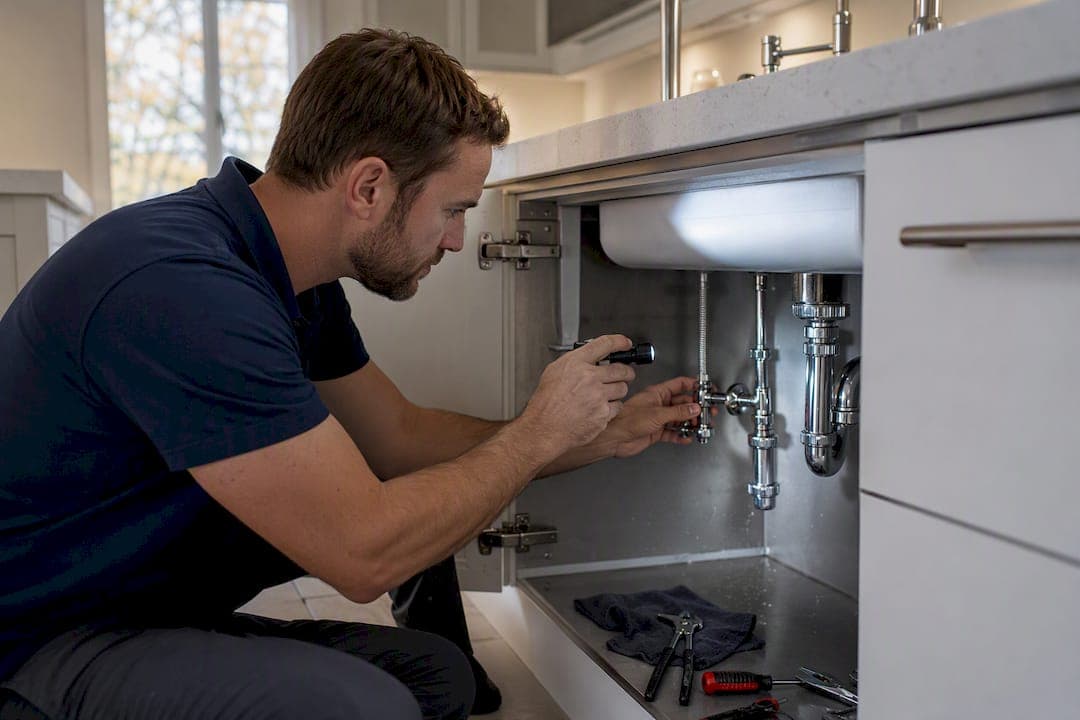
Estate-grade water leak detection pairs weekly physical inspections with delegated emergency response, so a slow pipe failure never becomes a demolished wine room. The right service model closes the gap between when water starts moving and when someone with authority to act actually finds out.
Look for three things in writing: a dispatch goal of 60 to 120 minutes, a documented mitigation plan, and 30apropertycollective's model of weekly inspections paired with delegated emergency authority.
- Insist on a written response-time commitment, not a verbal promise.
- Require photo and timestamp documentation on every visit.
- Confirm someone besides you can authorize emergency vendor work.
Key Takeaways
Estate-grade leak detection works because it pairs weekly physical inspections with delegated emergency authority, closing the gap between when water starts moving and when someone with power to act finds out.
| Point | Details |
|---|---|
| Require written response times | Insist on a dispatch goal of 60 to 120 minutes documented in your service contract. |
| Expect a multi-day mitigation window | Drying typically runs 3 to 7 days, extending to 7 to 10 days for dense or saturated finishes. |
| Document everything | Photos, timestamps, and mitigation logs materially strengthen insurance claims after an event. |
| Delegate emergency authority in writing | Give your estate manager a dollar-capped vendor spending threshold before an emergency happens, not during one. |
| Choose an integrated provider | 30apropertycollective builds detection into weekly inspections, delegated authority, and documented reporting as part of ongoing estate management. |
Table of Contents
- What Professional Water Leak Detection Includes for Luxury Estates
- How Often Should Leak Inspections and Monitoring Happen?
- How Fast Should a Leak Response Team Arrive and How Long Does Drying Take?
- How Detection Fits Into a Full Estate-Management Plan
- What to Ask Before You Sign an Estate-Grade Leak Detection Contract
- Overview of DIY Water Leak Detection Methods and Tools
- How to Interpret Water Detection Results and Decide Next Steps
- Preventive Maintenance Tips to Reduce Water Leak Risk
- Why an Estate-Management Plan Beats Piecemeal Detection
- A Final Word on Getting This Right
- Frequently Asked Questions
- Sources
What Professional Water Leak Detection Includes for Luxury Estates
A real estate-management leak program is not a sensor and an app. It is a service built around five components:
- Weekly physical inspections of mechanical rooms, under-sink cabinetry, and appliance connections.
- Remote monitoring access so an estate manager, not just the owner, sees alerts in real time.
- Whole-home shutoff authority, granted in writing before an emergency, not negotiated during one.
- Vendor coordination, meaning a plumber or restoration crew is already vetted and on call.
- Documentation standards that produce an insurer-ready record after every visit.
Custom millwork, climate-controlled wine storage, integrated AV closets, and pool and irrigation equipment all carry outsized repair costs when water finds them first. This article covers the professional, subscription-based version of leak detection delivered through estate management. It does not cover consumer sensor gadgets you'd install yourself.
Pro Tip: Ask your provider to name the exact rooms they inspect weekly. "The whole house" is not an answer; "utility room, three wet bars, and the pool equipment pad" is.
How Often Should Leak Inspections and Monitoring Happen?
Weekly walkthroughs are the baseline, not the ceiling, for a property with the kind of finishes that punish slow discovery. During each visit, an inspector should check supply lines under every sink, the water heater pan, washing machine hoses, irrigation valve boxes, and any visible pipe runs in crawlspaces or garages. Photos and a timestamped log matter as much as the check itself, since effective documentation materially strengthens an insurance claim compared to an undocumented event.

Continuous monitoring runs in parallel with those visits. A layered setup combining a whole-home automatic shutoff valve, point sensors at high-risk spots, and integrated notification routing to your home watch team and vendors is now standard practice in luxury markets. The question worth asking a provider is not "do you have sensors," but who actually receives the alert and what happens in the next ten minutes.
That escalation chain is the entire point. As industry guidance for luxury condo buyers puts it, an alert's value is determined by the response workflow behind it, not the sensor itself.
For vacant or seasonal properties, the workflow needs redundancy: a primary and alternate contact, app access for the estate manager, delegated authority to shut off water without a phone call to you first, and backup power for sump pumps and routers so a storm outage doesn't blind the monitoring system exactly when you need it most.
- Weekly log: photos of every check point, timestamp, and inspector initials.
- Alert routing: primary contact, backup contact, and after-hours protocol.
- Seasonal protocol: alternate contacts, app credentials, delegated shutoff authority.
How Fast Should a Leak Response Team Arrive and How Long Does Drying Take?
Speed determines whether a leak stays a repair or becomes a renovation. Professional emergency teams typically target dispatch within 60 to 120 minutes of a call, and that window matters more in a home with hardwood inlays, plaster ceilings, or a wine cellar than it does in a standard build. Water sitting under a $40,000 hand-scraped floor for six hours does different damage than water sitting there for sixty minutes.
Once a team arrives, mitigation moves through phases. Initial extraction and stabilization generally takes 3 to 7 days, and saturation into deep structural materials or dense high-end finishes can push full drying to 7 to 10 days. A plaster wall or a stone floor holds moisture longer than drywall and standard tile, which is why the same leak in two different homes can carry two very different timelines.
Documentation you should require from any restoration partner:
- Moisture mapping readings taken at the start and throughout drying.
- Timestamped photos before, during, and after mitigation.
- A written log of every mitigation step, including equipment placement and removal dates.
- A final report suitable for submission to your insurer.
Luxury homeowners increasingly treat detection as infrastructure rather than an afterthought, precisely because custom finishes don't get replaced at big-box prices, and insurers respond better to claims backed by contemporaneous records than to a homeowner's memory of what happened three weeks ago. Read more on how to prevent property damage at a luxury estate for related timing considerations.
How Detection Fits Into a Full Estate-Management Plan
Detection only works if it plugs into a broader access and vendor system. Three pieces need to be locked down before you ever need them:
- Pre-authorized vendor lists with spending thresholds. Your estate manager should have a written, dollar-capped authority to dispatch a plumber or restoration crew without waiting for you to answer a phone from another continent.
- Access protocols for vacant periods. Smart locks, documented key custody, and a log of every entry into the home protect you legally and practically, especially when multiple vendors need access during a single event.
- A defined reporting cadence after any incident. Immediate notification when something is found, a follow-up report within 24 hours detailing scope and next steps, and a written remediation plan before major repair work begins.
This is where a layered technical approach and a human operating structure converge, since complex properties often benefit from non-destructive detection techniques like thermal imaging and acoustic testing that locate a leak without tearing into a wall. But none of that technology matters if the person who gets the alert doesn't have authority to act on it. Owners managing multiple properties should also review home watch services for how vacant-property protocols typically get structured.
What to Ask Before You Sign an Estate-Grade Leak Detection Contract
A few pointed questions during procurement will tell you more than any sales brochure. Ask to see a sample inspection report, not a description of one. Ask how many luxury or high-value properties the provider currently services, and whether they've handled a claim involving custom finishes. Ask for the exact response-time commitment in writing, and whether that number changes on weekends or holidays.
Contract essentials worth requiring before you sign:
- A stated inspection frequency (weekly, at minimum, for full-time estate management).
- Delegated emergency authority with a defined dollar threshold.
- Documentation standards specifying photos, timestamps, and written mitigation logs.
- Confirmation the provider will support you directly through the insurance claims process.
Pro Tip: If a provider can't produce a sample report on the spot, that's your answer. A real estate-management company generates these every single week and should have dozens on hand.
Red flags are just as telling as good answers. Walk away from any provider who has no written escalation chain, refuses to accept a delegated emergency-spend limit, or can't name the vendors they'd actually call during a middle-of-the-night event.
Overview of DIY Water Leak Detection Methods and Tools
Some owners want a baseline understanding of detection methods even when a full-service program handles the actual work. Acoustic listening devices pick up the sound of water moving through pipes behind walls or under slabs, useful for pinpointing a leak's location before anyone opens drywall. Moisture meters measure water content in wood, drywall, and masonry, which helps distinguish a fresh leak from old residual dampness.
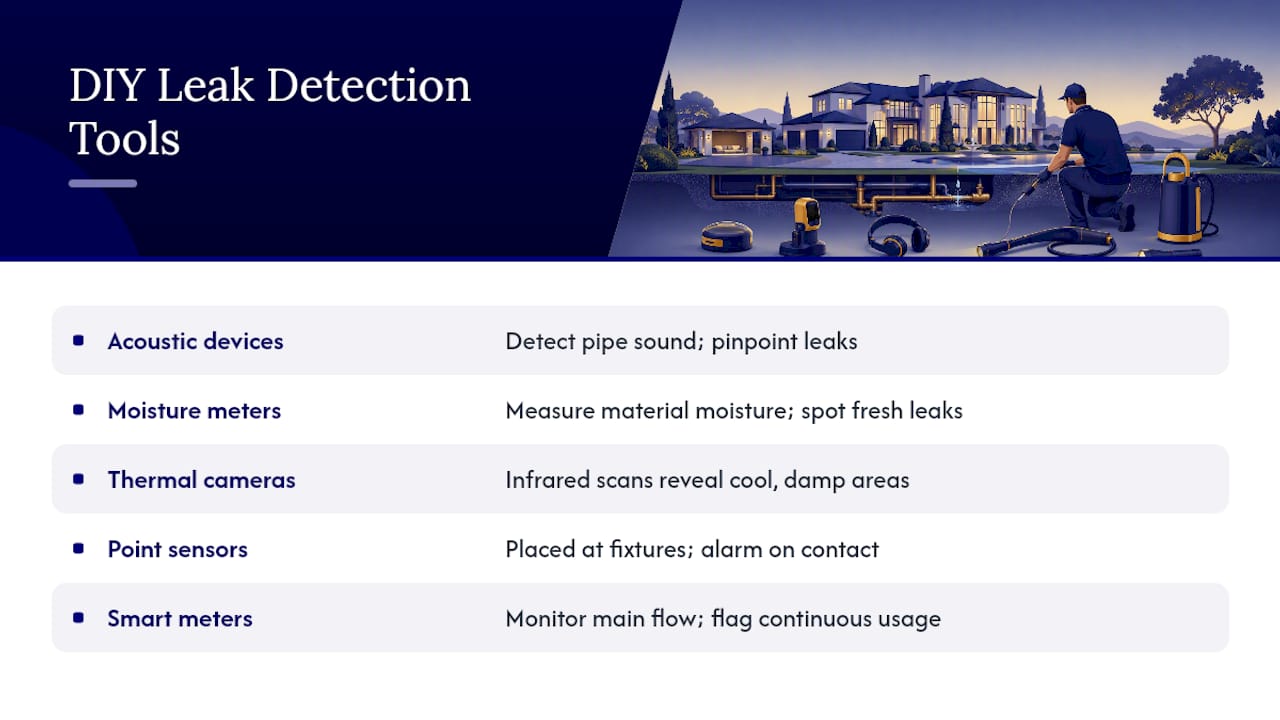
Thermal imaging cameras spot temperature differences that often indicate water intrusion, since wet materials read cooler than dry surrounding surfaces on an infrared scan. Standalone point sensors, placed near water heaters, under sinks, or behind washing machines, trigger a local alarm when they contact moisture. Smart water meters track flow patterns at the main line and can flag unusual continuous usage that suggests a hidden leak, even one you'd never spot by walking through the house.
None of these tools replace a trained eye doing a physical weekly walkthrough. A sensor tells you water is present. It does not tell you whether the source is a failing supply line, a slab leak, or condensation from an HVAC unit, and it certainly doesn't call a licensed plumber at 2 a.m. That gap between detection and action is exactly what a managed estate program is built to close, and it's worth understanding these tools mainly so you can ask better questions of whoever runs your detection program.
How to Interpret Water Detection Results and Decide Next Steps
A moisture reading or a sensor alert is a starting point, not a diagnosis. The first question is scope: is this an isolated wet spot from a one-time spill, or a persistent reading that returns after drying, which usually points to an active supply-line or fixture failure. A single elevated moisture-meter reading near a window during a rainstorm means something different than the same reading recurring daily near a water heater.
The second question is source. A rising water bill combined with a smart meter flagging continuous flow overnight, when no fixtures are running, almost always means a hidden leak somewhere in the supply system. A localized damp patch on a ceiling below a bathroom usually traces to a failed wax ring or supply connection above it, not a roof issue.
Once you know scope and likely source, the decision tree is straightforward. Isolated, dry-within-24-hours moisture from a known, one-time cause typically needs monitoring rather than a full mitigation call. Anything recurring, anything tied to an unexplained utility spike, or any reading near electrical systems or structural framing warrants an immediate inspection by a licensed plumber or your estate manager. When in doubt, the cost of an unnecessary inspection is trivial next to the cost of a slab leak that ran for three more weeks.
The three-layer detection model of shutoff valve, point sensors, and integrated notification exists specifically so this interpretation step doesn't fall entirely on you. It routes the data to someone trained to make that call.
Preventive Maintenance Tips to Reduce Water Leak Risk
Most leaks are preventable failures of ordinary maintenance, not freak accidents. Supply line hoses on washing machines and dishwashers have a service life, generally five to eight years, and replacing them proactively costs far less than the water damage they eventually cause when they burst. Water heater tanks should get a visual inspection for rust and pooling at the base every few months, since tank failure rarely happens without warning signs.
Irrigation systems deserve particular attention on large estate lots, where a cracked valve box or a broken drip line can run for weeks unnoticed before it surfaces as a soggy patch of lawn or, worse, water tracking toward the foundation. Review the irrigation system maintenance guide for a seasonal schedule.
Seasonal transitions are the highest-risk windows. Freeze events crack pipes that then fail on thaw, and summer humidity swings stress seals and gaskets that were fine all winter. A structured seasonal maintenance checklist and a dedicated spring maintenance checklist both build in the inspection points that catch these failures before they become emergencies. Broader guidance on property maintenance issues covers additional systems worth watching year-round.
Why an Estate-Management Plan Beats Piecemeal Detection
If you've been comparing standalone monitoring apps against hiring a plumber on an as-needed basis, both leave the same gap: nobody with authority is watching your home when you're not there. 30apropertycollective closes that gap by folding leak detection into a weekly, in-person estate-management routine rather than treating it as a separate gadget purchase.

Members get weekly physical inspections that check supply lines and mechanical spaces before a sensor would ever trigger, delegated emergency authority so a vetted vendor gets dispatched immediately instead of waiting on a phone call, and a documented report after every visit with photos and timestamps that stand up if you ever need to file a claim. The onboarding process is straightforward: a consultation to scope your property's specific risk areas, a walkthrough to set inspection points and vendor authorizations in writing, and delivery of a sample report so you know exactly what you're getting before the first bill.
If you're ready to put a real system behind your property, start the enrollment process or explore concierge service options for one-time coordination needs.
A Final Word on Getting This Right
The mistake I see most often isn't a missing sensor. It's an owner who bought monitoring technology and assumed the technology itself was the plan. It never is. The plan is whoever answers the alert, and how fast they're allowed to act without waiting for your sign-off from a different time zone.
If you're building or reviewing a leak-detection program, read our seasonal maintenance checklist alongside this piece, then request a consultation to see where your current setup has gaps.
Frequently Asked Questions
What does professional water leak detection for a home actually include?
It includes weekly physical inspections of high-risk areas, remote monitoring access for your estate manager, whole-home shutoff authority granted in writing, vendor coordination with pre-vetted contractors, and documentation standards that produce insurer-ready reports after every visit.
How fast should an emergency leak response team arrive?
Professional teams typically target dispatch within 60 to 120 minutes of a call, a window that matters more in homes with custom millwork, stone flooring, or plaster finishes where extended water exposure causes disproportionate damage.
How long does drying and mitigation take after a leak?
Initial extraction and stabilization generally takes 3 to 7 days, with saturated structural materials or dense finishes sometimes extending full drying to 7 to 10 days.
What documentation should I require after a leak-detection event?
Ask for moisture mapping readings, timestamped photos before and after mitigation, a written log of every mitigation step, and a final report formatted for submission to your insurer.
Do I still need a monthly walkthrough if I have smart sensors installed?
Yes. Sensors flag that water is present; they don't diagnose the source or dispatch help. A weekly in-person inspection catches slow failures, like a corroding supply line, before they ever trigger an alert.
Sources
For technical mold and moisture control standards, the EPA's mold cleanup guidance covers remediation timelines referenced throughout this article. For a closer look at alert-response questions luxury buyers should raise, see what condo buyers ask about leak alerts.
If a leak does occur, Pure Resto's 24/7 restoration service handles extraction, structural drying, and insurer-ready documentation as a practical next step after detection.