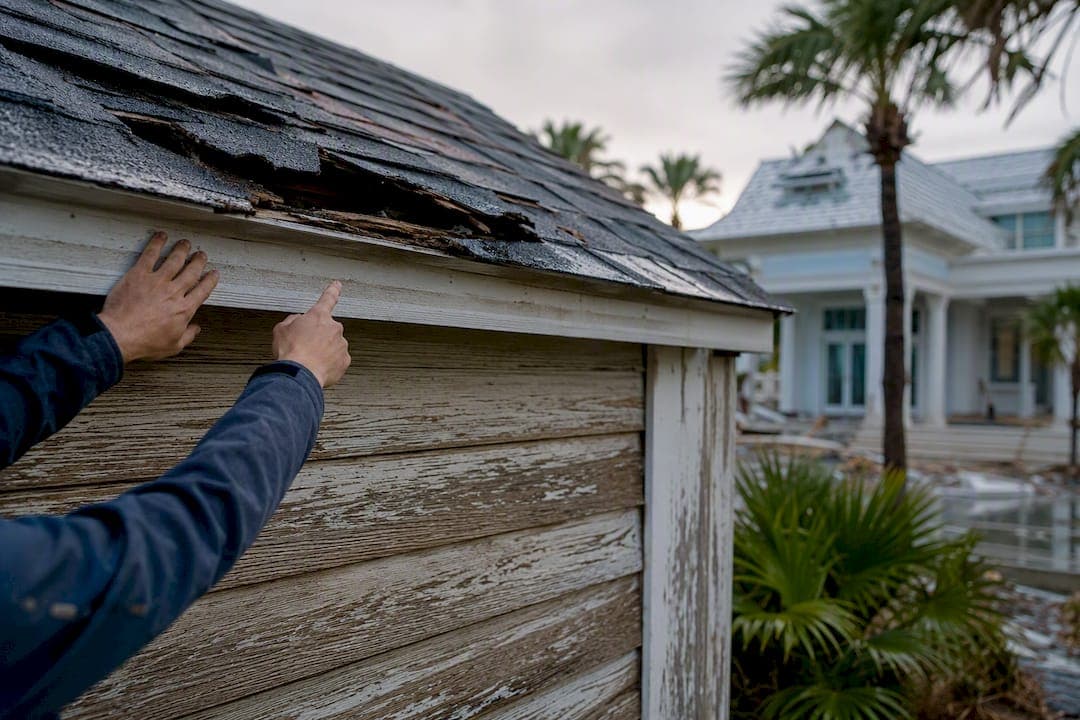
A hurricane deductible is a separate, higher deductible your homeowners policy applies specifically to hurricane or named-storm damage, replacing your standard deductible for those claims. It's usually a percentage of your dwelling coverage limit rather than a flat dollar figure, though some states allow flat amounts too. Before anything else, pull out your declarations page and find the number. Then set that cash aside before hurricane season starts.
- Definition: A carved-out deductible that applies only when a storm meets your policy's hurricane or named-storm trigger.
- Most common form: A percentage of your dwelling limit (Coverage A), typically 1% to 5%.
- First move: Locate the exact figure on your declarations page and confirm what triggers it.
Key Takeaways
A hurricane deductible is a percentage-based, storm-specific deductible that homeowners must calculate against their actual dwelling limit and fund ahead of hurricane season, not during it.
| Point | Details |
|---|---|
| Check your declarations page now | Find your exact hurricane deductible percentage or dollar figure before a storm is forecast. |
| Calculate your real exposure | Multiply your dwelling limit by the deductible percentage to know your out-of-pocket dollar amount. |
| Fund a dedicated deductible savings account | Set aside the calculated dollar figure separately from your general emergency fund. |
| Document mitigation upgrades | Keep inspection reports and contractor invoices to support premium credits and claims. |
| File claims even under the deductible | Additional damage often surfaces later and creates a record for compounding storm events. |
Table of Contents
- Hurricane Deductible Explained: How It Works and Why It Exists
- When Does a Hurricane Deductible Actually Kick In?
- Calculating Hurricane Deductibles: Real Dollar Examples
- Should You File a Claim Below Your Deductible?
- Financial Preparedness and Mitigation for High-Value Coastal Homes
- Does a Higher Hurricane Deductible Actually Lower Your Premium?
- Documenting Damage Right After a Hurricane
- Building Codes, Premiums, and Your Deductible Options
- Primary Homes vs. Second Homes: Does the Deductible Differ?
- Hurricane Deductibles vs. Wind, Hail, and Standard Deductibles
- Hurricane Deductible Myths That Cost Homeowners Money
- An Honest Read on Hurricane Deductibles
- Protecting Your Estate Before the Next Storm Season
- Frequently Asked Questions
- Sources
Hurricane Deductible Explained: How It Works and Why It Exists
Insurers didn't invent hurricane deductibles to make claims more painful. They built them to keep coverage available at all in storm-exposed states. When a single hurricane can generate billions in claims overnight, spreading some of that cost onto policyholders through a higher deductible is one of the tools carriers use to keep writing policies in coastal markets. The NAIC explains that these deductibles function as a risk-sharing mechanism, and as of 2026, nineteen states plus the District of Columbia have adopted some form of hurricane or named-storm deductible.
A standard deductible applies to everyday claims: a burst pipe, a tree branch through a window, a kitchen fire. A hurricane deductible only kicks in when your policy's storm trigger is met, and it usually replaces the standard deductible for that event rather than stacking on top of it.
- Percentage deductibles commonly run from a small to moderate proportion of your dwelling limit, though in some coastal areas they may be higher.
- Florida requires insurers to offer a menu of deductible options, including both flat-dollar and percentage choices, providing homeowners with a selection at renewal.
- Some states cap how high these deductibles can go, Rhode Island among them, which limits its cap at 5%.
A 5% deductible on a $300,000 home means $15,000 out of pocket before your insurer pays a dime, according to an Investopedia breakdown of how these deductibles calculate in practice. That number rarely gets the attention it deserves until a claim is on the table. Read the wording on your declarations page closely. Some carriers list the deductible as a flat percentage, others tie it to a specific peril label like "named storm" or "hurricane only," and the distinction changes when the deductible actually applies.
When Does a Hurricane Deductible Actually Kick In?
The word "trigger" matters more than most homeowners realize. A hurricane deductible only applies once specific conditions are met, and those conditions vary by insurer and by state. Most policies tie the trigger to official weather service action: a hurricane watch or warning issued by the National Weather Service or National Hurricane Center, or the moment a storm system gets an official name.
Timing windows add another layer. Many policies define the deductible as active starting 24 hours before a watch or warning is issued and remaining in effect for up to 72 hours after the storm downgrades or the advisory is lifted, based on guidance from the Insurance Information Institute. Damage that happens outside that window might fall under your standard deductible instead, which can work in your favor.
- Hurricane watch/warning: Common trigger point tied to NWS/NHC advisories.
- Named storm declaration: Some policies apply the deductible once a system is named, regardless of category.
- State-by-state variation: Florida, Rhode Island, and Maryland each define triggers and caps differently.
Never assume your trigger matches your neighbor's policy, even if you live on the same street. Call your carrier or check with your state insurance department if the wording on your declarations page feels ambiguous.
Calculating Hurricane Deductibles: Real Dollar Examples
Converting a percentage deductible into an actual dollar figure takes one calculation: multiply your dwelling coverage limit (Coverage A on your policy, not your home's market value) by the deductible percentage. That's it. But seeing it laid out for real dwelling values makes the exposure click.
- Find your Coverage A dwelling limit on the declarations page.
- Multiply that figure by your hurricane deductible percentage.
- The result is your out-of-pocket cost before insurance coverage starts paying.
The actual dollar amount of your hurricane deductible is calculated by applying the deductible percentage to your dwelling coverage limit, resulting in potentially significant out-of-pocket expenses depending on the size of your policy.
Most hurricane deductibles apply per storm event, not per season or per year, though this varies by state and insurer, so back-to-back storms in one season could each trigger the deductible separately. One detail that trips up a lot of homeowners: your homeowners policy generally excludes flood and storm-surge damage entirely, regardless of your hurricane deductible. That coverage lives in a separate flood policy, and it matters even more for waterfront and barrier-island properties along the Emerald Coast.
Should You File a Claim Below Your Deductible?
Damage that looks minor right after a storm doesn't always stay minor. Water intrusion behind drywall, compromised roof flashing, and hairline cracks in stucco often reveal themselves weeks later as mold or structural issues. The Insurance Information Institute recommends filing anyway, even when your contractor's initial estimate sits below your deductible, because a documented claim creates a paper trail if the damage worsens or if a second storm compounds the first.
- Photograph everything immediately with timestamps, inside and out, before any cleanup begins.
- Get a written contractor estimate rather than a verbal walkthrough.
- Save the weather advisory that applied to your area, since it may determine which deductible triggers.
- Call your agent to log the event, even if you decide not to pursue payment yet.
- Track every communication with dates, names, and reference numbers.
Multiple storms in one season can each apply your deductible separately, so a string of near-miss systems can add up fast in a single year.
Pro Tip: Keep a dedicated folder, digital or physical, for every storm season. Label it by storm name and date. If a second storm hits before repairs from the first are finished, you'll need to prove which damage came from which event.
Financial Preparedness and Mitigation for High-Value Coastal Homes
Budgeting for a hurricane deductible works best as two separate funds: one sized to cover your actual deductible dollar amount, and a second contingency fund for the incidentals that always show up after a storm, generator fuel, temporary lodging, spoiled food. Knowing your exact number, from the calculation above, turns an abstract worry into a concrete savings target.
Mitigation upgrades often reduce your premium and, in some states, unlock better deductible options. A wind mitigation inspection documenting hurricane shutters, reinforced roof attachments, and impact-rated windows is frequently a prerequisite for premium credits, and insurers generally require licensed documentation before granting them.
- Schedule a wind mitigation inspection well before hurricane season, not during a watch.
- Keep contractor invoices and inspection reports in one file for your insurer.
- Consider weekly property inspections between storms to catch small vulnerabilities early.
For estates along 30A, weekly inspections and pre/post-storm assessments, the kind of proactive oversight 30apropertycollective provides, catch loose shutters, clogged drains, and roof issues before they become five-figure claims. Coordinated vendor scheduling also means repairs start faster after landfall, which limits secondary water and mold damage that often exceeds the original wind loss.
Does a Higher Hurricane Deductible Actually Lower Your Premium?
Generally, yes. Choosing a higher percentage deductible, moving from 2% to 5%, for instance, typically reduces your annual premium because you're absorbing more of the early-loss risk yourself. Insurers price that tradeoff directly: the more you agree to pay before coverage responds, the less risk sits on their books, and the lower your premium tends to run.
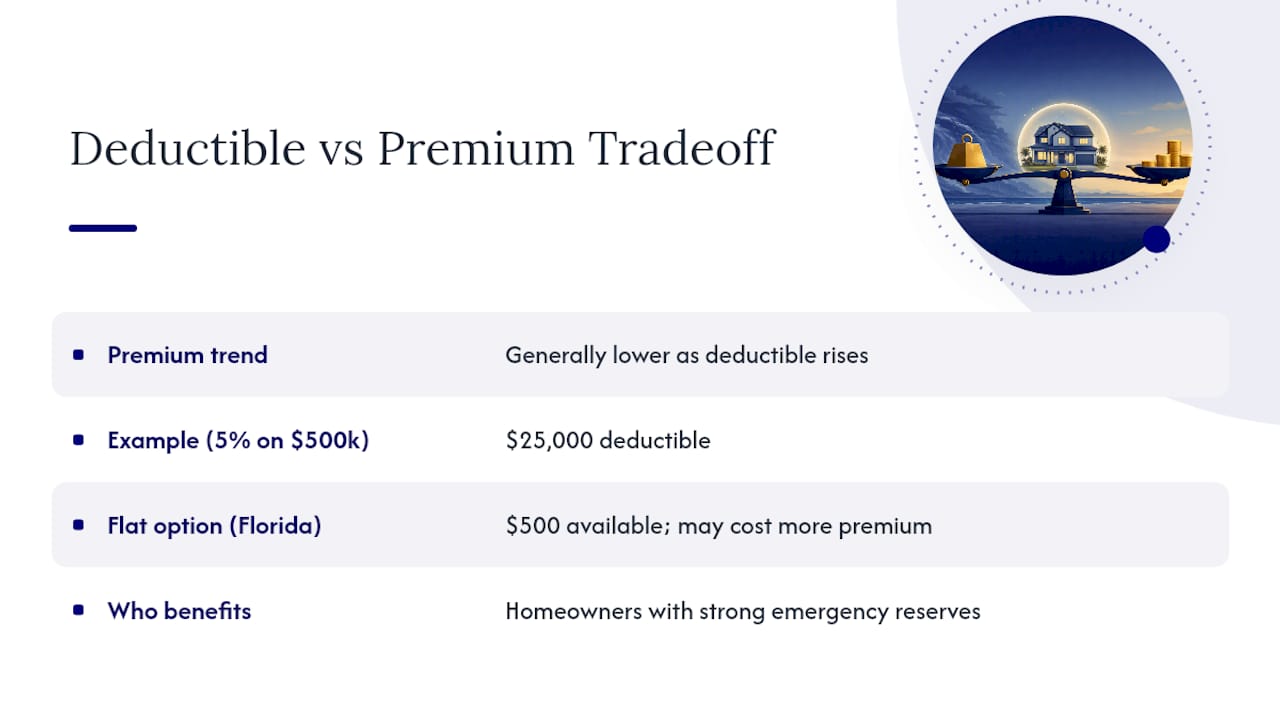
The math only makes sense if you can actually cover the deductible when a storm hits. A lower premium paired with a 5% deductible on a $500,000 home means finding $25,000 in cash on short notice. If that number would force you into debt or delay repairs, the premium savings aren't worth it. Homeowners with strong emergency reserves, or with mitigation credits already stacking discounts on top of a higher deductible, tend to come out ahead over a multi-year horizon.
It's also worth checking whether your state allows flat-dollar deductible options instead of percentages. Florida does, offering $500 alongside its percentage tiers, which can make budgeting more predictable even if the flat option costs more in premium. Run both scenarios against your actual savings, not just the sticker price of the premium quote, before deciding which deductible tier fits your household.
Documenting Damage Right After a Hurricane
The claims process rewards homeowners who move fast and document thoroughly. Before any cleanup or temporary repairs, walk the property with your phone and photograph every angle of visible damage, roof, siding, fencing, landscaping, and interior water intrusion. Video walkthroughs work even better than still photos because they capture context a single frame misses.
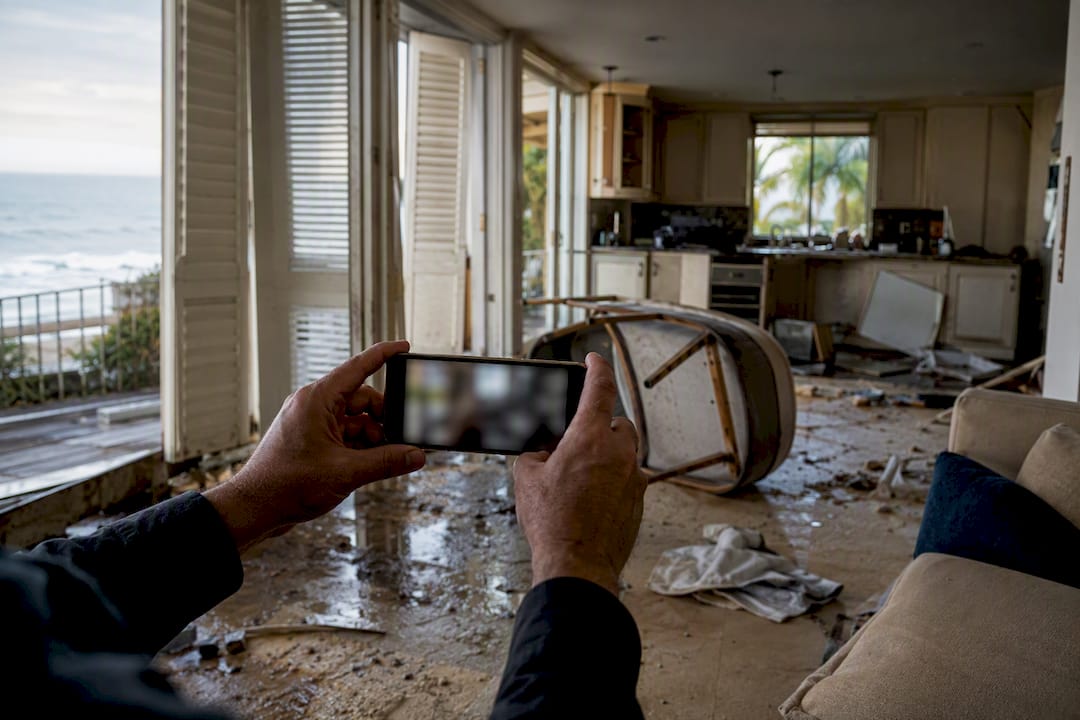
Keep receipts for any emergency repairs made to prevent further damage, tarping a roof or boarding a window, since most policies reimburse reasonable mitigation costs. Write down the date and time damage was discovered, and note which weather advisory was active during the storm, since that detail can determine which deductible applies to your claim.
Contact your insurance agent within days, not weeks. Ask for a claim number immediately, even if you're still assessing the full scope. A property that's been through consistent weekly inspections already has a documented "before" condition on file, which makes proving storm-caused change to an adjuster far simpler than reconstructing it from memory after the fact.
Building Codes, Premiums, and Your Deductible Options
Florida and other hurricane-prone states have tightened building codes significantly since major storms exposed weaknesses in older construction, particularly around roof-to-wall connections and window impact resistance. Homes built or retrofitted to current code standards often qualify for better rates and, in some cases, access to lower deductible tiers that insurers reserve for lower-risk structures.
This creates a real incentive for older coastal homes to catch up. A property built decades before current codes existed carries more risk in an insurer's model, which shows up as fewer deductible choices and higher premiums regardless of which deductible you select. Retrofitting to current standards, impact windows, reinforced garage doors, updated roof strapping, can shift a home into a more favorable pricing tier over time.
Check with your insurer directly about whether code-compliant upgrades on your specific property have been reflected in your policy. Some carriers require a fresh inspection to recognize the improvement, and without it, you could be paying premiums calculated against your home's older, riskier profile.
Primary Homes vs. Second Homes: Does the Deductible Differ?
Your hurricane deductible percentage itself usually doesn't change based on occupancy, but everything around it often does. Secondary and vacation homes frequently carry higher premiums overall because insurers assume less frequent oversight, a bigger risk when storm damage, a slow roof leak, or a failed sump pump can go unnoticed for weeks between visits.
That gap in oversight is exactly where seasonal and second-home owners along the Emerald Coast run into trouble. A primary residence owner notices a damaged shutter the next morning. A second-home owner three states away might not find out until their next visit, by which point water damage has spread and mold has taken hold, turning a deductible-level claim into a far larger loss.
Some insurers also apply different underwriting standards to seasonal properties, and coverage for personal property or additional living expenses may look different from a primary-residence policy. If you own a second home, confirm directly with your carrier whether your hurricane deductible calculation and trigger definitions match those on your primary policy. Assuming both work identically because they're both "homeowners" policies is a common and costly mistake.
Hurricane Deductibles vs. Wind, Hail, and Standard Deductibles
Hurricane deductibles are just one type in a family of storm-related deductibles, and confusing them causes real claims headaches. A named-storm deductible applies specifically to storms officially named by the NHC or NWS, which is distinct from a wind/hail deductible that can apply to any severe wind event, including tornadoes and unnamed thunderstorms, regardless of hurricane status.
Here's where it gets tricky: some policies carry both a named-storm deductible and a separate wind/hail deductible, and only one applies per event depending on how the damage occurred and whether the storm was officially named at the time. If your area gets hit by a strong but unnamed windstorm, your standard deductible or a separate wind/hail deductible might apply instead of the higher hurricane figure, potentially saving you money.
The reverse is also true. A tropical system that never technically becomes a hurricane but does get named can still trigger your named-storm deductible if your policy is written that way. Read the peril labels on your declarations page carefully; "hurricane," "named storm," and "wind/hail" are not interchangeable terms, and each triggers under different conditions.
Hurricane Deductible Myths That Cost Homeowners Money
The biggest misconception: many homeowners assume their hurricane deductible works like a health insurance deductible, a one-time annual threshold that, once met, stops applying. In most policies, it applies per storm event, not per year, so a second hurricane in the same season can trigger the full deductible again.
Another common mix-up is assuming flood damage falls under the hurricane deductible. It doesn't. Storm surge and flooding are excluded from standard homeowners policies entirely and require a separate flood insurance policy, regardless of how the flooding happened.
Some homeowners also assume every state handles hurricane deductibles the same way. They don't. Florida's statutory menu of options, Rhode Island's 5% cap, and other states' varying trigger definitions mean a policy that made sense for a friend in another state might work completely differently for you. And a surprising number of people never check their declarations page at all, discovering their actual deductible percentage for the first time while filing a claim, which is exactly the wrong moment to learn you owe $15,000 out of pocket.
An Honest Read on Hurricane Deductibles
Most advice on this topic treats the deductible as a fixed cost to accept and move past. That undersells how much control homeowners actually have. The percentage on your policy is negotiable at renewal, mitigation credits are real and often underused, and the gap between a documented, well-maintained property and a neglected one shows up directly in claim outcomes, not just premiums.
Where conventional advice falls short is timing. Most homeowners think about their deductible during a watch or warning, when it's too late to change anything. The number that matters gets decided months earlier, at renewal, and in the inspection reports that back up a mitigation discount.
If you own a coastal or high-value property, prioritize two things before anything else: know your exact dollar figure, and keep documentation current enough that an adjuster has no room to argue about your home's condition before the storm. Everything else, funding strategy, claims filing, code upgrades, follows naturally once those two pieces are solid.
Protecting Your Estate Before the Next Storm Season
Knowing your hurricane deductible number is only useful if your property can actually withstand a storm long enough to minimize what that deductible covers. 30apropertycollective's concierge and estate management services build that protection into a year-round rhythm rather than a scramble each June: weekly inspections that catch loose flashing or aging caulk before they become breach points, coordinated storm preparation and pre/post-storm assessments, and vendor oversight that gets repairs moving the moment it's safe to return. For homeowners managing a second home or a property they can't check on personally every week, that ongoing presence often makes the difference between a claim that stays near the deductible and one that spirals well past it.
Frequently Asked Questions
What is a hurricane deductible in simple terms? A hurricane deductible is a separate, usually higher deductible that applies to hurricane or named-storm damage instead of your standard homeowners deductible. It's typically a percentage of your dwelling coverage limit rather than a flat dollar amount.
Does every homeowners insurance policy have a hurricane deductible? No. Hurricane or named-storm deductibles apply mainly in states with meaningful hurricane exposure, currently nineteen states and D.C. Homeowners elsewhere typically use their standard deductible for storm damage.
How is a hurricane deductible different from a regular deductible? A regular deductible applies to everyday claims like fire or plumbing failures. A hurricane deductible only applies once a specific trigger is met, usually a hurricane watch, warning, or named-storm declaration, and it's often calculated as a percentage rather than a flat number.
How do I calculate my hurricane deductible in dollars? Multiply your dwelling coverage limit (Coverage A) by your deductible percentage.
Can I have both a hurricane deductible and a wind/hail deductible? Yes, some policies carry both, and which one applies depends on whether the storm causing the damage was officially named at the time. Reading your declarations page's peril definitions clarifies which applies to your specific situation.
Does a hurricane deductible reset every year? It generally applies per storm event rather than annually, so multiple hurricanes in one season can each trigger the deductible separately. Confirm the exact wording with your insurer, since some state rules limit application per calendar year.
Will a higher hurricane deductible lower my insurance premium? Usually, yes. Choosing a higher percentage deductible, such as moving from 2% to 5%, typically reduces your annual premium since you're covering more of the early-loss cost yourself.
Does my hurricane deductible cover flood damage? No. Flood and storm-surge damage are excluded from standard homeowners policies and require separate flood insurance, regardless of your hurricane deductible.
Sources
- Insurance Topics | Hurricane Deductibles | NAIC
- Hurricane insurance deductible fact sheet | Investopedia