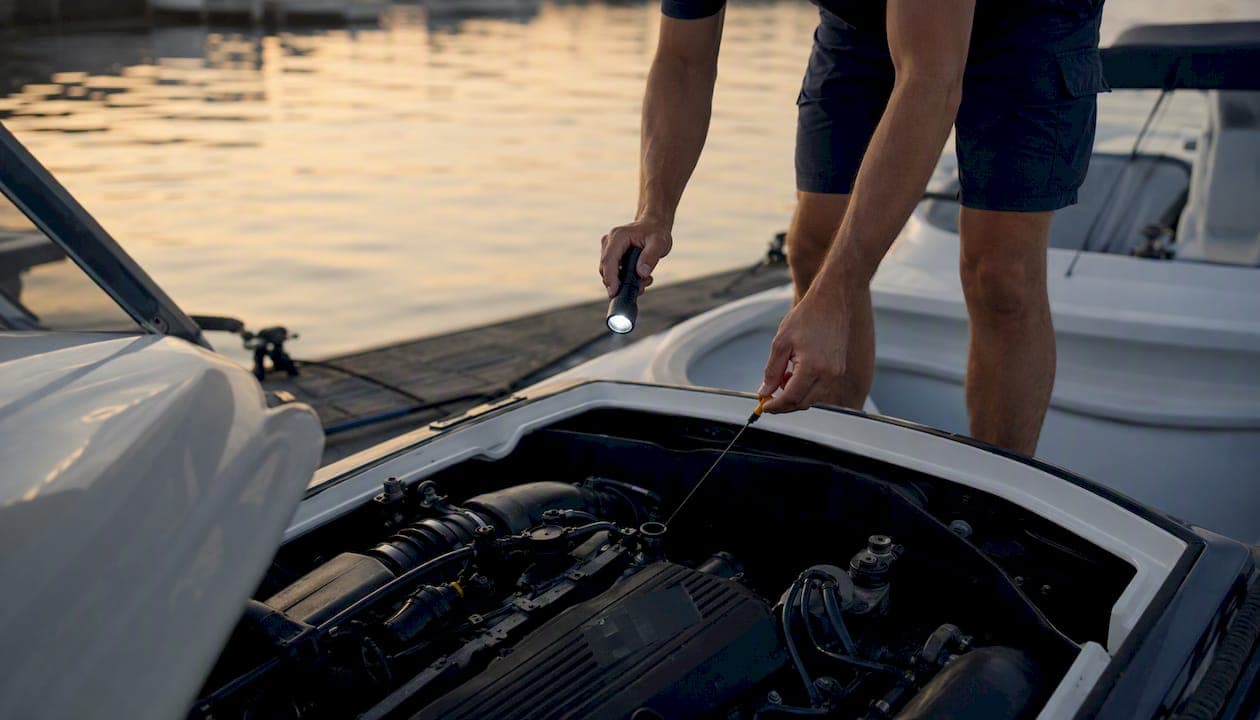
A solid boat maintenance schedule runs like this: check before every outing, rinse and inspect weekly, run through a systems checklist monthly, service the engine quarterly or by hours, do a full annual inspection, and winterize when the season ends. That rhythm, applied consistently, keeps most boats out of the repair yard.
Here is the quick-reference version to post in your cabin or save to your phone:
- Before every outing: fuel level, bilge, battery voltage, engine sniff test, PFDs, navigation lights
- Weekly: freshwater rinse, dock lines, bilge pump test, visible hardware check
- Monthly: full wash, battery bank voltage, zinc anodes (saltwater), bilge pump cycle test, fire extinguisher pin check
- Quarterly: engine oil and filter (or per engine-hour interval), gear oil, fuel-water separator, impeller inspection, steering play check
- Annually: full haul-out inspection, bottom paint, safety gear certification, trailer bearings, electrical system review, and owner's manual, service intervals
- Winterize: fuel stabilizer, fogging oil, drain freshwater systems, battery storage, cover and ventilate
One rule cuts through the confusion on timing: engine-hour intervals beat calendar intervals for propulsion systems. Oil changes, impeller swaps, and gear oil checks are driven by hours on the engine, not months on the wall. Everything else (hull, antifouling, safety gear, battery replacement) runs on calendar time. DiscoverBoating's beginner maintenance tips put battery, oil, and safety checks at the top of every new owner's list for exactly this reason.
Key Takeaways
A consistent boat maintenance schedule built around pre-departure checks, monthly in-season tasks, engine-hour-based servicing, and annual haul-outs prevents most on-water failures and protects long-term resale value.
| Point | Details |
|---|---|
| Pre-departure checks are non-negotiable | Run fuel, bilge, sniff test, PFDs, and lights before every single outing. |
| Engine hours drive propulsion service | Change oil, impellers, and gear oil by hours first, annual calendar second. |
| Winterize before freezing, not after | Stabilize fuel, fog cylinders, drain water systems, and store the battery before temperatures drop. |
| Log every task with date and hours | A complete service log adds resale value and makes the next service interval easy to find. |
| Book haul-outs in fall or winter | Off-season scheduling reduces cost and avoids spring yard congestion. |
Table of Contents
- What should you check before every single outing?
- At-a-glance maintenance intervals and the engine-hours rule
- Month-by-month seasonal maintenance calendar for US boat owners
- System-by-system maintenance checklists
- How to winterize your boat and verify it before the next season
- When should you call a marine technician?
- What tools, supplies, and records does every boat owner need?
- How to personalize your schedule to your boat, region, and usage
- The part of boat maintenance advice most guides get wrong
- Sources
What should you check before every single outing?
No matter how short the trip, a pre-departure check takes under two minutes and catches the problems that strand boats a mile from the dock. Run these in order:
- Fuel level: top off before leaving, not after you realize you are low mid-channel
- Bilge water: open the bilge hatch and look; standing water before you even start the engine is a red flag
- Engine compartment sniff test: open the engine box and pause. Smell fuel? Stop. Smell burning plastic or rubber? Stop. Neither smell should be present before startup
- Blower run: if you have a gasoline inboard or stern drive, run the bilge blower for at least four minutes before starting the engine
- Battery voltage: a quick glance at the battery monitor or a multimeter check; anything below 12.4V on a 12V system deserves attention before you leave
- Navigation lights: flip them on, walk around the boat, confirm all are working
- PFDs: one per person onboard, accessible, not buried under gear
- Throwable device: required by the U.S. Coast Guard for most vessels over 16 feet; confirm it is within reach
- VHF radio: power on, confirm channel 16 is active
Pro Tip: Build a "BEST" habit before every departure: Bilge, Engine compartment, Safety gear, Throttle/controls. Run those four in 60–90 seconds and you have covered the most common causes of on-water emergencies.
The sniff test deserves its own emphasis. Professional captains and yard technicians use it routinely because it catches fuel leaks and electrical shorts long before any gauge shows a problem. Make it automatic.
At-a-glance maintenance intervals and the engine-hours rule
The table below maps each interval to its core tasks and a realistic time commitment. Use it as your scheduling backbone.
| Interval | Core Tasks | Time Needed |
|---|---|---|
| Before every outing | Fuel, bilge, sniff test, PFDs, lights, battery check | 2–5 minutes |
| Weekly (in-season) | Freshwater rinse, dock lines, bilge pump test, hardware scan | 30 minutes |
| Monthly (in-season) | Full wash, battery voltage, zinc check (saltwater), bilge cycle test | 90 minutes |
| Quarterly / by hours | Engine oil and filter, gear oil, fuel-water separator, impeller check, steering | 2–4 hours |
| Annually | Haul-out, bottom paint, safety gear, trailer, full electrical review | Full day or more |
| Winterization | Stabilizer, fogging, drain systems, battery storage, cover | 3–6 hours |
The engine-hours rule explained. Most outboard and inboard manufacturers set oil change intervals at 100 hours or annually, whichever comes first. If you run 200 hours a season, you are changing oil twice a season. If you run 20 hours, the annual calendar interval triggers first. Track hours on your engine hour meter and log them every time you refuel. The same logic applies to impeller replacement: many manufacturers recommend every 200–300 hours or every two seasons, but a boat running in warm, sandy water may need it sooner.
Battery and fuel filter cadence vary more than most owners expect. A battery in a hot Florida climate may last three seasons; the same battery in a cooler northern marina often reaches five. Fuel filters on a boat used infrequently with ethanol-blend fuel can clog faster than the calendar suggests, especially after winter storage. Check them at commissioning every spring regardless of the calendar interval.
Month-by-month seasonal maintenance calendar for US boat owners
This calendar assumes a typical northern or mid-Atlantic season. Adjust the months if you boat year-round in Florida, the Gulf Coast, or Southern California.
Spring commissioning (March–May)
- January–February (pre-season planning): order parts now. PassageMaker's month-by-month calendar specifically recommends booking haul-outs and ordering parts during the quiet winter months to avoid the spring rush and parts shortages. Call your yard in January, not April.
- March: pull the cover, inspect for winter damage, check for rodent activity, inspect the hull for cracks or blistering, reconnect the battery and load-test it
- April: engine service (oil, filter, impeller, zincs, belts, hoses), flush and test the cooling system, power up electronics and run software updates, inspect through-hulls and seacocks, check all safety gear expiration dates
- May: full wash and wax, bottom paint touch-up or full repaint if due, test all navigation lights and VHF, confirm registration and documentation are current, first water test before any real trip
Peak season (June–August)
- Monthly full wash and hull wipe-down
- Monthly battery voltage check and bilge pump cycle test
- Monthly dock line and fender inspection
- Monthly zinc anode check for saltwater boats (replace when significantly consumed)
- Mid-season cooling system check: raw water strainer, thermostat function, impeller condition if hours warrant
- Prop inspection after any grounding or debris strike
Catalyst Marine Services' seasonal schedule organizes peak-season tasks as monthly recurring items, which is the right approach. Skipping a month is how small problems compound into expensive ones.
Fall prep and haul-out (September–November)
- September: deep clean interior and bilge, inspect all hoses and clamps, check steering cables and hydraulic fluid
- October: schedule haul-out, drain raw water cooling system, flush with fresh water, inspect hull below waterline, replace zincs if needed, pull drain plugs
- November: antifreeze through raw water systems where required, fog the engine, change oil before storage (not after, since used oil is acidic), remove or store battery on a maintainer, install cover with ventilation
Winter storage (December–February)
- Check the cover and ventilation monthly; a collapsed cover traps moisture and invites mold
- Top up the battery every 4–6 weeks if stored aboard, or keep it on a smart float charger
- Inspect for pest activity after any warm spell
- Use January and February to plan the coming season: book the yard, order parts, review the owner's manual for any overdue service
Regional note: saltwater boats need more frequent zinc and antifouling attention than freshwater boats. If you keep your boat in Florida or along the Gulf Coast year-round, you may skip traditional winterization but still need a defined off-season service window. Warm-climate owners should treat their "slow season" the same way northern owners treat winter: use it for the deep work.
System-by-system maintenance checklists
Engine and drive
- Oil and filter: every 100 hours or annually (check your owner's manual for your specific engine)
- Gear oil: every 100 hours or annually; inspect for milky color, which signals water intrusion
- Impeller: every 200–300 hours or every two seasons; replace proactively rather than reactively. Impeller failures are a leading cause of overheating, and they often follow months of running in silty or warm water
- Thermostat and cooling: inspect annually; a stuck thermostat causes overheating that can warp heads
- Belts and hoses: inspect for cracking or softness at every service; replace at the first sign of wear
- Exhaust: check for carbon buildup and secure mounting annually
Fuel system
- Fuel-water separator: drain and inspect monthly in-season; replace the filter element annually or when contamination appears
- Fuel stabilizer: add at the correct ratio when laying up for more than 30 days; ethanol-blend fuels absorb moisture and degrade faster than pure gasoline
- Signs of contamination: dark fuel, visible water in the separator bowl, rough idle, or hard starting after storage all point to a fuel system problem
Electrical systems and batteries
- Terminal cleaning: every spring and fall; use a wire brush and apply corrosion inhibitor
- Load test: annually, or any time the battery struggles to start the engine
- Replacement cadence: marine batteries typically last three to five seasons depending on climate and charging habits; a battery that fails a load test should be replaced before the season starts, not mid-trip
- Charging system: check alternator output annually; a failing alternator drains batteries faster than most owners realize
Pro Tip: Keep a multimeter onboard. A two-minute voltage check at the battery terminals tells you more about your electrical system's health than any dashboard gauge.
Hull, bottom, and props
- Zinc anodes: inspect monthly in saltwater; replace when significantly consumed. Neglected zincs allow electrolytic corrosion to eat through props, shafts, and fittings
- Prop inspection: after every grounding or debris strike, and annually at haul-out; look for dings, bent blades, and fishing line wrapped around the shaft
- Antifouling paint: repaint annually in warm, fouling-heavy waters; every two seasons may work in colder or freshwater environments. Note that some antifouling products contain copper compounds regulated under state environmental rules. Check your state's current guidelines before purchasing, particularly in California and Washington where certain formulations face restrictions
Steering, controls, and fittings
- Steering cables or hydraulic ram: inspect for corrosion, stiffness, or play annually; lubricate per manufacturer spec
- Throttle and shift cables: check for smooth operation and secure end fittings each season
- Through-hulls and seacocks: exercise (open and close) every spring; a seacock that has not moved in years can seize open or closed at the worst moment
Safety equipment
The U.S. Coast Guard sets minimum carriage requirements for recreational vessels. Check these annually:
- PFDs: inspect for tears, faded fabric, and functional buckles; replace any that show deterioration
- Fire extinguishers: check the gauge monthly; replace or recharge when the needle drops below the green zone. USCG-approved extinguishers have service date requirements
- Flares: check expiration dates; most pyrotechnic flares expire after 42 months
- EPIRB or PLB: test per manufacturer schedule; register with NOAA at beaconregistration.noaa.gov
Trailer
For owners who trailer frequently, wheel bearing service and brake checks should happen at least annually and after any long-distance haul. Bearing failure is one of the most common causes of trailer-in-transit emergencies. Also inspect:
- Lights and wiring: test before every launch
- Tie-down straps and winch strap: inspect for fraying; replace when worn
- Coupler and safety chains: confirm secure connection before every tow
- Bunks or rollers: check for wear that could damage the hull
How to winterize your boat and verify it before the next season
Winterization done right takes three to six hours and prevents the kind of freeze damage that costs thousands to repair. Work through these steps in order.
- Add fuel stabilizer to the tank at the manufacturer's recommended ratio; run the engine for 10 minutes to circulate it through the fuel system
- Change the engine oil and filter before storage, not after; used oil contains acids that corrode internal engine surfaces over a long layup
- Fog the engine cylinders with fogging oil through the carburetor or air intake while the engine is running, then shut it down
- Flush the raw water cooling system with fresh water, then run antifreeze through it where freezing temperatures are possible
- Drain the freshwater system completely: tanks, lines, water heater, and pump. Blow out lines with compressed air or run non-toxic propylene glycol antifreeze through the system
- Protect the toilet and macerator: flush with antifreeze; a cracked macerator housing is an expensive spring surprise
- Remove the battery or connect it to a smart float charger; store in a cool, dry location above freezing
- Clean and dry the interior thoroughly before covering; moisture trapped under a cover breeds mold
- Install a breathable cover with ventilation; a sealed cover without airflow creates condensation problems
- Check the cover and vent condition monthly through winter
Post-storage commissioning checklist (before first spring use):
- Load-test the battery and check all terminal connections
- Inspect all hoses and clamps for winter cracking
- Check the raw water strainer and impeller
- Run the engine at the dock and confirm water flow from the exhaust
- Test all navigation lights, VHF, and electronics
- Confirm all safety gear is current and aboard
- Check the bilge pump operation
- Inspect the hull for any winter damage before launching
When should you call a marine technician?
Some jobs belong to professionals. Knowing which ones saves you money and, in some cases, keeps you safe.
Warning signs that need a technician immediately:
- Engine overheating that persists after checking the impeller and raw water strainer
- Persistent fuel smell in the bilge or cabin after running the blower
- Electrical burning odor anywhere aboard
- Bilge pump running continuously or filling faster than normal
- Charging system failure that does not resolve with a new battery
Common professional jobs and approximate US cost ranges:
- Full outboard engine service (100-hour): $200–$500 depending on engine size and labor rate
- Haul-out and bottom paint (including yard fees): $500–$2,500+ depending on boat length and region; booking in late fall or early winter typically costs less than spring rush pricing
- Battery bank replacement (two batteries): $300–$700 installed
- Hull blister repair and osmosis treatment: highly variable; minor repairs start around $500, extensive osmosis work on a larger vessel can reach several thousand dollars
- Complex electrical diagnostics: $100–$175 per hour at most marine yards
These are ballpark figures. Labor rates vary significantly by region, and boat size affects almost every cost. Always get a written estimate before authorizing work.
Pro Tip: Schedule non-emergency professional work in fall or winter. Yards are less congested, labor is sometimes discounted, and parts are easier to source before the spring rush hits.

For owners whose boats are part of a larger estate, coordinating marine technician visits alongside property maintenance can simplify scheduling. Vendor and contractor oversight is a service that estate managers handle on behalf of owners who are not on-site year-round.
What tools, supplies, and records does every boat owner need?
Essential onboard toolkit and spares
- Spare impeller (sized for your raw water pump)
- Spare drive belts
- Assorted fuses and a fuse puller
- Hose clamps in multiple sizes
- Basic hand tools: screwdrivers, pliers, adjustable wrench, socket set
- Multimeter
- Duct tape and marine-grade electrical tape
- Spare fuel line and hose clamps
Consumables to keep at home or in the dock box
- Fuel stabilizer (Sta-Bil Marine or equivalent)
- Marine grease and waterproof grease for trailer bearings
- Corrosion inhibitor spray (CRC 6-56 or equivalent)
- Spare zinc anodes sized for your boat
- Non-toxic propylene glycol antifreeze for winterization
Building a maintenance log that actually works
A maintenance log does two things: it tells you what is due next, and it adds to resale value. A buyer who sees a complete service history pays more and negotiates less. The Yacht Maintenance Hub recommends organizing logs into separate sections for service intervals, completed maintenance, spare parts inventory, and budget tracking.
Every log entry should include:
- Date and engine hours at time of service
- Task performed
- Parts used and part numbers
- Cost
- Next due date or hours
Digital options include a simple spreadsheet (Google Sheets works well and syncs across devices), or dedicated apps like Dockwa, Boat Maintenance Log, or Helm. Some owners keep a physical logbook aboard and photograph each page for a digital backup.
Pro Tip: Photograph completed jobs before reassembly. A picture of the old impeller next to the new one, dated and saved to a cloud folder, is worth more than a written description when a mechanic asks what was done and when. Keep receipts in the same folder.
How to personalize your schedule to your boat, region, and usage
No two boats need exactly the same schedule. Here are the decision rules to adjust yours.
Increase frequency if:
- You boat in saltwater (more frequent zinc, antifouling, and rinse cadence)
- You run high hours (track engine hours and trigger service by hours, not months)
- Your boat is chartered or used by multiple operators
- You keep the boat in a warm, fouling-heavy marina year-round
Reduce some calendar tasks if:
- You boat in freshwater (antifouling may be unnecessary; zincs last longer)
- You trailer the boat and store it indoors between uses (hull and bottom tasks shift to annual)
- Your season is short (under 60 days of use, some monthly tasks become seasonal)
Converting calendar tasks to hour-based tasks:
- Identify which tasks your owner's manual lists with an hour interval
- Set the rule as "hours or calendar, whichever comes first"
- Log hours at every refuel so the trigger is always current
- For tasks with no hour interval (hull, safety gear, trailer), keep them on calendar time
Quick checklist to set your priorities:
- Engine type: outboard, inboard, stern drive, or diesel each have different service intervals
- Hull material: fiberglass, aluminum, and wood each have specific inspection and maintenance needs
- Typical season length: short seasons compress the calendar; long seasons may require mid-season service windows
- Storage method: in-water, on a lift, or trailered changes which systems need the most attention
Catalyst Marine Services built their example schedule around Chesapeake Bay saltwater conditions, which is a useful baseline for East Coast owners. Freshwater and warm-climate owners should adjust antifouling and zinc intervals accordingly. Pairing your boat schedule with your broader seasonal home maintenance checklist keeps everything coordinated, especially for waterfront estate owners managing multiple systems at once.
The part of boat maintenance advice most guides get wrong
Most boat maintenance content treats the schedule as the hard part. It is not. The hard part is the gap between knowing what to do and actually doing it before the season starts.
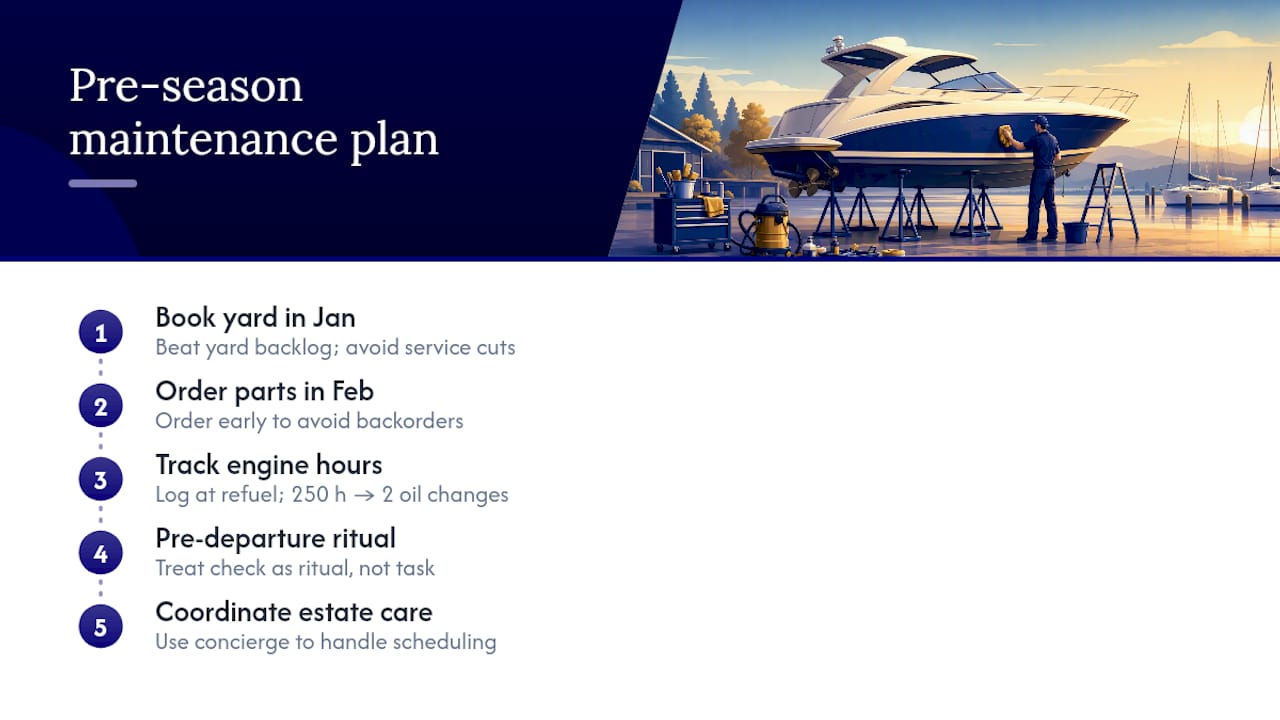
The conventional advice is to follow a checklist. That is fine as far as it goes. What it misses is the sequencing problem: owners who try to do everything at once in April, when the yard is full and parts are backordered, end up cutting corners or skipping the annual service entirely. The owners who actually maintain their boats well do two things differently. They book the yard in January and order parts in February, before anyone else is thinking about it. And they treat the pre-departure check as a ritual, not a task.
The other thing most guides underweight is the engine-hours rule. Calendar-based thinking leads owners to change oil once a year regardless of how many hours they ran. A boat that logged 250 hours last season needed two oil changes, not one. Tracking hours is not complicated; it just requires writing down the meter reading every time you refuel. That one habit, done consistently, is worth more than any checklist.
For owners with waterfront estates along the Emerald Coast, the boat schedule rarely exists in isolation. It overlaps with storm preparation, dock maintenance, and the broader rhythm of property care. 30apropertycollective coordinates boat and golf cart maintenance as part of its estate management services, which means owners who travel frequently do not have to manage the scheduling themselves. If that kind of proactive coordination matters to you, their concierge services are worth a look.
The bottom line: a boat maintenance schedule only works if it is built around your actual season, your actual engine hours, and a booking habit that starts in winter. Everything else is just a list.

Sources
These sources informed this article and are worth bookmarking for model-specific intervals and regulatory updates:
- Complete Boat Maintenance Calendar - Month-by-Month Guide - Passage Maker Mag
- Boat And Trailer Maintenance Checklist | BoatUS
- Boat Maintenance Schedule: Monthly, Seasonal, and Annual Checklist (2026)
- Basic Boat Maintenance Checklist for New Boaters
- The Complete Boat Maintenance Guide: Planning & Long-Term Care | The Yacht Maintenance Hub
Always verify model-specific service intervals in your owner's manual. Manufacturer intervals override any general guideline in this article or any other. When in doubt, ask your marine mechanic.