
Expect to pay a broad range to buy and install a whole-home standby generator, with most homeowners landing somewhere near the middle of the cost spectrum. That range reflects real installed totals: equipment, labor, the automatic transfer switch (ATS), concrete pad, gas connection, permits, and accessories. The single most useful thing you can do right now is schedule an on-site load analysis with an authorized dealer before requesting quotes.
Here is how the three price tiers break down in plain terms:
- Low tier: A smaller air-cooled unit covering essential circuits such as lights, refrigerator, a few outlets, and a window AC or small central unit. Suitable for smaller homes with modest power needs.
- Median tier: An air-cooled standby generator powering most of a mid-sized home, including central AC, kitchen appliances, and a sump pump. This is where the majority of residential installs land.
- High tier: A liquid-cooled higher capacity unit suitable for large estates, homes with pools, well systems, or multiple HVAC zones. Coastal properties and high-labor markets push costs toward the upper end.
Pro Tip: Get the load analysis before you pick a unit size. Dealers who skip this step and recommend a unit based on square footage alone are the ones who leave you with a generator that sheds load the first time the AC and water heater run simultaneously.
For luxury and seasonal homeowners along Florida's Emerald Coast, 30apropertycollective coordinates vendor selection, permit oversight, and post-install maintenance, so the entire process runs smoothly without requiring your constant presence.
Table of Contents
- What does whole home generator cost by tier?
- Where does the money actually go?
- How is the right generator size determined?
- Which fuel type makes the most sense for your property?
- What does the installation process look like, and how long does it take?
- What extra costs catch homeowners off guard?
- What does ongoing maintenance cost, and how long will the unit last?
- How do homeowners typically finance the install, and what are the tax implications?
- What do realistic line-item quotes look like?
- How do you choose the right installer?
- Why standby generators matter most for luxury and seasonal estates
- What should you do next?
- Key Takeaways
- The real cost most homeowners underestimate
- Generator installation and ongoing care, handled for you
- Useful sources
What does whole home generator cost by tier?
Whole-home generator pricing in 2026 typically runs $5,000–$25,000 fully installed, with equipment accounting for $3,000–$15,000 of that and professional installation adding $1,500–$8,000. Regional labor markets and site complexity are the two biggest swing factors outside of the unit itself.
| Tier | Typical kW Range | Equipment Cost | Installed Total | What It Covers |
|---|---|---|---|---|
| Low (essentials) | 10–14 kW | $3,000–$5,000 | $5,000–$8,000 | Essential circuits, small home under 1,500 sq ft |
| Median (whole-home) | 18–22 kW | $3,000–$15,000 | $10,000–$15,000 | Most of a 2,000–2,500 sq ft home, central AC |
| High (estate/liquid-cooled) | 36–48 kW | $14,000–$25,000 | $16,000–$25,000+ | Full estate, pool, well, multiple HVAC zones |
Generac, Kohler, and Briggs & Stratton are the three manufacturers you will see most often in installer quotes. Generac dominates residential market share and tends to offer the widest dealer network for service. Kohler units are frequently specified for luxury builds where quieter operation matters. Briggs & Stratton occupies a competitive mid-range position, though dealer density varies by region.
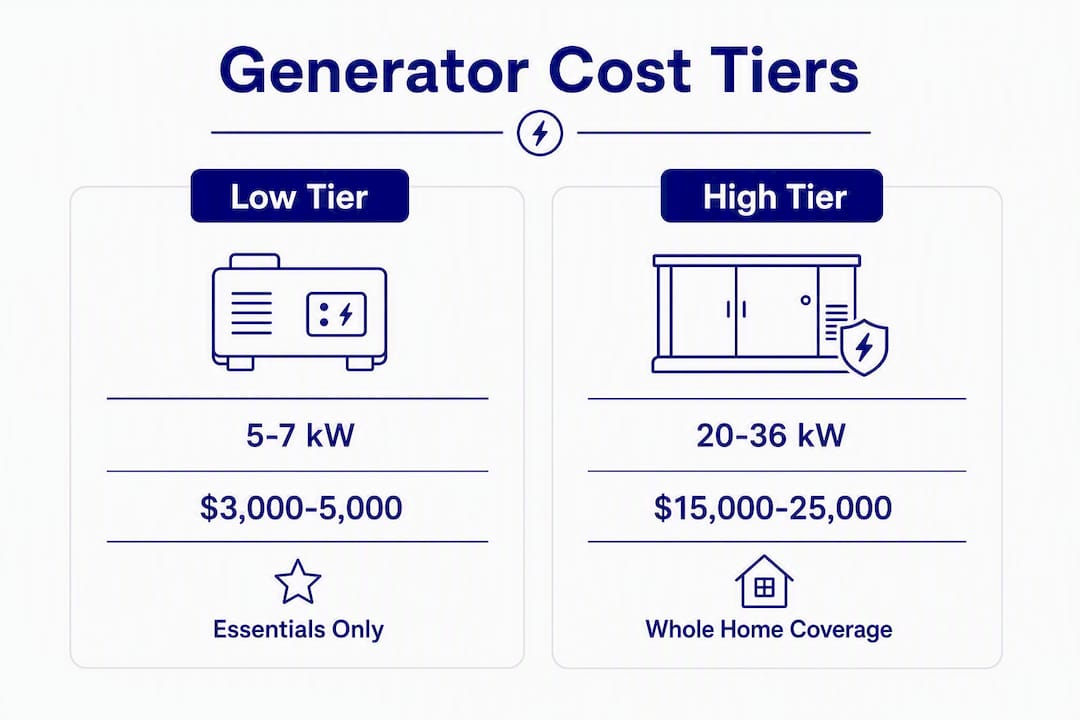
Coastal and high-labor markets like Florida's Emerald Coast, the Pacific Coast, and the Northeast consistently price at the upper end of each band. A 20 kW Generac that installs for $11,000 in the Midwest might run $14,000–$16,000 in a coastal Florida market once corrosion-resistant enclosures, local permit fees, and higher electrician rates are factored in.
Where does the money actually go?
Breaking a generator quote into line items is the fastest way to spot an inflated bid or a suspiciously cheap one. Here is how a typical residential install allocates costs:
- Generator unit: Usually 50–65% of the total project cost. This is the hardware itself, before any site work.
- Automatic transfer switch (ATS): The ATS unit runs $400–$2,000 depending on amperage and whether a service-entrance rated model is required. Installation labor adds another $400–$1,200. Service-entrance rated ATS units cost more upfront but can simplify meter-base work and future utility inspections.
- Concrete pad or composite base: $300–$800 for a standard residential pour.
- Gas line connection: $300–$1,500 for a short run from an existing meter; longer runs or trenching can push this significantly higher.
- Electrical work and panel upgrades: $500–$3,000 depending on whether the existing service entrance needs upgrading.
- Permits and inspections: $150–$600 in most jurisdictions, though coastal and urban markets sometimes run higher.
- First-year maintenance and startup: $200–$500 for the initial service visit and commissioning check.
- Accessories (remote monitoring, weather enclosure, fuel stabilizer): $100–$800 depending on options selected.
Warranty coverage typically applies to the generator unit itself and factory-installed components. The concrete pad, gas line, and electrical panel work are almost always outside the manufacturer warranty and are the contractor's responsibility under their workmanship guarantee. Ask every installer to specify which line items carry their own labor warranty and for how long.
How is the right generator size determined?
Square footage is a starting point, not a sizing method. A 2,500 sq ft home with a gas range, gas water heater, and a single-zone AC system needs a very different generator than a 2,500 sq ft home with an electric range, electric water heater, and two AC zones. The difference can easily be 8–10 kW, which translates to thousands of dollars in equipment cost.
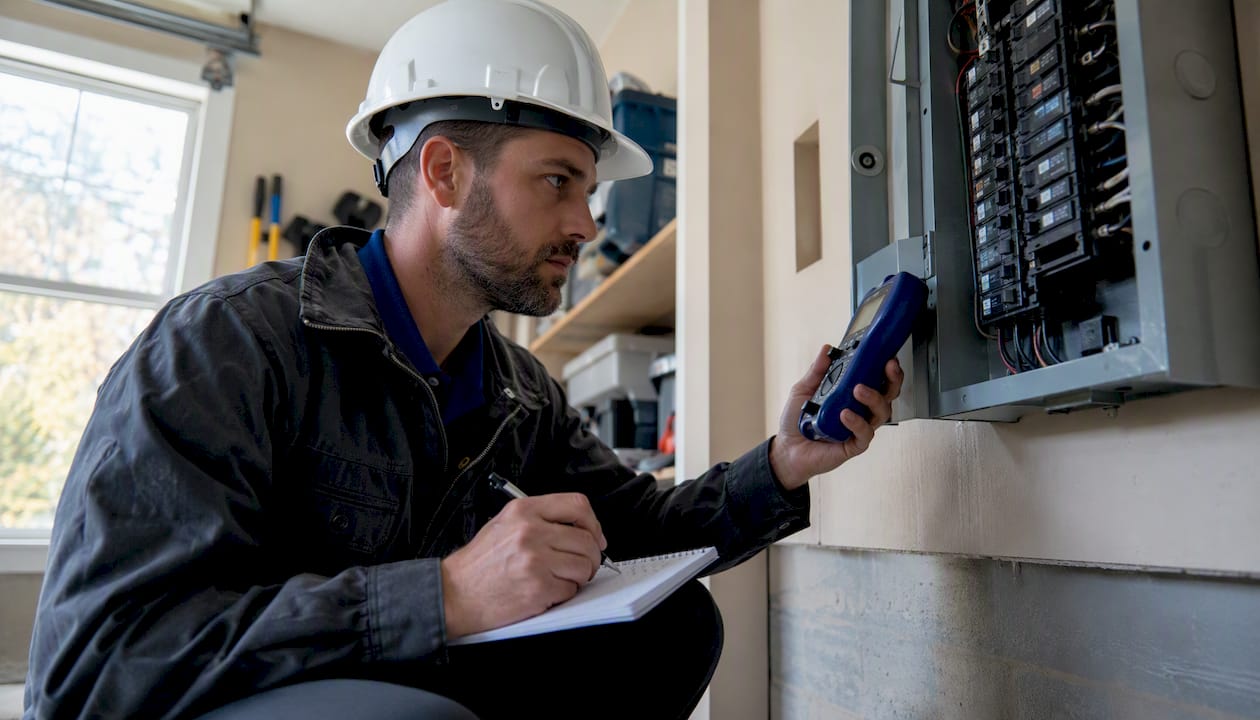
A professional load analysis identifies every high-draw appliance in your home, calculates their simultaneous demand, and adds a safety margin. The result is the minimum kW rating your generator needs to handle peak load without tripping into load-shedding mode.
| Home Scenario | Approx. Peak Load | Recommended kW | Notes |
|---|---|---|---|
| 1,200–1,500 sq ft, gas appliances, 1 AC zone | 8–12 kW | 12–14 kW | Essentials-only coverage |
| 2,000–2,500 sq ft, mixed appliances, 2 AC zones | 14 kW | 18 kW | Whole-home coverage |
| 3,000+ sq ft estate, pool, well pump, 3+ AC zones | — | 36–48 kW | Liquid-cooled recommended |
Before the site survey, pull together: photos of your electrical panel, a list of every high-draw appliance (central AC tonnage, electric water heater wattage, well pump HP, pool pump HP), and confirmation of your gas meter location and line size.
Pro Tip: Under-sizing to save $1,500 upfront is one of the most expensive mistakes homeowners make. When the AC, water heater, and refrigerator all kick on simultaneously during a storm, an undersized unit either sheds load automatically or trips offline entirely. A correct load calculation from Generac or another authorized dealer prevents this.
Which fuel type makes the most sense for your property?
Fuel choice affects both upfront cost and what you pay every time the generator runs. Natural gas is the default for most residential installs where a gas line already exists: no tank to manage, no refueling logistics, and lower per-hour operating cost. Propane is the go-to when there is no gas service, but it requires a tank, which adds $800–$2,500 for a standard above-ground installation plus ongoing delivery coordination.
| Fuel Type | Upfront Cost Impact | Operating Cost | Refueling | Best For |
|---|---|---|---|---|
| Natural gas | Lowest (uses existing line) | Low | None (utility supplied) | Homes with existing gas service |
| Propane | Moderate (tank required) | Moderate | Scheduled delivery | Rural or off-grid properties |
| Diesel | Higher (larger tank, fuel storage) | Higher | Manual refueling | Large commercial or remote installs |
| Hybrid/battery | Highest upfront | Lowest operating | Grid or solar recharge | Short outages, solar-paired systems |
Diesel is rarely specified for residential standby use today; it appears more often in large commercial or remote-site applications where propane delivery is impractical. Hybrid systems pairing a battery bank with a smaller generator are gaining traction for shorter outages, but the upfront cost remains high and the technology is still maturing for whole-home coverage.
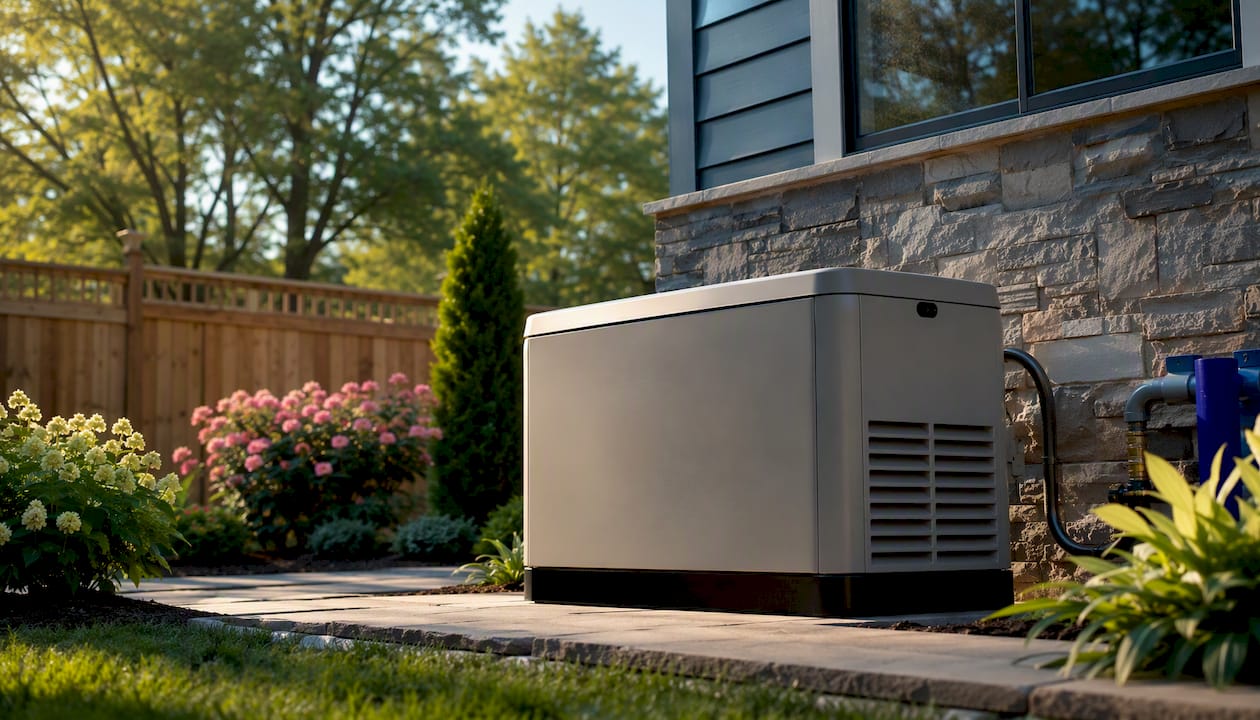
Coastal properties face one additional variable: salt air accelerates corrosion on standard enclosures and electrical components. Corrosion-resistant or marine-grade enclosure packages typically add $300–$800 to the base unit cost. For a property on the Emerald Coast, this is not optional.
What does the installation process look like, and how long does it take?
The physical installation of a clean-site generator takes 1–3 days. The full process from signed contract to final inspection sign-off commonly spans 2–4 weeks, and in jurisdictions with backlogged permit offices, 4–6 weeks is not unusual.
Here is the typical sequence:
- Site survey and load analysis — The installer visits, measures the site, identifies the ATS location, gas meter access, and pad placement.
- Permit drawings and submission — The contractor prepares and submits electrical and gas permit applications to the local authority.
- Concrete pad pour — A pad is poured and cured (typically 48–72 hours before equipment placement).
- Generator delivery and placement — The unit is set on the pad and anchored.
- ATS wiring — The transfer switch is wired to the service entrance or sub-panel, depending on the design.
- Gas line tie-in — A licensed plumber or gas fitter connects the generator to the gas supply.
- Final inspection and commissioning — The local inspector signs off, and the installer runs a full load test.
Permit timelines are the most common source of delay. Gas-line trenching, when required, can also add 1–3 days to the physical work. Service-entrance upgrades, if the existing panel is undersized, can push the electrical permit into a separate review cycle.
As a homeowner, your job during this process is to keep the work area clear, confirm utility access, and be available for the commissioning test so you can see the automatic transfer sequence run live.
What extra costs catch homeowners off guard?
The base quote rarely tells the whole story. These are the line items that most commonly inflate a final invoice:
| Add-On | Typical Cost Range |
|---|---|
| Electrical panel upgrade (if required) | $1,500–$3,000 |
| Long gas-line run or trenching (per linear foot) | $15–$25/ft |
| Propane tank purchase and siting | $800–$2,500 |
| Coastal/marine corrosion package | $300–$800 |
| Remote monitoring module | $150–$400 |
| Extended warranty (years 3–5) | $300–$800 |
| Non-standard permitting fees (coastal/urban) | $200–$600 |
| Conduit and wiring for long ATS runs | $300–$1,500 |
Regional pricing spreads are real: Pacific and Northeast markets consistently land at the upper end of every range above, and coastal Florida is not far behind. Budget a 10–15% contingency on top of your initial quote to cover discoveries made during trenching or inspection, such as an undersized gas line or a panel that needs a service upgrade before the ATS can be wired in.
What does ongoing maintenance cost, and how long will the unit last?
A well-maintained standby generator lasts 20–30 years. Neglected units, particularly those that miss annual service, can fail within 10–12 years. The math on maintenance is straightforward.
Annual professional maintenance runs $200–$500 and typically covers an oil and filter change, battery inspection and load test, spark plug check, coolant inspection (liquid-cooled units), and a full exercise run with load verification. Most manufacturers require documented annual service to keep the warranty valid.
What annual service usually covers:
- Oil and filter change
- Air filter inspection and replacement
- Battery voltage and load test
- Coolant level check (liquid-cooled units)
- Fuel system inspection
- Transfer switch operation test
What typically costs extra:
- Battery replacement ($100–$250 every 3–5 years)
- Coolant flush ($150–$300 every 3–5 years)
- Major component repairs outside warranty
- Fuel system cleaning after extended storage
Exercise runs, where the generator starts automatically and runs under light load for 20–30 minutes weekly, use roughly $50–$150 in fuel per year for a natural gas unit. Propane units will vary based on tank pricing at delivery. A seasonal maintenance checklist that includes generator service keeps these costs predictable and prevents the unpleasant surprise of a unit that fails to start during the first storm of the season.
How do homeowners typically finance the install, and what are the tax implications?
Most homeowners pay for generator installs one of three ways: cash, a home equity line of credit (HELOC), or contractor-arranged financing. HELOCs tend to offer the lowest interest rates for homeowners with sufficient equity, and the interest may be deductible if the funds are used for home improvement. Contractor financing is convenient but often carries higher rates; read the terms carefully before signing.
A whole-home generator may not be directly deductible as a residential expense in the year of purchase but can be considered a capital improvement increasing your home's cost basis. Some homeowners may also qualify for insurance premium credits for adding permanent backup power. Consult a tax professional and your insurance carrier before assuming either benefit applies to your specific situation.
On the insurance side, some carriers offer discounts for permanent standby generators because they reduce the risk of frozen pipes, sump pump failures, and refrigerator losses during outages. The discount varies by carrier and state; ask your agent directly rather than assuming it applies.
Keep every receipt, permit, inspection certificate, and warranty document in a dedicated file. This documentation supports both the capital-improvement claim at sale and any insurance discount verification.
What do realistic line-item quotes look like?
These sample estimates reflect national mid-range pricing. Your local quotes will vary based on labor market, site complexity, and fuel type.
Scenario 1: Small home essentials (1,200 sq ft, natural gas, 12 kW)
| Line Item | Estimated Cost |
|---|---|
| ATS (100A, standard) | $600 |
| Concrete pad | $400 |
| Gas line connection (short run) | $400 |
| Electrical labor | $800 |
| Permits and inspection | $250 |
Scenario 2: Typical whole-home install (2,200 sq ft, natural gas, 20 kW)
| Line Item | Estimated Cost |
|---|---|
| Concrete pad | $500 |
| Permits and inspection | $400 |
| First-year maintenance | $300 |
Scenario 3: Large estate (3,500 sq ft, propane, 36 kW liquid-cooled)
| Line Item | Estimated Cost |
|---|---|
| ATS (400A, service-entrance rated) | $2,000 |
| Electrical labor and service upgrade | $3,000 |
| Coastal corrosion package | $600 |
| Permits and inspection | $500 |
For comparison, a portable generator with a manual transfer interlock runs $1,200–$3,500 installed, but it requires manual startup, does not provide automatic whole-home coverage, and leaves you managing fuel during the outage itself.
How do you choose the right installer?
The lowest bid is rarely the right choice when gas integration and ATS work are involved. A botched ATS installation can void the generator warranty, fail inspection, or create a safety hazard. Here is what to require from every installer you consider:
- State electrical and gas contractor licenses — Verify both; generator installs require both trades.
- Authorized dealer status — Authorized dealerships maintain factory certification that protects warranty terms and simplifies service coordination. An unauthorized installer may void the manufacturer warranty.
- Proof of local permit experience — Ask which jurisdiction they pull permits in most often and whether they handle the permit submission themselves.
- General liability and workers' comp insurance — Request certificates before work begins.
- References from similar installs — Ask specifically for references on installs of similar size and fuel type.
Must-ask questions for every quote:
- Does your quote include an on-site load analysis, or are you sizing by square footage?
- Is the ATS service-entrance rated or sub-feed? What amperage?
- Does the quote include gas-line trenching, or is that a separate allowance?
- What panel work, if any, is included?
- Which items are explicitly excluded from the quoted scope?
- Who handles the permit submission and inspection scheduling?
- What is your warranty on labor, and who services the unit after the manufacturer warranty expires?
Red flags: a very low bid with no site visit, vague scope language like "gas connection as needed," no mention of permits, or an installer who cannot explain the difference between a service-entrance and sub-feed ATS. Get at least three written quotes and lay the scopes side by side before deciding. Quote variance of several thousand dollars for the same unit is common, and it almost always traces back to differences in what is included.
Why standby generators matter most for luxury and seasonal estates
For a primary residence, a generator outage is an inconvenience. For a luxury estate, an absentee owner's coastal property, or a seasonal home left unoccupied for months, a power failure can mean burst pipes, failed sump pumps, spoiled wine cellars, and HVAC systems running unchecked. The stakes are categorically different.
Liquid-cooled units are the right specification for estate-scale properties: they run quieter, handle sustained load more reliably, and carry longer service intervals than air-cooled units. The higher upfront cost is justified by the operational profile.
For high-value properties, the generator is only as reliable as the maintenance program behind it. A unit that has not been exercised, serviced, or fuel-checked before storm season is a liability, not an asset.
Managed maintenance programs address exactly this gap. A coordinated service schedule includes:
- Scheduled weekly or monthly exercise run verification
- Pre-season fuel and battery inspections (especially before hurricane season)
- Post-storm commissioning checks to confirm the unit transferred and returned to standby correctly
- Vendor coordination for annual professional service
- Documentation of all service visits for warranty compliance
Pro Tip: For absentee homeowners and seasonal residents, the question is not whether to invest in managed generator maintenance — it is whether to discover a failed unit during a storm or before one. A managed service catches the dead battery and the empty propane tank before they matter.
30apropertycollective provides exactly this level of proactive oversight for estates along Florida's Emerald Coast, coordinating vendor scheduling, storm prep, and post-storm system checks as part of their estate management model.
What should you do next?
The installed cost of a whole-home standby generator is almost always determined by three things: the kW size the load analysis requires, the site work the property demands, and the labor market you are in. Everything else is secondary.
Three concrete next steps:
- Schedule an on-site load analysis with an authorized Generac, Kohler, or Briggs & Stratton dealer before requesting any quotes. This single step prevents the most common and expensive sizing mistakes.
- Get three written quotes with fully itemized scopes. Compare line by line, not total by total, and ask each installer to explain any scope differences.
- Document everything from the permit application through the final inspection certificate. This file protects your warranty, supports any insurance discount claim, and establishes the capital-improvement record for future sale.
Key Takeaways
Whole home generator cost runs $5,000–$25,000 fully installed, with sizing, site work, and fuel type as the three primary drivers of where your project lands in that range.
| Point | Details |
|---|---|
| Installed cost range | Expect $5,000–$25,000 total; most homeowners pay $10,000–$15,000 for a typical whole-home install (18–22 kW air-cooled, fully installed). |
| Top cost drivers | Generator kW size, gas-line distance, ATS type, and panel condition move the number most. |
| Load analysis is non-negotiable | Square footage alone cannot size a generator; a professional load calculation prevents costly under-sizing. |
| Maintenance is recurring | Budget $200–$500 per year for professional service; skipping it risks voiding the manufacturer warranty. |
| 30apropertycollective | Coordinates vendor selection, permit oversight, and ongoing generator maintenance for luxury estates on Florida's Emerald Coast. |
The real cost most homeowners underestimate
The price of the generator is not what surprises people. It is the gap between what they budgeted and what the site actually required: the panel that needed upgrading, the gas line that ran 80 feet instead of 20, the coastal corrosion package the installer added at delivery. Every one of those is a legitimate cost, and none of them shows up in the headline price.
The other underestimated cost is time. A homeowner who manages the install themselves, chasing permits, coordinating the electrician and the gas fitter, and scheduling the inspection, spends 15–20 hours on a project that a managed service handles as a matter of course. For a primary residence, that trade-off might be worth it. For a seasonal property you visit four times a year, it almost certainly is not.
The contractors who skip the load analysis and the site survey are not offering you a deal. They are transferring their risk to you. An authorized dealer who insists on the site visit before quoting is doing the job correctly. Pay attention to which installers push back on that step and which ones treat it as standard.
For luxury estate maintenance, the generator is one system among many that requires coordinated, documented care. The homeowners who get the most reliable performance out of their systems are the ones who treat maintenance as a scheduled operational cost, not a reactive expense.
Generator installation and ongoing care, handled for you
Managing a generator install from a distance is one of the more stressful property projects a homeowner can take on: multiple contractors, a permit timeline you cannot control, and a commissioning test you may not be there to witness. For estates along Florida's Emerald Coast, 30apropertycollective removes that friction entirely.

As part of their estate management and concierge services, 30apropertycollective handles vendor vetting, permit coordination, contractor scheduling, and final commissioning verification so you do not have to manage the process from another state. After installation, their team integrates generator maintenance into the property's ongoing care schedule: pre-season inspections, exercise run verification, post-storm commissioning checks, and annual service coordination with authorized dealers. For seasonal homeowners and absentee owners, this is the difference between a generator that works when it matters and one that fails silently between visits. Reach out to 30apropertycollective to discuss how their estate management services can cover your generator and every other system your property depends on.
Useful sources
These are the most authoritative resources for verifying generator pricing, fuel properties, and insurance considerations:
- Whole Home Generator Cost in Florida: Pricing by Size — Florida-specific pricing context from a state-affiliated resource.
- Alternative Fuels Data Center: Fuel Properties — U.S. Department of Energy reference for fuel energy content and cost comparisons.
- Consumer Reports: Home Improvements That Can Save on Insurance — Independent guidance on insurance premium impacts of permanent backup power.
- GeneratorPrice.com: Whole-House Generator Cost Guide — Detailed national pricing breakdown including equipment, installation, and permit ranges.
- Caudill's: Whole House Generator Cost Calculator — Pricing benchmarks compiled from over 180 residential installations.
For on-site quotes, contact authorized Generac, Kohler, or Briggs & Stratton dealers in your area. Require a written, itemized scope before signing anything, and confirm the installer pulls their own permits.