
Rinse exposed metal with fresh water weekly, upgrade to 316 stainless or anodized aluminum where corrosion has already started, and inspect fasteners and HVAC coils on a set monthly rotation. These three moves cut coastal corrosion damage more than any single product on the market. They will not stop it entirely in a heavy spray zone, but they buy years of extra life on railings, hardware, and equipment that would otherwise fail early.
TL;DR:
- Weekly rinsing with fresh water significantly extends the lifespan of metal fixtures and equipment exposed to salt spray by removing deposited salts before they cause damage.
- Using 316 stainless steel fasteners and Type III anodized aluminum resists corrosion much longer than standard materials, especially in high-salt environments.
- Applying corrosion inhibitors and promptly repairing chips and scratches help prevent pitting and deeper structural damage that become costly over time.
- Coatings such as epoxy, polyurethane, and fluorocarbon finishes offer improved resistance, but regular maintenance remains crucial for long-term protection.
- A consistent maintenance routine, including inspections, touch-ups, and professional services, outperforms relying solely on expensive coatings or systems.
Table of Contents
- What Actually Stops Salt Air Corrosion Damage?
- Prioritized Countermeasures for Homeowners
- Which Materials and Coatings Actually Hold Up?
- Weekly, Monthly, and Annual Maintenance Checklist
- Protecting Your HVAC Condenser From Salt Damage
- Preventing Galvanic and Stray-Current Corrosion
- Signs of Corrosion and When to Call a Professional
- How 30A Property Collective Handles Corrosion Prevention
- Salt Air Corrosion Prevention: Why the Basics Beat the Lab Talk
- A Managed Maintenance Plan for Corrosion-Prone Coastal Homes
- Sources
What Actually Stops Salt Air Corrosion Damage?
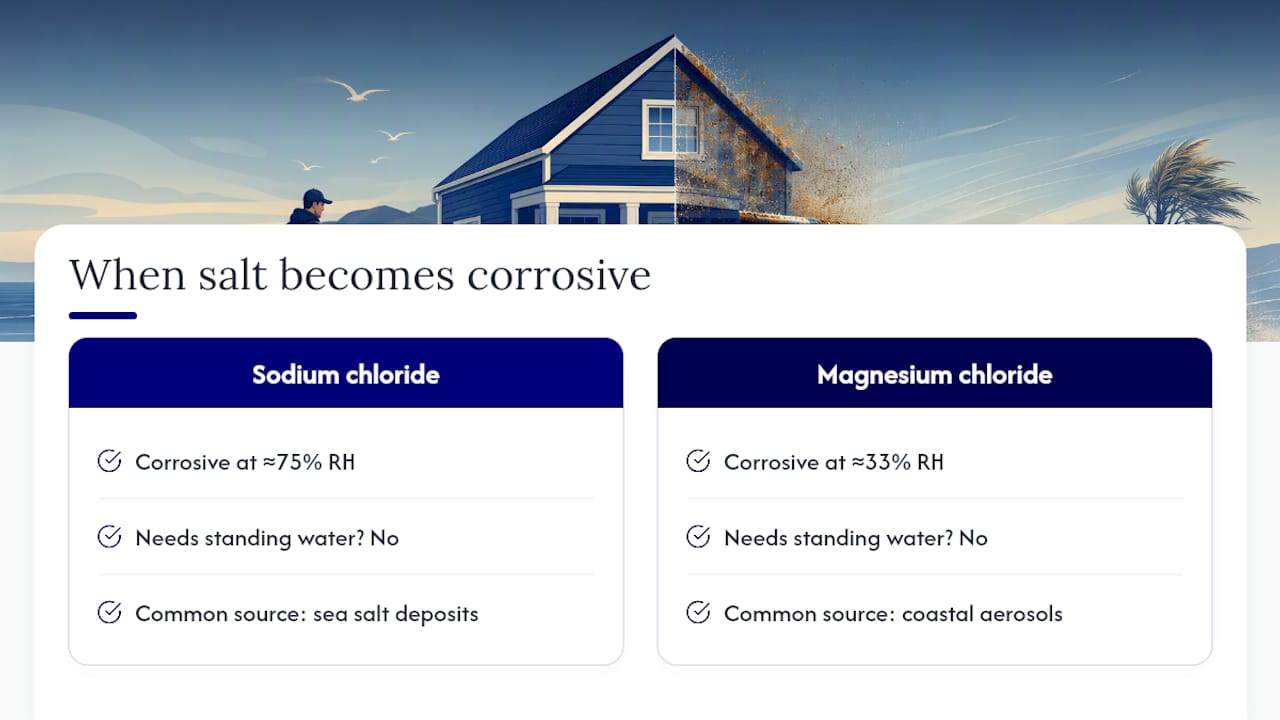
Salt air corrosion prevention comes down to interrupting the chemistry before it starts, not fighting rust after it appears. Salt deposited on metal surfaces does not need standing water to cause damage. Sodium chloride becomes a corrosive electrolyte once relative humidity crosses about 75%, while magnesium chloride, common in some coastal aerosols, turns corrosive at roughly 33% RH, according to research on salt-air corrosion of electrical enclosures. That means a humid, salty morning on your porch is doing more damage than a rainstorm, because the film of salt sitting on your railing is already acting like a tiny battery, and it will keep working until you rinse it off or seal it away.
Homeowners near the water often assume distance from the beach buys them safety. Chloride deposition is significantly higher near windward shorelines and drops considerably just a few hundred feet inland, based on coastal corrosion data from Hawaii. A house three streets back from the beach faces a fraction of the exposure a beachfront property does, but "a fraction of" is not "none of." The countermeasures below apply to both, just with different urgency.
Prioritized Countermeasures for Homeowners
Fresh-water rinsing is the single highest-value habit you can build, and it costs nothing but a garden hose and ten minutes.
- Rinse weekly, not after it rains. Rain does not reliably wash salt out of crevices, screw heads, or louvered vents. Use a low-pressure hose nozzle and work top to bottom on railings, light fixtures, and the HVAC condenser, holding the stream at an angle so you push salt out of joints rather than driving it deeper in.
- Wash monthly with a pH-neutral marine soap, not a household degreaser, on painted or anodized surfaces. Avoid high-pressure washers on finished metal. The force can strip protective coatings and etch anodized aluminum faster than the salt would on its own.
- Apply corrosion inhibitors and anti-seize on threaded fasteners, hinges, and hose bibs. A light spray inhibitor displaces moisture and forms a thin barrier film; copper-free anti-seize on bolts keeps them from galling shut after a year of salt exposure.
- Touch up chips and scratches immediately. A dime-sized bare spot on a railing is where pitting starts. Clean it, prime it, and match the coating within days, not months.
Weekly rinsing alone can roughly double the service life of exposed HVAC fins and exterior hardware in high-salt zones, according to field data from Hawaii's coastal construction industry.
Pro Tip: Rinse in the late afternoon rather than midday. Salt spray settles overnight and through the morning, and rinsing before it has a chance to dry into a crusted film makes the water actually lift it away instead of just wetting it in place.
Which Materials and Coatings Actually Hold Up?
Not all metal survives salt air the same way, and the difference between a hardware store bolt and a marine-grade one shows up within a single season.
- 316/316L stainless steel for exposed fasteners, hinges, and railings, as recommended in The Best Coastal Driveway Materials for Salt, Sand, and Storms. It contains molybdenum that 304 stainless lacks, and that difference is why 304 develops rust streaks and pitting in coastal air within a year or two while 316 stays clean far longer, per comparisons of stainless and aluminum hardware for salt-air sites.
- 5052-H32 aluminum with Type III hard-anodizing for railings, brackets, and trim where weight or cost rules out stainless. The hard-anodized layer resists the pitting that plain mill-finish aluminum develops quickly near the water.
- Epoxy and polyurethane coatings for painted surfaces, offering strong adhesion and chemical resistance, though both eventually chalk under UV exposure and need recoating.
- Fluorocarbon finishes for the longest-lasting factory color retention, common on higher-end railings and fixtures.
Newer high-solid-content, low-surface-treatment coatings have shown resistance to blistering through 3,000 to 6,000 hours of accelerated salt-spray testing, where some commercial zinc-rich coatings blistered by 3,000 hours. That matters for large repair jobs where full abrasive blasting isn't realistic. Ask any contractor bidding coastal work whether their coating has been tested to ASTM B117 salt-spray standards and rated against ISO 9223 atmospheric corrosivity categories. Those two references separate a real marine-grade product from a repainted hardware-store can.
Weekly, Monthly, and Annual Maintenance Checklist
A simple calendar beats a complicated one, because the calendar you'll actually follow is the one that fits into a Saturday morning.
- Weekly: Rinse the HVAC condenser, railings, and exterior light fixtures with fresh water. Check visible fasteners for rust bleed. Lubricate hinges and latches.
- Monthly: Wash painted and metal surfaces with marine soap. Inspect for paint chips and touch up immediately. Test moving parts like gate hinges and shutter tracks for stiffness or grinding.
- Quarterly and annually: Schedule professional HVAC coil cleaning and inspection. Pressure-wash exterior siding and hardscape, staying off finished metal. Inspect structural connectors, flashing, and any concealed hardware behind trim.
- After every named storm: Rinse within 48 hours of the storm passing. Check crevices, electrical enclosure seals, and any spot where debris packed against metal, since trapped salt water there does more damage than open exposure ever will.
This routine maps closely to the year-round coastal maintenance checklist many Emerald Coast homeowners already follow for storm prep and general upkeep.
Protecting Your HVAC Condenser From Salt Damage
Your outdoor condenser is usually the first thing to show corrosion damage, because it sits low, runs constantly, and has thin aluminum fins designed for airflow, not durability.
- Rinse the coil fins weekly with a gentle, low-pressure spray from the top down, and never aim water directly into the electrical disconnect box or control panel.
- Ask about factory-applied or aftermarket coil coatings before you buy or repair a unit near the water. They add upfront cost but meaningfully slow fin corrosion.
- Corroded fins block airflow and reduce heat transfer, which shows up as higher energy bills and shorter compressor life long before the unit fails outright.
- When you interview an HVAC technician, ask directly whether the coil coating carries a coastal warranty, what service interval they recommend for salt exposure, and whether they've serviced other homes in your zip code.
Preventing Galvanic and Stray-Current Corrosion
Bolt an aluminum bracket directly to a stainless railing post with no barrier between them, and you've built a small battery. The less noble metal, usually aluminum, corrodes faster than it would on its own. This is galvanic corrosion, and it is entirely preventable at almost no cost.
- Use nylon sleeves and dielectric washers anywhere dissimilar metals touch.
- Bed fasteners in a nonconductive sealant rather than letting bare metal contact bare metal.
- Sacrificial anodes and cathodic protection matter mainly for boats, docks, and buried or submerged metal, not typical railings and fixtures, so most homeowners can skip them entirely.
- If you have a dock, boat lift, or shore power connection, stray-current corrosion moves faster and less predictably than galvanic corrosion. Call an electrician or marine technician if you notice rapid, unexplained pitting near any electrified equipment.
Pro Tip: A five-cent nylon washer at every mixed-metal joint prevents damage that costs hundreds of dollars to fix once it's established.
Signs of Corrosion and When to Call a Professional
Surface rust bleed and small paint chips are a weekend fix. Blistering paint over a wide area, seized fasteners that won't turn, or a noticeable drop in AC cooling performance signal deeper damage that a touch-up won't solve.
- Light pitting or rust streaks on hardware: clean, prime, and repaint yourself.
- Seized bolts, cracked coatings, or visible metal loss: replace the fastener or bracket with 316 stainless.
- Reduced HVAC efficiency or corroded coils: call a technician before the compressor is affected.
Touch-up repairs typically run far less than fastener replacement, which in turn costs a fraction of an HVAC coil swap. Homes that follow a consistent rinse-and-inspect routine tend to catch problems at the cheapest stage instead of the most expensive one.
How 30A Property Collective Handles Corrosion Prevention
Weekly inspections catch a chipped railing or a salt-crusted condenser coil before it becomes a repair invoice. That's the core of proactive estate care: fresh-water rinses, vendor-managed touch-ups, and documented reports that flag small issues early, rather than waiting for a homeowner to notice rust after the damage is done.
Salt Air Corrosion Prevention: Why the Basics Beat the Lab Talk
Most articles on this topic reach for lab chemistry, alloy charts, and corrosion-rate equations. That information isn't wrong, but it isn't what actually saves a coastal property. What saves it is a hose used every week and a habit of catching small chips before they pit.
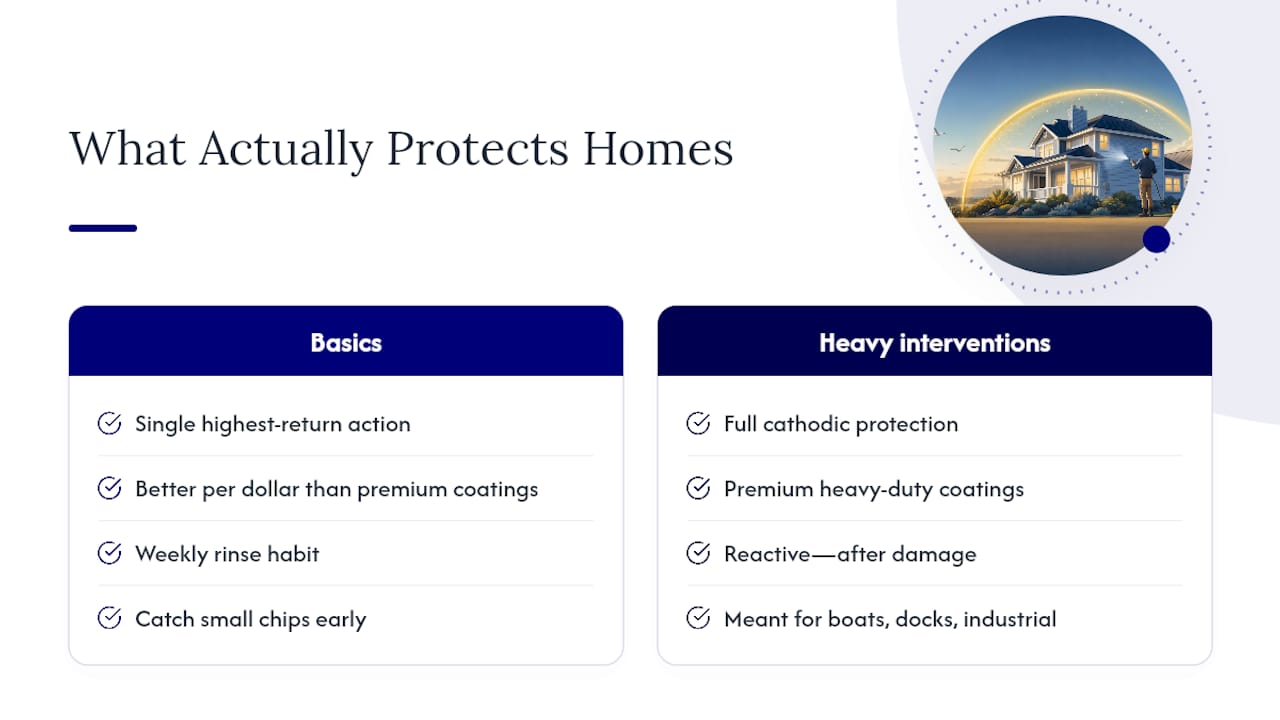
The conventional advice oversells expensive interventions. Full cathodic protection systems and heavy-duty coatings matter for boats, docks, and industrial equipment. For a typical coastal home, a nylon washer at a mixed-metal joint does more good per dollar than most premium coatings marketed to worried homeowners. The research backs this up: a simple weekly rinse is repeatedly identified as the single highest-return action a property owner can take, ahead of any product purchase.
Where I'd push back hardest is on timing. Homeowners tend to treat maintenance as reactive, something to handle after a storm or after rust shows up. The properties that hold up best treat it as a fixed weekly task, the same as mowing a lawn. If you can only commit to one change this month, make it the rinse, not the coating.
— Zackary
A Managed Maintenance Plan for Corrosion-Prone Coastal Homes
Reading a checklist and actually rinsing a condenser every week for the next ten years are two different things, and that gap is where most corrosion damage happens. A managed maintenance plan is an alternative to handling this alone or hoping a once-a-year handyman visit catches everything, because weekly inspections mean someone is physically checking your railings, fixtures, and HVAC unit before salt has time to do real damage.

Clients with estate management services get scheduled rinses, vendor coordination for touch-ups and coating repairs, and a documented inspection report after every visit, so details of checks and findings are tracked. That combination tends to mean fewer emergency repair calls and longer service life on the hardware and equipment this article covers. It also removes the burden of remembering the schedule yourself, since the weekly cadence gets built into a routine that runs whether you're home or three states away.
If you want a done-for-you preventive program instead of managing a checklist solo, visit the concierge services page to see what's included, or head to the contract sign-up page to start a membership built around weekly inspections and preventive care for your coastal property.
Sources
- Metals 2026 — study on high-solid-content / low-surface-treatment anti-corrosion coatings (DOI:10.3390/met16010123)
- Hawaii saltwater corrosion and galvanic coastal construction — How to Live in Hawaii
- Salt-air corrosion: protecting electrical enclosures in coastal environments — So Sponge
- Stainless vs. aluminum for salt-air sites — Hyperlite
- Saltwater corrosion protection: galvanic isolation, anodes, stray current — Boat Care Authority