
Get a current Certificate of Insurance (COI) from your contractor and confirm it directly with the insurer before anyone sets foot on your property. That single step prevents most of the financial exposure homeowners face when uninsured contractors cause damage or injury. To verify contractor insurance completely, you need three things: the COI, a confirmed active license from your state's contractor licensing board, and proof of workers' compensation if the crew has employees. If you'd rather hand that process to a professional, 30apropertycollective manages contractor verification as part of its estate management services along Florida's Emerald Coast.
Quick verification checklist (do this before work begins):
- Request the COI directly from the contractor's insurance agent, not the contractor.
- Look up the contractor's license on your state licensing board's online portal.
- Call the insurer using a phone number from the insurer's public website to confirm the policy is active.
- Ask for an Additional Insured endorsement naming you and your property address.
- Confirm workers' comp coverage if the contractor has employees.
Key Takeaways
Confirming contractor insurance before work starts requires a COI, insurer confirmation, a license check, workers' comp verification, and an Additional Insured endorsement — all completed before the first payment.
| Point | Details |
|---|---|
| Always get an agent-sent COI | Request it from the agent directly; never accept a contractor-forwarded screenshot. |
| Confirm with the insurer | Call using the insurer's public number to verify policy number, limits, and active status. |
| Check license and workers' comp | Use your state licensing board and tools like EWCCV to confirm both before work starts. |
| Require Additional Insured status | An endorsement naming you and your property is stronger protection than a COI alone. |
| 30apropertycollective handles this for you | Their estate management service manages pre-hire verification, COI tracking, and mid-project re-checks on your behalf. |
Table of Contents
- Step-by-step: how to verify license, COI, workers' comp, and subcontractor coverage
- What should you do if the contractor is uninsured or the COI looks fake?
- Red flags to watch for and questions to ask
- Contract clauses that tie payment to valid insurance
- How professional estate managers verify contractor insurance
- The verification step most homeowners skip
- Let 30apropertycollective handle contractor verification for you
- Authoritative sources and state tools to use right now
Step-by-step: how to verify license, COI, workers' comp, and subcontractor coverage
Follow these four steps before the first payment clears or the first day on site. If the project runs longer than a month, set a calendar reminder to re-check.
Step 1: Verify the contractor's license
Go to your state's contractor licensing board website and run the license number the contractor gave you. Check: license status (active vs. expired or suspended), license classification (does it match the work being done?), expiration date, bond status, and any complaint or disciplinary history. Most state portals take under five minutes.
Step 2: Authenticate the COI
Many verification failures come from accepting screenshots or old COIs. Call the insurer using a phone number you find on the insurer's public website, not the number printed on the COI. Confirm the policy number, named insured, coverage limits, and effective/expiration dates. Ask whether the homeowner has been added as Additional Insured.
Step 3: Confirm workers' compensation
Workers' compensation is required in most states once a contractor has employees, and if a contractor has employees but no WC, you may become the default responsible party for any on-site injury claim. State-run tools like the Electronic Workers Compensation Coverage Verification System (EWCCV) let you confirm whether a contractor carried a WC policy on a specific date. Many states have their own equivalent portal.
Step 4: Collect subcontractor COIs
| Verification step | What to check | Timing |
|---|---|---|
| License lookup | Active status, classification, bond, complaints | Before hiring |
| COI authentication | Policy #, named insured, limits, dates | Before first payment |
| Workers' comp confirmation | Active account, covers all crew | Before work starts |
| Subcontractor COIs | Each sub named or covered under GC policy | Before subs arrive on site |
"Two policies stand between you and a large injury bill: general liability and workers' compensation. A four-move verification process turns a contractor's promise into proof." — buildquest Insurance Verification Checklist
What should you do if the contractor is uninsured or the COI looks fake?
Stop work immediately. Do not sign off on any final payment or authorize the next phase until the coverage question is resolved. Then work through this list:
- Call the insurer or agent directly using contact details you find independently, not from the contractor.
- Ask the contractor to provide the agent's name and phone number and confirm the policy yourself.
- Request proof that all subcontractors on site are covered.
- Document every communication in writing, including emails, texts, and call logs with dates and times.
- Notify your homeowner's insurance carrier that work was in progress and coverage may be in question.
- If you suspect the COI was altered or fabricated, contact your state's insurance department or contractor licensing board to report it.
- Withhold final payment until a valid COI and Additional Insured endorsement arrive from the agent.
Do not let the contractor pressure you into resuming work before coverage is confirmed. A contractor who resists verification is a contractor who has something to hide.
Red flags to watch for and questions to ask
Most insurance fraud in the contractor space is not sophisticated. It shows up as small inconsistencies that are easy to catch if you know what to look for.
| Red flag | What it likely means |
|---|---|
| Refuses to provide a COI | No coverage, or coverage that won't hold up to scrutiny |
| COI older than 30 days | Policy may have lapsed since it was issued |
| Business name mismatch | COI may belong to a different entity |
| "No employees" but multiple workers on site | Misclassified workers; WC gap |
| Screenshot instead of agent-sent COI | Possible alteration |
| No Additional Insured endorsement offered | Homeowner has no direct claim against the policy |
Questions to ask the contractor:
- "Can your agent email the COI directly to me?"
- "Who is the carrier and can I call them to confirm policy number X?"
- "Are all subcontractors covered under your policy, or will you provide their COIs separately?"
- "Does your GL include products and completed operations coverage?"
Questions to ask the agent:
- "Is this policy currently active and paid to date?"
- "Can you add my name and property address as Additional Insured and send the endorsement?"
- "Will you notify me 30 days before any cancellation?"
Pro Tip: Watch for behavioral signals: a contractor who pressures you to skip verification, asks you to pull permits in your own name, or gets evasive when you ask for the agent's contact information is showing you exactly how the project will go.
Contract clauses that tie payment to valid insurance
The contract is where your verification work becomes enforceable. Add these clauses before signing anything, and require the agent-sent COI and endorsements before the first payment.
- COI required before start: — "Contractor shall provide a current Certificate of Insurance from its agent to Owner before commencing work. Work should not begin until Owner has received and confirmed the COI."
Insert your name, property address, and project end date where indicated. For contract management support, 30apropertycollective can help structure these requirements as part of its vendor oversight services.
How professional estate managers verify contractor insurance
Estate managers who oversee high-value properties treat contractor verification as a repeatable process, not a one-time task. The vendor and contractor oversight practices used by professional managers follow a consistent sequence.
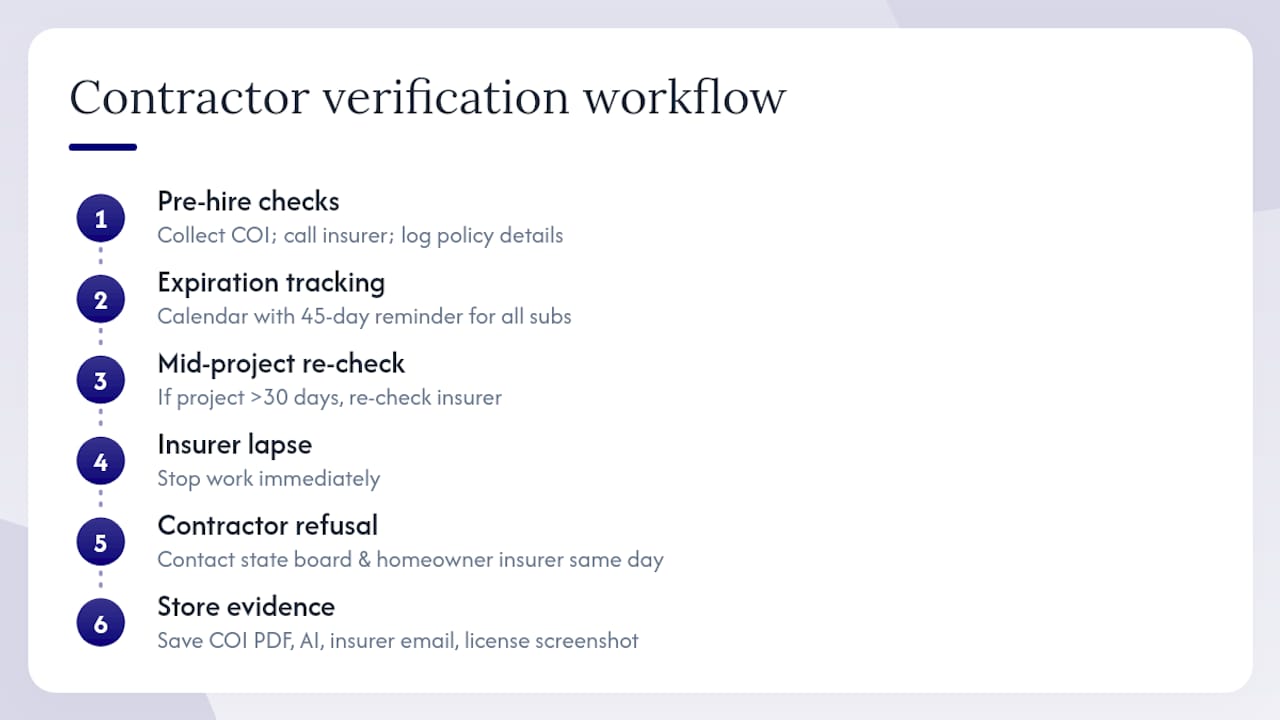
Before any contractor is hired, the manager collects the COI, calls the insurer to confirm the policy, and logs the policy number, limits, and expiration date in a certificate file. Every sub gets the same treatment. Expiration dates go into a calendar with a 45-day advance reminder so there's time to request a renewal certificate before the old one lapses.
Mid-project re-checks happen automatically when a project spans more than 30 days. If the insurer confirms a lapse, work stops. If the contractor refuses to cooperate, the manager contacts the state licensing board and the homeowner's insurer the same day.
Pro Tip: Store your COI PDF, the Additional Insured endorsement, the insurer confirmation email, and a screenshot of the license lookup result in a single project folder. If a claim ever arises, that file is your evidence.
The verification step most homeowners skip
The part of contractor insurance verification that actually prevents losses is not the paperwork — it's the phone call. Homeowners collect the COI, glance at the dates, and assume they're covered. The COI is a summary document. It does not confirm the policy is paid, active, or that you are actually named as Additional Insured. The only way to know those things is to call the insurer yourself.
I've seen projects where the contractor handed over a COI that looked perfectly fine. The business name matched, the dates were current, the limits looked right. But when the insurer was called, the policy had lapsed two weeks earlier for non-payment. The contractor had no idea, or claimed not to. Either way, the homeowner would have been exposed.
The four-move verification routine — ask for the COI, get it from the agent, confirm subcontractor coverage, call the carrier — takes less than an hour. That hour is the difference between documented protection and an expensive assumption.
Let 30apropertycollective handle contractor verification for you
Verifying contractor insurance on your own is manageable once. Tracking renewals, collecting subcontractor COIs, and re-checking mid-project across multiple vendors is a different job entirely.

30apropertycollective handles the full verification cycle for homeowners along Florida's Emerald Coast: pre-hire contractor qualification, agent-confirmed COIs, Additional Insured endorsements, and calendar-tracked re-checks throughout the project. Every certificate goes into a digital file you can access if a claim ever arises. For homeowners who want documented proof without managing the paperwork themselves, the concierge and estate management services cover contractor oversight from first hire to project close. Contact 30apropertycollective to set up a service plan before your next project begins.
Authoritative sources and state tools to use right now
| Resource | What it verifies | How to use it |
|---|---|---|
| Your state contractor licensing board | License status, classification, bond, complaint history | Search by license number or contractor name on the state DOI or licensing board website |
| EWCCV | Workers' comp coverage on a specific date | Enter the contractor's policy or employer information to confirm active WC account |
| State insurance department consumer portal | Insurer license status, complaint history | Search the insurer's name to confirm it is licensed in your state |
| Insurer's public website | Policy confirmation, agent contact | Use to find the correct phone number before calling to verify the COI |
Save these in your project file:
- How to Verify If Your Contractor Has the Right Insurance | New Hampshire Insurance Department
For a broader look at how property maintenance management companies handle insurance standards when hiring contractors, that comparison covers what professional oversight looks like across different service tiers.