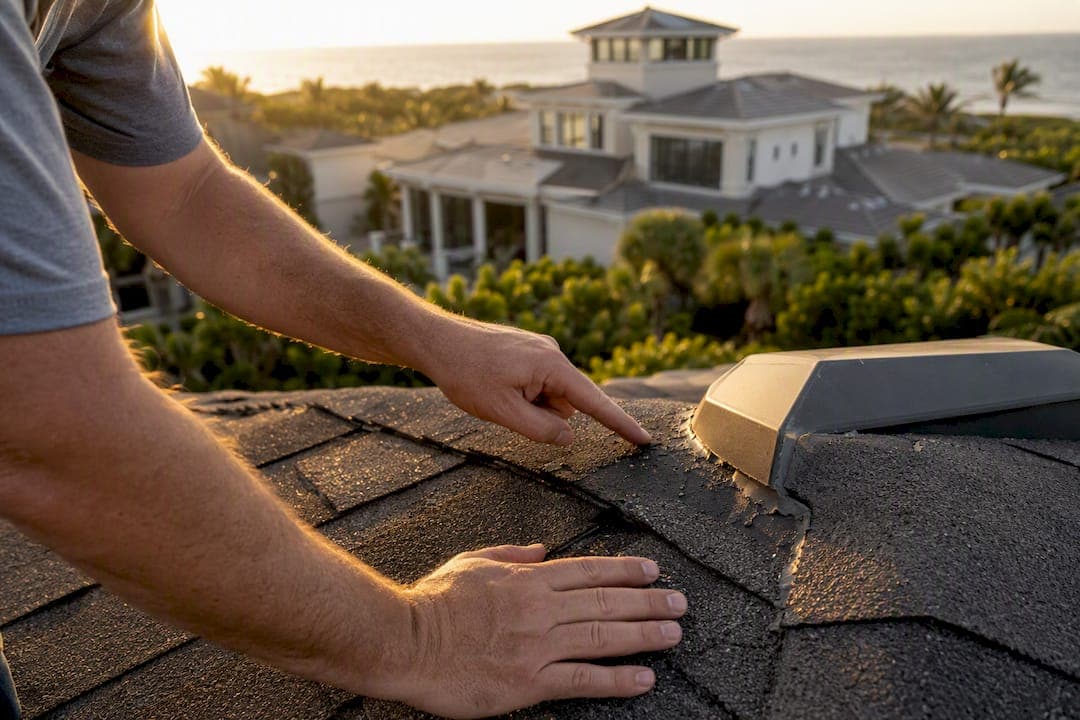
A proper home hurricane risk assessment starts with three checks, done this week, not the week a storm forms in the Gulf. First, pull up your address on FEMA's flood map and the National Hurricane Center's surge tools. Second, walk your property and inspect the roof attachments, garage door, and window openings. Third, read your insurance declarations page for your hurricane deductible and confirm your flood policy isn't sitting inside its 30-day waiting period.
Each step covers a different failure mode. Water, not wind, causes most hurricane deaths and property losses, according to NOAA, which is why the map check comes first. Roofs and openings decide whether wind gets inside your house and takes the structure apart from within. Insurance timing decides whether you're covered at all when the storm actually arrives.
- Check FEMA NFHL and NHC surge maps for your exact address
- Inspect roof attachments, garage door, and window/door openings
- Confirm your hurricane deductible and flood insurance waiting period
Key Takeaways
A sound home hurricane risk assessment combines FEMA and NHC map data, a hands-on structural check of the roof and openings, and a review of your insurance timing before storm season begins.
| Point | Details |
|---|---|
| Start with public maps | Check FEMA NFHL, NHC surge tools, and your county evacuation zone lookup for your exact address. |
| Water outranks wind | Storm surge and inland flooding cause more deaths and damage than wind alone, so prioritize elevation checks. |
| Inspect roof and openings | Roof-to-wall connections, garage doors, and window frames drive most wind-related structural failures. |
| Check insurance timing | Confirm your hurricane deductible percentage and buy flood insurance before the 30-day NFIP waiting period matters. |
| Pair DIY with oversight | Recurring inspections catch deterioration between your own seasonal checks and speed up repairs before a storm. |
Table of Contents
- How Do You Check Your Home's Hurricane Risk on Public Maps?
- Property-Level Structural Assessment: What to Check First
- Storm Surge and Flooding: Reading Elevation and Evacuation Zones
- What Should You Check on Your Insurance Policy?
- Prioritized Mitigation: What to Fix Now, Soon, and Eventually
- When Should You Call in a Structural Engineer?
- Why Continuous Oversight Beats a One-Time Checklist
- How Do Topography and Landscaping Affect Your Risk?
- Turning Your Assessment Into an Action Plan
- What Building Codes and Local Rules Affect Your Options?
- An Editorial Take on What Homeowners Get Wrong About Hurricane Risk
- Sources
How Do You Check Your Home's Hurricane Risk on Public Maps?
Three public tools cover most of what a homeowner needs, and none of them cost anything.
- FEMA's National Flood Hazard Layer (NFHL) shows your flood zone designation and, where available, Base Flood Elevation data tied to your parcel.
- NHC surge tools, including the Potential Storm Surge Flooding Map and the P-Surge probabilistic model, show worst-case coastal surge inundation for an active storm or a hypothetical one at your location.
- Your county or city emergency management site lists your evacuation zone, which combines surge and access-road data that neither FEMA nor NHC maps capture on their own.
Run them in that order: NFHL for your baseline flood zone, the surge tool for storm-specific inundation, then the evacuation zone lookup to see how officials actually classify your block. County and ZIP-level risk scores you'll find on real estate or insurance comparison sites are useful for a first pass, but they smooth over block-by-block differences in elevation and drainage. A property two lots from the water can carry a meaningfully different surge exposure than its neighbor, and none of the screening scores catch that. Treat them as a filter, not a verdict.
Property-Level Structural Assessment: What to Check First
Screening tools tell you the neighborhood's exposure. A walk around your own house tells you whether that exposure turns into damage. Focus on the systems that actually fail first in a hurricane.
Roof: Note the age and covering type, then look for lifted or missing shingles, exposed nail heads, and cracked seals around vents and flashing. Roof-to-wall connections matter more than most homeowners realize. FEMA's mitigation assessment teams have consistently found that homes retrofitted to current building-code standards for roof-deck attachment hold up dramatically better than older construction with toe-nailed rafters and no clips or straps.
Openings: Garage doors fail more often than people expect, since they're the largest opening on most homes and a common entry point for wind pressure. Test that yours operates smoothly and check whether it's rated for wind load or reinforced with a bracing kit. Inspect window and door frames for rot, gaps, or loose caulking, and note whether any openings already have impact-rated glass or shutters.
Site and drainage: Walk your gutters and downspouts, check grading around the foundation, and look for staining or watermarks that suggest past pooling.
- Photograph every vulnerability you find, with a wide shot and a close-up
- Measure your first-floor height off the ground, in inches
- Score each item as fine, watch, or fix now
Pro Tip: Keep your photos and scorecard in one folder by year. When you file an insurance claim or book a contractor, that timestamped record is worth more than any verbal description of "it was fine last time I checked."
If you find exposed roof decking, a garage door with visible bowing, or a first floor close to grade, that's your signal to bring in a professional rather than keep DIY-ing the fix.
Storm Surge and Flooding: Reading Elevation and Evacuation Zones
Storm surge is the wall of ocean water a hurricane pushes ashore. Inland flooding is what happens when rainfall overwhelms drainage far from the coast, sometimes days after landfall. Homeowners who fixate on wind often miss that a property fifteen miles inland can flood worse than one directly on the beach, depending on watershed and rainfall totals.
Your Base Flood Elevation (BFE) is the projected flood height FEMA assigns to your zone. Compare it against your first-floor height, the measurement you took during your structural sweep. A first floor sitting close to or below BFE means water is a realistic scenario, not a theoretical one.
Evacuation zones add a layer maps alone don't capture, since they factor in access roads and regional evacuation capacity alongside flood risk. Confirm yours with your county emergency management office and cross-reference it against your surge map results.
- Compare first-floor height to your published BFE
- Confirm your evacuation zone with the county, not a national database
- Reconcile surge maps against NFHL flood zones for the full picture
Mapped zones are built from historical data and regional modeling. They can underestimate risk on an individual lot, particularly where local drainage has changed since the map was last updated. Water hazards remain the leading cause of hurricane deaths and property damage, which is exactly why this section deserves more attention than most homeowners give it.
What Should You Check on Your Insurance Policy?
Your hurricane risk assessment isn't complete until you've read your own policy, not just your roof.
Find your named-storm or hurricane deductible on the declarations page. It's typically expressed as a percentage of your dwelling coverage rather than a flat dollar figure. Hurricane deductibles commonly run between 2% and 5% of dwelling coverage, meaning a $500,000 dwelling limit could carry a $10,000 to $25,000 deductible before your insurer pays a dime. Know that number before a storm, not after.
Standard homeowners insurance excludes flood damage entirely. Flood coverage requires a separate NFIP or private flood policy, and new NFIP policies carry a 30-day waiting period before coverage takes effect, with narrow exceptions like lender-required policies at closing.
- Locate your hurricane deductible percentage on the declarations page
- Buy or renew flood insurance well outside hurricane season, never during an active watch
- Ask your agent about binding moratoriums, which insurers use to freeze new policies once a storm is named
Insurers routinely stop writing or endorsing policies once a storm enters the forecast cone. If you're shopping for coverage in June, you have options. If you're shopping in September with a storm five days out, you may not.
Prioritized Mitigation: What to Fix Now, Soon, and Eventually
Once you know your risk, sequence the fixes by cost and urgency rather than tackling whatever feels most obvious.
- This week, low cost: Secure or store outdoor furniture, grills, and planters. Trim dead branches and overhanging limbs. Assemble an emergency kit, and the Red Cross recommends a minimum 72-hour supply of water, food, and medication per person.
- Within weeks, moderate cost: Brace or upgrade your garage door, install shutters or shutter-ready track clips, and repair any small roof issues you flagged during your inspection before they become bigger ones.
- Long term, higher cost: Retrofit roof-to-wall connections with hurricane clips or straps, replace an aging roof deck, or explore elevation work if your first-floor height sits near your BFE.
Cost and impact don't always move together. A $200 garage door brace can prevent a failure that leads to full roof loss once wind gets inside the structure, which makes it a higher-priority spend than a $3,000 landscaping upgrade. Save the bigger structural retrofits for when you've already handled the openings and roof attachment issues.
Pro Tip: If you're planning shutters, check the mounting specifications, not just the coverage. In high-velocity hurricane zones, shutters that flex too much on impact can shatter the glass they're supposed to protect.
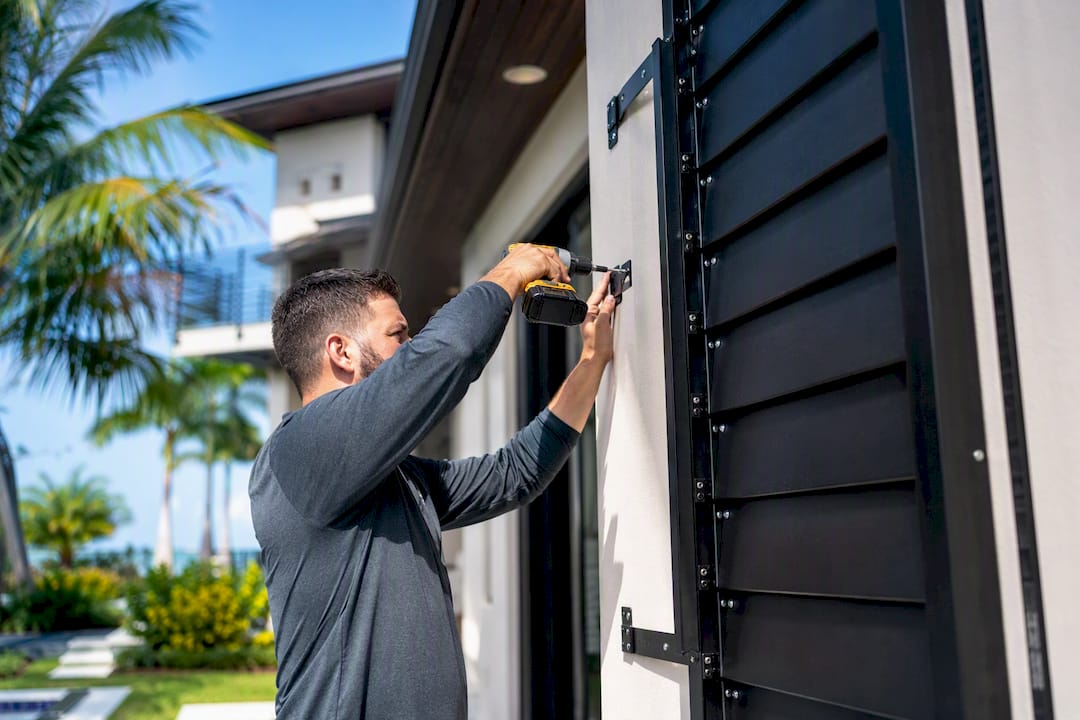
Bring in a contractor once you're past simple bracing and into structural work like re-strapping a roof or replacing decking. That's a licensed-trade job, not a weekend project.
When Should You Call in a Structural Engineer?
A home inspector, a wind-mitigation inspector, and a structural engineer aren't interchangeable, and knowing which one you need saves time and money.
A general home inspector covers broad condition issues. A wind-mitigation inspector, certified to Florida's uniform mitigation form, specifically documents roof shape, roof-deck attachment, and opening protection, the exact items insurers use to calculate premium discounts. A structural engineer gets involved when you've found something a mitigation inspector can't sign off on, such as suspected foundation movement or a roof-to-wall connection that looks compromised.
- Ask for a written report with photos, prioritized findings, and rough cost ranges for each repair.
- Use that report to solicit apples-to-apples contractor bids.
- Submit the mitigation portion to your insurer for a possible premium adjustment.
- Home inspector: general condition, broad scope
- Wind-mitigation inspector: roof, openings, insurance-relevant findings
- Structural engineer: load-bearing and connection concerns
Why Continuous Oversight Beats a One-Time Checklist
A single assessment tells you where your house stands today. It says nothing about the gutter that clogs in October or the roof screw that works loose over a mild winter. That's the gap a checklist can't close on its own, and it's the reason recurring, weekly-level inspection has real value for owners who split time between properties.
At 30apropertycollective, weekly inspections and anticipatory storm prep, including pre-authorized vendor coordination and securing outdoor assets before a named storm even forms, catch the small failures before they turn into the big ones. A proactive, managed approach shortens the gap between spotting a vulnerability and fixing it, which matters most for owners who aren't on-site to notice a loose shutter track or a failing garage door seal.
- Weekly inspections catch deterioration between your own DIY checks
- Vendor coordination means repairs happen before, not during, a watch
- Digital reporting gives you a documented history for insurers and contractors
Pair this guide's DIY assessment with scheduled oversight, or a one-time managed storm audit, for coverage that doesn't depend on you remembering to look.
How Do Topography and Landscaping Affect Your Risk?
Two houses on the same street can face different hurricane exposure because of elevation, slope, and tree cover, and most homeowners underestimate how much that local geography matters.
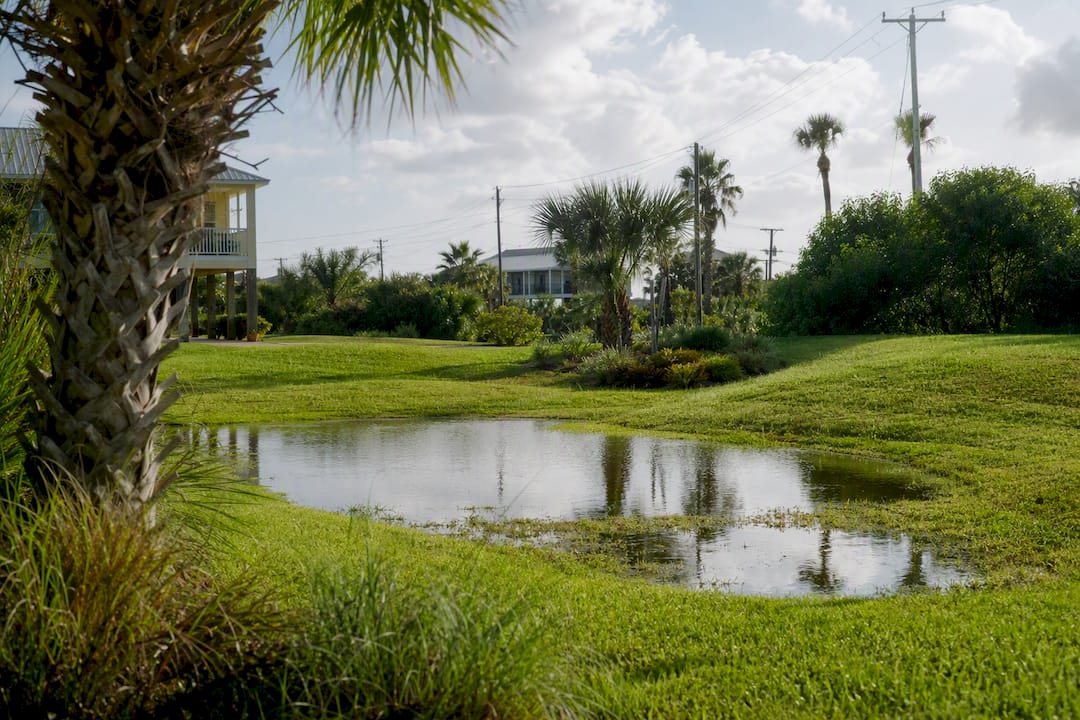
Elevation relative to your neighbors, not just relative to sea level, determines where water pools during heavy rain. A house sitting a few feet lower than the surrounding grade becomes the natural collection point for runoff, regardless of your official flood zone. Walk your lot after a heavy rain and note where water actually sits. That's more reliable than any map for predicting your own drainage problem.
Tree cover cuts both ways. Mature trees can buffer wind speed at ground level, but a large tree positioned too close to your roofline or power line becomes a liability once winds exceed 60 or 70 mph. Look at species, root depth, and proximity rather than assuming all mature trees are assets. Shallow-rooted species like laurel oaks and Bradford pears fail more often in saturated soil during a hurricane than deep-rooted natives.
Dune lines, seawalls, and even a neighbor's fence can redirect surge and wind in ways a regional map won't show. If your property sits near a canal, inlet, or low point in the terrain, walk the surrounding blocks to understand how water and wind funnel through your specific lot, not just your street's general flood zone. This is the layer a physical site visit adds that no digital tool replicates.
Turning Your Assessment Into an Action Plan
An assessment without a plan is just a list of worries. Convert your findings into a sequence you'll actually execute by sorting every item into one of three tiers: life-safety, property protection, and long-term resilience.
Life-safety items go first, always. That means confirming your evacuation zone, knowing your evacuation route, and having a plan for pets, medications, and important documents. Nothing on a structural checklist outranks getting people out safely.
Property protection items come next: garage door bracing, shutter installation, and small roof repairs you can complete in weeks, not months. These are the fixes that most directly reduce the odds of a total loss versus a repairable one.
Long-term resilience work, like roof-deck retrofits or elevation changes, gets scheduled on its own timeline, often tied to your next roof replacement or a planned renovation, since bundling structural work saves money compared to doing it in isolation.
Set a calendar reminder for each tier. Life-safety plans get reviewed every hurricane season, before June 1. Property protection items get a firm deadline, not a vague "someday." Long-term resilience work gets revisited annually alongside your insurance renewal, when you'll want fresh documentation anyway of what's been fixed since your last assessment. A wind-mitigation inspection at that point can also translate your completed upgrades into a premium discount.
What Building Codes and Local Rules Affect Your Options?
Local ordinances shape what mitigation you're allowed to do, sometimes more than your budget does.
Florida's High-Velocity Hurricane Zone (HVHZ) counties, primarily Miami-Dade and Broward, enforce stricter fenestration and attachment standards than the rest of the state. Shutters, impact windows, and even garage doors installed in HVHZ jurisdictions must meet specific product-approval and mounting-separation requirements, and a shutter that would pass inspection in a non-HVHZ county might not qualify there.
Many coastal municipalities also require permits for roof replacement, shutter installation, and garage door swaps, particularly when the work affects wind-resistance ratings. Skipping the permit doesn't just risk a fine. It can void the insurance premium credit you were hoping to earn from a wind-mitigation inspection, since insurers often want permitted, code-compliant work on file.
Historic district overlays add another wrinkle. Homes in a designated historic zone may face restrictions on visible exterior changes, including shutter style or window replacement, which means you'll need architectural review board approval before installing certain hurricane protection products. Check with your local building department before buying materials, not after.
If you're doing a full retrofit involving replacement doors or reinforced openings, a partner like One Day Doors & Closets can help you source products that already meet regional code requirements, which saves a permitting headache down the line.
An Editorial Take on What Homeowners Get Wrong About Hurricane Risk
Most hurricane preparedness content treats wind as the main event and water as an afterthought. That's backward. The data on hurricane fatalities and property loss keeps pointing to surge and inland flooding as the bigger threat, yet the popular imagination still runs toward plywood and shutters first.
The conventional advice also treats risk assessment as a one-time event, something you do in May and forget until next season. That's a mismatch with how houses actually deteriorate. A roof connection that passed inspection two years ago can loosen from ordinary weather cycling, long before any named storm arrives. Annual or seasonal DIY checks are a floor, not a ceiling.
What I'd prioritize differently: spend more time on your BFE and evacuation zone than on debating shutter brands, and treat your insurance declarations page with the same seriousness as your roof. A homeowner who nails the maps, the openings, and the paperwork, but skips a fancy retrofit, is in better shape than one who buys premium shutters while sitting on a lapsed flood policy. The unglamorous parts of this process are usually the ones that matter most.
— Zackary
Sources
- FloodSmart — How to buy flood insurance (NFIP)
- NOAA — Inland flooding: the hidden danger of tropical cyclones
Ready to move from assessment to action? A concierge membership through 30apropertycollective pairs weekly inspections with anticipatory storm prep, so the vulnerabilities you find on your own walk-through get scheduled, tracked, and resolved before the next watch goes up.