
Most homes need their gutters cleaned seasonally, in spring and fall. That's the baseline, and for a typical suburban lot with a few trees and a standard roof, it's enough to prevent nearly all water damage. But that number moves fast: homes shaded by pine or other evergreen trees often need quarterly attention because needles drop year-round instead of in one seasonal burst, and any property that just took a direct hit from a storm needs an inspection promptly, irrespective of schedule.
Here's your immediate next step:
- Check your calendar right now. If you haven't cleaned since last fall or you've had a major storm in the past week, schedule an inspection this week, not next month.
Key Takeaways
Most homes need gutters cleaned twice a year, but tree type, climate, storms, and roof complexity can push that to quarterly or triggered-by-event cleaning instead.
| Point | Details |
|---|---|
| Baseline schedule | Clean gutters at least twice a year, spring and fall, for most standard homes. |
| Trees change the math | Pine and evergreen coverage often pushes cleaning to quarterly due to year-round needle drop. |
| Guards reduce, don't eliminate | Even micromesh guards need at least an annual flush to clear silt and biofilm. |
| Watch for early signs | Overflow, siding stains, sagging troughs, and shingle grit all mean clean now, not later. |
| Delegate for tall or complex homes | 30apropertycollective folds gutter checks into weekly inspections and post-storm response so nothing gets missed. |
Table of Contents
- What Happens If You Skip a Gutter Cleaning Schedule?
- How Often Should You Clean Gutters Based on Your Situation?
- What's the Best Seasonal Schedule for Gutter Cleaning?
- What Factors Push Your Gutter Cleaning Frequency Higher?
- Do Gutter Guards Mean You Never Have to Clean Gutters?
- What Signs Mean You Need to Clean Your Gutters Right Now?
- Should You Clean Gutters Yourself or Hire a Professional?
- Let 30apropertycollective Handle the Gutter Calendar for You
- Frequently Asked Questions
- Sources
What Happens If You Skip a Gutter Cleaning Schedule?
A clogged gutter doesn't just look bad. It redirects water exactly where you don't want it: against your foundation, behind your siding, and under your roofline.

Here's the chain reaction most homeowners don't see coming. Water backs up over the gutter edge and pools next to the foundation, saturating the soil and eventually pushing moisture into basements or crawlspaces. That same standing water works its way behind fascia boards, where it feeds wood rot you won't notice until the board is soft enough to push a finger through. In cold climates, the water that doesn't drain freezes and thaws in cycles, building the ice dams that lift shingles and force water under your roofline.
Statistic callout: The EPA identifies excess moisture and standing water as a primary driver of mold growth inside homes, and a gutter system that isn't clearing water is one of the most common, least visible sources of that moisture.
A few consequences show up faster than others:
- Foundation cracking from repeated soil saturation near the base of the house.
- Siding and soffit rot where overflow runs down the exterior wall instead of through the downspout.
- Pest habitat in standing debris, which attracts mosquitoes, rodents, and nesting birds.
- Roof and fascia damage from water intrusion at the roofline, often invisible until you're paying for a full repair.
None of this is dramatic until it is. A neglected gutter system is one of the quieter ways a property racks up expensive repair bills over a few seasons of inattention.
How Often Should You Clean Gutters Based on Your Situation?
The twice-a-year rule is a starting point, not a universal law. Your actual gutter cleaning frequency depends on what's hanging over your roof and what your climate throws at your house.
| Situation | Recommended frequency | Why |
|---|---|---|
| Few or no trees nearby | Twice a year (spring, fall) | Minimal debris load, standard baseline applies |
| Typical suburban lot with some trees | Twice a year, plus a post-storm check | Seasonal leaf drop is manageable with routine cleanings |
| Many deciduous trees over the roof | Quarterly | Heavier leaf volume clogs troughs faster between seasons |
| Near pine or evergreen trees | Every three months | Needles shed year-round instead of one seasonal drop |
| Storm-prone or high-rainfall climate | After every major storm, minimum quarterly | Heavy rain events overload gutters faster and expose weak joints |
| Large or complex roof (multiple valleys, dormers) | Quarterly | More roof planes funnel more water and debris into fewer gutter runs |
| Older seamed gutters | Twice a year with a structural check | Seams loosen over time and need inspection beyond just clearing debris |
| Homes with micromesh gutter guards | Annual flush, plus visual checks | Guards cut volume but silt and biofilm still build up on the screen |
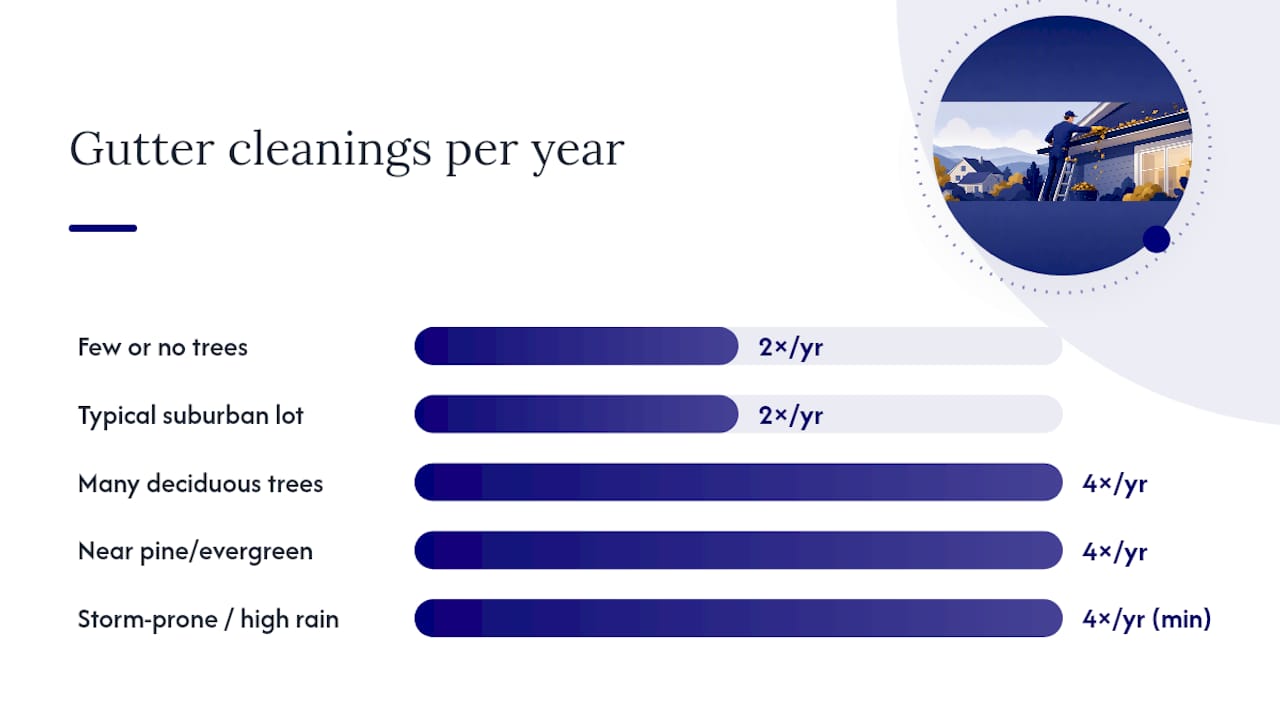
A property with several mature oaks overhanging the roofline may require quarterly cleaning, especially heading into fall. A single-story home with a clean roofline and no trees within 30 feet can often stick to the twice-a-year baseline without issue. Match your row to your actual property, not the average one.
Pro Tip: Walk your gutter line the day after any storm with sustained wind or heavy rain. Early signs like a sagging bracket or a slow drip from a downspout joint are cheaper to fix in week one than in month three.
What's the Best Seasonal Schedule for Gutter Cleaning?
Timing matters as much as frequency. Cleaning at the wrong moment in the season wastes effort, since you'll just do it again once more debris falls.
Spring is for clearing what winter left behind. Once temperatures stabilize, clear out compacted debris, check for winter damage like cracked seams or pulled brackets, and flush downspouts to confirm free-flowing drainage before spring rain arrives.
Summer is a light-touch season. Do a visual inspection after any major thunderstorm, and knock out small touch-ups if you notice a sagging section or a spot where water is overflowing during rain.
Fall is the primary cleaning window for most homes, but timing it right takes patience. Wait until most leaves have dropped rather than cleaning too early and doing the job twice. The goal is clear gutters before the first hard freeze, which lowers ice dam risk significantly.
Winter is for watching, not climbing. Avoid ladder work on icy ground or frozen roofs entirely. Instead, watch for ice dams forming along the roof edge and note any trouble spots to address as soon as conditions allow.
A practical seasonal action list:
- Clear compacted debris and flush downspouts (spring).
- Inspect for winter damage to seams, brackets, and end caps (spring).
- Check flow during or after heavy summer storms (summer).
- Fix any minor sagging or leaks you spot (summer).
- Do a full clean once most leaves are down (fall).
- Confirm downspouts discharge freely before the first freeze (fall).
- Watch for ice dams and log trouble spots for spring repair (winter).
What Factors Push Your Gutter Cleaning Frequency Higher?
Five variables do most of the work in deciding how often you actually need to clean, beyond the baseline calendar.
Tree type and placement matters more than tree count. Deciduous trees dump their debris in a concentrated seasonal window, which spring and fall cleanings handle well. Pines and other evergreens shed small needles continuously, which is why they push a property toward quarterly cleaning regardless of season.
Climate and storm frequency change the math too. Regions with frequent high winds or heavy rain events load gutters faster and expose weak seams sooner, so a storm-prone coastal property needs inspections tied to weather events, not just the calendar.
Roof size and complexity add up fast. More valleys, dormers, and roof planes mean more water and debris funneling into the same gutter run, which clogs faster than a simple gable roof of the same square footage.
Gutter guards change the type of maintenance more than the need for it, which the next section covers in detail.
Picture an older home with three mature pines and a multi-valley roof. That combination pushes past quarterly into a near-monthly visual check during peak needle drop, even if a full clean only happens four times a year.
Pro Tip: Strategic tree trimming, cutting back limbs that overhang the roofline by even a few feet, can meaningfully cut debris load and stretch your cleaning interval without touching the gutters at all.
Do Gutter Guards Mean You Never Have to Clean Gutters?
No. Gutter guards reduce debris volume, but they don't eliminate maintenance, and treating them as a "set it and forget it" fix is how homeowners get caught off guard.
Different guard types come with different limits:
- Mesh guards block leaves well but can let fine silt and seed pods through over time.
- Foam inserts are cheap and easy to install but degrade and can trap moisture inside the foam itself.
- Reverse-curve guards shed leaves effectively in heavy rain but struggle with low-flow drizzle.
- Screen guards work for larger debris but need regular brushing to stay clear of smaller particles.
Even premium micromesh systems need at least one annual flush, since fine silt and biofilm can seal the screen over time and block water intake without ever looking clogged from the ground. Guarded gutters still warrant a visual check twice a year and a full flush annually. That's a lighter load than unguarded gutters, not a free pass.
What Signs Mean You Need to Clean Your Gutters Right Now?
Some warning signs mean don't wait for spring or fall. Deal with these the day you notice them.
- Overflowing water during rain instead of draining through the downspout, which usually means a full or partial clog.
- Water stains on siding below the gutter line, a sign that overflow has been happening for a while.
- Pooling water near the foundation after rain, which points to a downspout dumping water in the wrong place.
- Sagging gutter sections that pull away from the fascia, often from waterlogged debris weight.
- Plant growth or nests inside the trough, a clear sign debris has been sitting long enough to become soil.
- Downspout backups where water sits instead of flowing through when you run a hose test.
- Visible shingle grit collecting in the gutter, which signals roof wear beyond the gutters themselves and deserves a broader roof inspection.
Once you've cleared debris, run a garden hose at the roofline and watch the water travel the full length of the gutter and out the downspout. If it backs up anywhere, you've found your next problem spot.
Should You Clean Gutters Yourself or Hire a Professional?
The decision usually comes down to height, complexity, and how much time you actually want to spend on a ladder.
Safety comes first. Ladder work on wet or sloped ground, near power lines, or above a second story carries real fall risk, and OSHA's ladder safety guidelines exist for a reason. If your home is more than one story or your roof has a steep pitch, that alone is a strong argument for hiring out the job.
Cost expectations vary by region, but professional gutter cleaning cost varies by region and property size, often ranging from modest to moderate prices per visit, with multi-story or heavily wooded properties running higher. Price scales with roof height, total gutter footage, debris type, and whether the crew finds repairs along the way.
Statistic callout: Preventative gutter maintenance costs are consistently far smaller than the repair bills that follow foundation, siding, or roof damage from prolonged neglect. Routine cleaning is cost-effective insurance against potentially expensive water damage repair.
Before hiring anyone, ask a few direct questions:
- Are you insured and licensed to work in this area?
- Can you provide references from recent jobs?
- Will I get a written estimate before work starts?
- Do you offer any warranty on the work?
Red flags include a contractor who won't put pricing in writing, can't show proof of insurance, or pressures you to sign same-day. A good property inspection process includes documentation you can actually review afterward, not just a verbal "all clear."
Professionals typically go beyond a simple clean anyway: flushing downspouts fully, resealing loose joints, correcting gutter slope, and photographing the finished job for your records. That last part matters more than most homeowners realize, since insiders always verify the downspout discharge point at ground level, not just the trough itself, because a clear gutter with a blocked downspout exit still sends water straight into your foundation.
How Estate Management Services Handle Gutter Care
Professional estate management folds gutter care into a routine rather than treating it as a standalone task. A typical approach includes scheduled seasonal cleanings tied to the property's specific tree cover, weekly visual checks that catch early sagging or debris buildup, and rapid post-storm response when overflow or downspout blockages show up unannounced.
The recurring tasks usually include:
- Routine visual inspection during weekly property walkthroughs.
- Scheduling and vetting contractors for seasonal cleanings.
- Photo documentation logged after every service visit.
- Coordinating tree trimming to reduce debris load before it becomes a problem.
- Pre-arrival checks before an owner returns, confirming gutters are clear and flowing.
A Practical Take on Scheduling and Delegation
I'd rather see a homeowner commit fully to the twice-a-year baseline and treat every exception as a real trigger, not an optional upgrade. The mistake I see most often isn't skipping gutters entirely. It's assuming a "normal" schedule applies to a property with three pines and a coastal storm pattern. Match your actual property to your actual schedule, then stop guessing at it.
One habit worth building: keep a simple photo log after each cleaning, dated and stored somewhere you'll actually find it. If your home is tall, has a complex roofline, or you're simply busy enough that gutters fall off your radar every year, handing the job to a service you trust isn't cutting corners. It's the same logic as a maintenance contract on anything else that's expensive to ignore.
Let 30apropertycollective Handle the Gutter Calendar for You
Keeping a gutter cleaning schedule on track means remembering the calendar, watching the weather, and vetting a contractor every single time, on top of everything else that comes with owning a home along the Emerald Coast. 30apropertycollective folds that entire cycle into routine estate care instead of leaving it as one more task you have to track yourself.

Through weekly inspections, 30apropertycollective catches early warning signs, sagging brackets, early overflow, debris buildup, before they become expensive repairs, then coordinates vetted contractors directly so you're never scrambling to find someone after a storm. Every visit gets documented, so you have a clear record of what was checked and when, without having to be on-site yourself. Plans scale to the property, whether you need a lighter touch through Essential-level care or full oversight through Estate Management, and every arrangement stays as discreet as the rest of your estate's upkeep.
If you'd rather stop tracking gutter cleanings on your own calendar, take a look at 30apropertycollective's estate management services and find the plan that fits your property.
Frequently Asked Questions
How often should you clean gutters if you have no trees nearby? Twice a year, in spring and fall, is usually enough. Without significant tree cover, debris accumulates slowly, so the standard baseline schedule holds up well.
How often should you inspect your roof along with gutter cleaning? Pair a roof inspection with each gutter cleaning, so at least twice a year, and add an extra check after any major storm to catch loosened shingles or damage early.
How often should you wash windows compared to cleaning gutters? Window washing typically follows a similar twice-a-year rhythm for most homes, though coastal properties dealing with salt spray may benefit from quarterly washing alongside more frequent gutter checks.
Can you go a full year without cleaning your gutters? It depends on your property, but skipping a full year on a home with any meaningful tree cover raises the risk of overflow, siding damage, and the moisture issues that come with clogged drainage.
Does rain wash debris out of gutters naturally? No. Rain typically pushes debris further into a clog rather than clearing it, and heavy rain on a clogged system is exactly when overflow and foundation saturation happen.
Sources
- Solved! This Is How Often to Clean Your Gutters - Bob Vila
- How Often Should You Clean Your Gutters—And Why It Matters More Than You Think | Southern Living
- A Brief Guide to Mold, Moisture, and Your Home | EPA
- How often to clean gutters | The Spruce