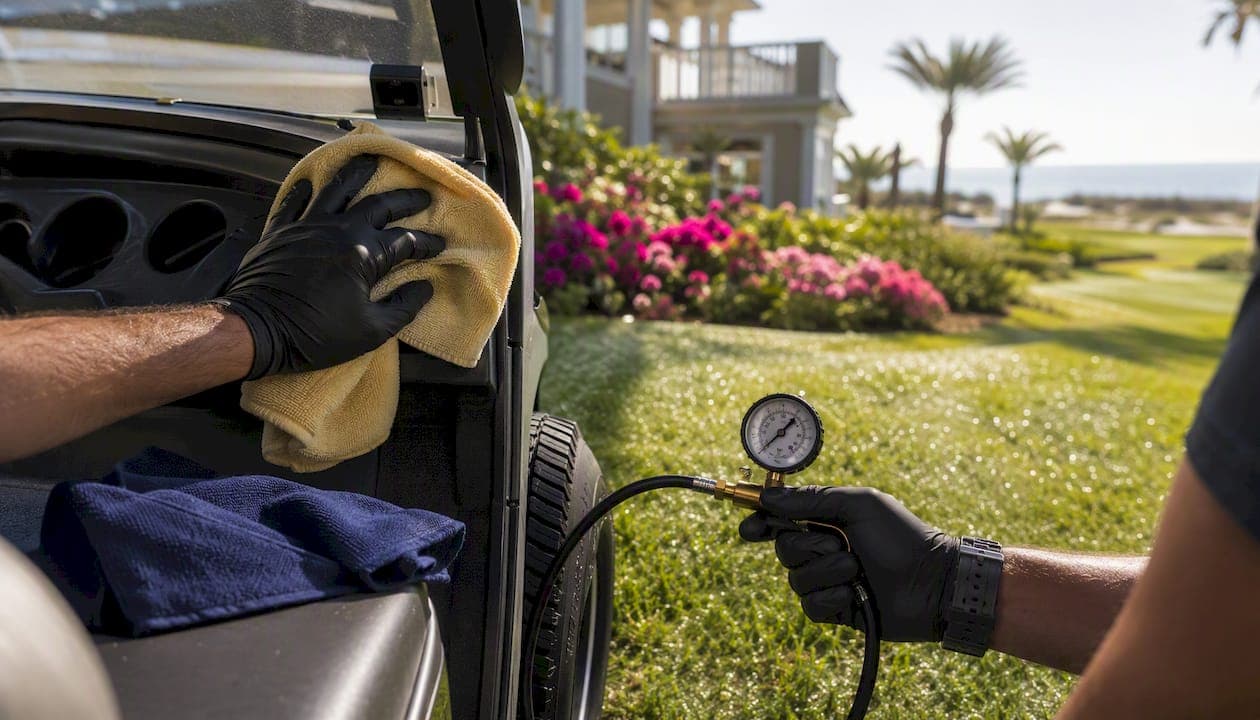
A weekly-to-annual, delegated golf cart maintenance schedule with photo-timestamped signoffs and vendor SLAs keeps estate-owned carts guest-ready and storm-ready on Florida's Emerald Coast. Run inspections weekly, charge checks monthly, mechanical service quarterly, full technician overhauls biannually, and a comprehensive annual review. Before and after every named storm, run a dedicated pre/post-storm assessment. Every completed task gets a photo, a timestamp, and a named signer.
Core tasks by frequency:
- Weekly: Visual inspection (tires, lights, body), battery charge level check, clean exterior, log odometer or hour meter, photo with timestamp, signer initials
- Monthly: Battery water level (lead-acid) or cell voltage (lithium), tire pressure, brake feel, charger connection and cord condition, update digital log
- Quarterly: Full mechanical check by approved vendor (brakes, steering, belts, battery terminals), tire rotation or replacement assessment, lighting test
- Biannual: Technician-led inspection of all electrical systems, suspension, and frame; battery load test; update service record
- Annual: Comprehensive overhaul, full battery replacement assessment, vendor-signed service report, photo documentation of all components
- Pre-storm: Secure carts in designated shelter, disconnect chargers, photograph condition, tag with date and signer
- Post-storm: Isolate all carts, block charging until inspected, complete flood-recovery checklist, vendor sign-off before return to service
Handoff rule: The estate attendant signs every weekly log.
Pro Tip: Set a recurring calendar block every Monday morning for the weekly inspection. Carts missed on Monday before a Friday arrival become the most expensive last-minute vendor calls of the season.
Key Takeaways
A delegated golf cart maintenance schedule, with weekly logs, quarterly vendor visits, and a documented storm protocol, is the difference between a guest-ready cart and an expensive reactive repair.
| Point | Details |
|---|---|
| Weekly logs are non-negotiable | Every inspection needs a photo, timestamp, and named signer before the next arrival. |
| Tiered scheduling cuts costs sharply | A structured monthly/quarterly/annual protocol reduced one Florida resort's repair bill from $12,247 to $2,814. |
| Storm protocol starts before the storm | Disconnect chargers, shelter carts, and photograph condition before a named storm makes landfall. |
| Vendor SLAs must be written | Require photo-documented repairs, 48-hour response windows, and proof of insurance before any vendor visit. |
| 30apropertycollective operationalizes the schedule | Signature and Estate plans include weekly cart inspections, vendor oversight, and pre/post-storm documentation. |
Table of Contents
- What does a full golf cart maintenance schedule look like week to year?
- Who is responsible for each task on a managed estate?
- How should you prepare golf carts for Emerald Coast storms?
- What SLA terms should you require from a golf cart service vendor?
- How do you approve drivers and set on-estate driving rules?
- How do you integrate golf cart logs into weekly estate inspections?
- How does 30apropertycollective handle delegated golf cart care?
- What estate managers get wrong about golf cart documentation
- Golf cart care without the coordination overhead
- Sources
What does a full golf cart maintenance schedule look like week to year?
A tiered preventive maintenance protocol is the single most cost-effective decision a managed fleet can make. One Florida resort cut annual repair costs from $12,247 to $2,814 after implementing a structured three-tier schedule. For a luxury estate with one to four carts, the savings are proportionally similar and the guest-readiness upside is even more visible.
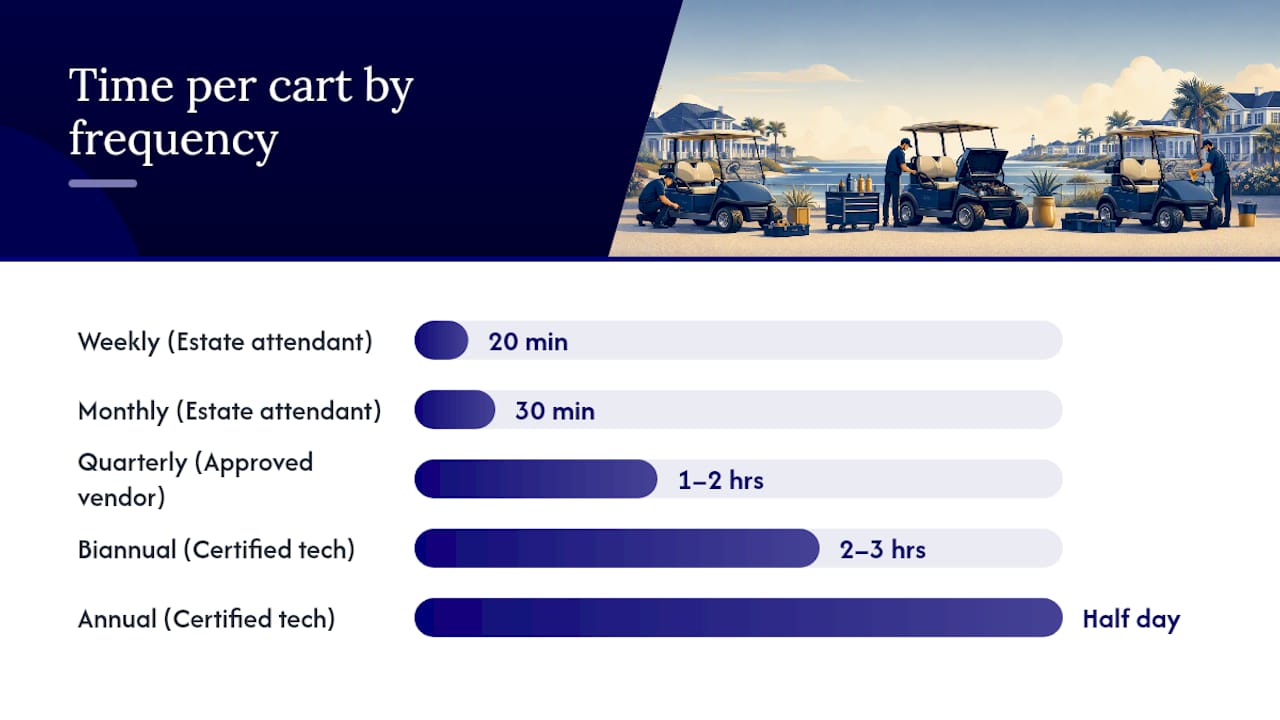
| Frequency | Core Tasks | Time per Cart | Role |
|---|---|---|---|
| Weekly | Visual check, charge level, clean, photo log | 20 min | Estate attendant |
| Monthly | Tire pressure, battery cells, charger cord, brake feel | 30 min | Estate attendant |
| Quarterly | Mechanical inspection, terminals, lighting, tire assessment | 1–2 hrs | Approved vendor |
| Biannual | Electrical systems, suspension, battery load test | 2–3 hrs | Certified technician |
| Annual | Full overhaul, battery replacement review, signed report | Half day | Certified technician |
| Pre-storm | Shelter, disconnect, photo, tag | 30 min | Estate attendant |
| Post-storm | Isolate, flood checklist, vendor clearance | 1–4 hrs | Vendor + attendant |
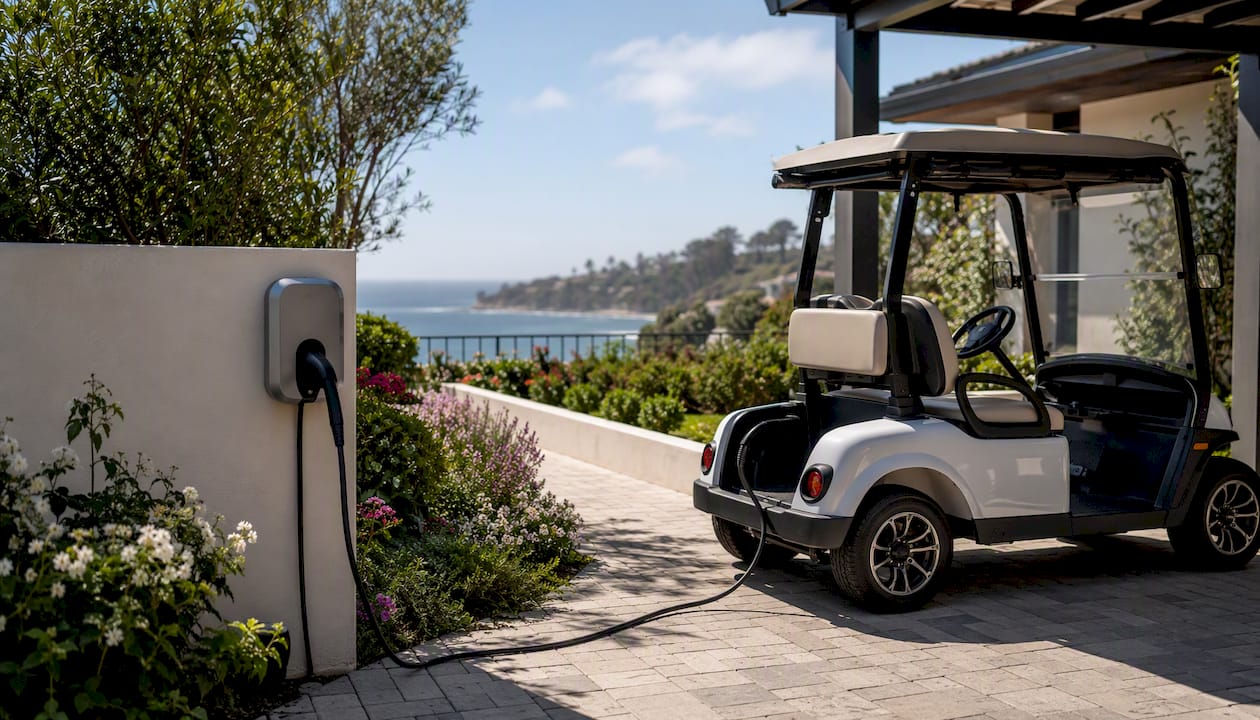
Electric vs. gas notes: Electric carts require daily charge monitoring and a fixed charging layout with predictable parking positions and weather-protected chargers. Gas carts add fuel level checks, oil changes, and air filter inspections to the monthly and quarterly intervals. The delegation logic is identical for both; only the vendor's checklist differs.
Pair quarterly vendor visits with your spring home maintenance checklist to consolidate crew time and reduce separate scheduling overhead.
Who is responsible for each task on a managed estate?
Clear ownership prevents the most common failure mode: a task everyone assumes someone else completed.
- Estate attendant: Weekly and monthly inspections, photo logs, charge monitoring, exterior cleaning, escalation calls
- Approved driver: Pre-drive walkaround (lights, tires, charge indicator), defect reporting before and after each use
- In-house mechanic (if applicable): Minor fixes between vendor visits, tire inflation, battery watering
- Third-party vendor: Quarterly and biannual mechanical service, annual overhaul, post-storm clearance, written service records
Driver approval requires a minimum age of 16 (per Florida statute for golf cart operation on approved roads), a documented orientation signoff, and a copy of the estate's driving rules on file. For vendor and contractor oversight, require proof of liability insurance and a written scope before any vendor touches a cart.
Pro Tip: Batch the quarterly mechanical check with any other vendor visits already scheduled that week. A technician already on-site for another task costs far less in travel time than a standalone call.
How should you prepare golf carts for Emerald Coast storms?
Florida's Gulf Coast storm season runs June through November. A cart left plugged in during a flood event is a total loss waiting to happen.
Pre-storm checklist:
- Move all carts to the designated interior shelter (garage bay, covered structure away from flood zones)
- Disconnect all chargers from wall outlets and from the cart
- Photograph each cart's condition with timestamp before securing
- Attach a pre-storm tag noting date, signer, and charge level at time of sheltering
Post-storm actions:
- Tag every cart out-of-service immediately after the storm passes
- Do not plug in any cart that may have had water exposure. After flood exposure, isolate the cart, document the exposure, and inspect system-by-system before returning it to service
- Estate staff can clear a cart for light duty only if it was confirmed sheltered above flood level with no water contact and passes the visual post-storm checklist
- Any cart with water contact requires a certified technician sign-off before charging or use
Vendor involvement timeline: contact your service vendor within 24 hours of storm passage. Technician inspection should occur within 48–72 hours for any cart with potential exposure. Golf cart safety guidance recommends comprehensive mechanical checks at least once yearly, and a post-storm event counts as a mandatory trigger regardless of the annual schedule.
Pro Tip: Pre-position your vendor's emergency contact and your estate's shelter location in the same document. During an active storm watch, you will not have time to search for either.

What SLA terms should you require from a golf cart service vendor?
A vendor without a written SLA is a vendor you cannot hold accountable. Require these terms before signing any recurring service agreement.
SLA minimums to insist on:
- Response window: non-emergency service within 48 hours, guest-readiness emergencies within 4 hours
- Photo-documented repairs with before-and-after images for every service visit
- Digital service records delivered within 24 hours of visit completion
- Written estimate before any work exceeding a pre-agreed threshold (typically $150)
- Parts warranty of at least 90 days on labor and installed components
- Proof of general liability insurance ($1 million minimum) and any applicable certifications on file before first visit
Pricing structures: Flat monthly retainers work well for estates with two or more carts and predictable usage. Per-service billing suits single-cart estates with low seasonal use. Ask vendors about fleet discounts for three or more carts and pre-season storm prep pricing, which is often bundled at a lower rate when scheduled before June 1.
Photo-documented service with written estimates and digital records is standard practice for property-manager-facing vendors in the 30A corridor. If a vendor resists any of these terms, that resistance is the answer.
How do you approve drivers and set on-estate driving rules?
Driver orientation is a one-time investment that prevents recurring liability. Run every approved driver through a documented checklist before their first use.
Driver approval criteria:
- Minimum age 16 for roads designated for golf cart use under Florida law
- Completed estate orientation with signed acknowledgment
- Insurance verification on file where the cart operates on public roads
- Familiarity with local rules: 30A golf cart rules, Santa Rosa Beach, and Walton County each have specific road-use designations
Orientation checklist:
- Approved routes and off-limits terrain (beach access, soft sand, steep grades)
- Speed limit: 20 mph maximum on most designated roads; estate-specific limits may be lower
- Passenger capacity per cart model (never exceed manufacturer rating)
- Pre-drive walkaround procedure (lights, tires, charge indicator)
- Defect reporting: who to call, how to tag the cart out-of-service
- Charging protocol: plug in after every use, never leave at partial charge overnight
Pro Tip: Post a laminated one-page rules card inside each cart. Guests read what is in front of them. A verbal briefing alone is forgotten by the second day.
How do you integrate golf cart logs into weekly estate inspections?
A golf cart maintenance checklist that lives in a separate binder is a checklist that gets skipped. Embed it in the weekly estate inspection report so it travels with every other property record.
Minimum fields per cart log entry:
| Field | What to Record |
|---|---|
| Cart ID | Unit number or license plate |
| Date and signer | Full date, printed name, initials |
| Odometer/hours | Current reading at inspection |
| Battery state | Charge percentage or voltage reading |
| Tire condition | Pressure (PSI) and visual tread note |
| Photo attachments | Minimum two photos, timestamped |
| Defects noted | Description or "none" |
| Next service due | Date of next scheduled vendor visit |
Integrate this log into the weekly estate inspection report alongside HVAC, pool, and exterior checks. Track three KPIs per cart monthly: uptime percentage, repairs per cart per quarter, and average time-to-repair. Modern fleet management best practices treat these metrics as the minimum for cost-aware asset oversight.
Pro Tip: Use a shared digital folder (Google Drive, Dropbox, or your estate management platform) with a subfolder per cart. Every photo, log, and vendor invoice goes in automatically. An owner can pull the full service history in 30 seconds from anywhere.
How does 30apropertycollective handle delegated golf cart care?
30apropertycollective builds golf cart coordination into its Signature and Estate membership tiers as part of weekly estate inspections and vendor oversight. Included in those plans:
- Weekly photo-timestamped inspection reports covering cart condition, charge state, and any defects
- Vendor scheduling and oversight for quarterly mechanical service and annual overhauls
- Pre-storm preparation and post-storm assessment reports with documented cart status
- Arrival-readiness confirmation that carts are charged, clean, and cleared before owner or guest check-in
- Digital maintenance logs integrated with the broader weekly estate report
The Concierge service adds bespoke coordination for owners who want vendor SLA management, emergency response, and custom reporting cadences handled entirely on their behalf.
For absentee owners, this means the cart is never the reason an arrival falls short. Every service record, photo, and vendor invoice is documented and accessible. To add golf cart maintenance to an existing membership or request a custom estate proposal, contact 30apropertycollective directly through the Concierge page.
What estate managers get wrong about golf cart documentation
The most common failure is treating the photo log as optional until something goes wrong. A cart returned with a cracked panel, a dead battery, or a brake issue after a guest stay becomes a dispute the moment there is no pre-stay photo on record. Without a timestamp and a signer, there is no baseline.
The habit change that prevents this: require a photo log entry as the final step of every arrival-readiness check, not a separate task. When it is the last item before the estate is cleared for arrival, it never gets skipped.
Golf cart care without the coordination overhead
Coordinating vendors, chasing service records, and verifying that a cart is charged and ready before a Friday arrival is exactly the kind of task that falls through the cracks when an owner is not on-site.

30apropertycollective handles the entire golf cart maintenance cycle as part of its Signature and Estate plans on Florida's Emerald Coast: weekly inspections with photo documentation, vendor scheduling and oversight, pre-storm preparation, and arrival-readiness confirmation. No separate vendor relationships to manage. No service records to chase. Every log, photo, and invoice is documented and accessible when you need it.
Owners who want golf cart coordination added to an existing membership or built into a new estate plan can request a custom proposal through the Concierge page.
Sources
The following sources support the schedule and protocols in this article. Attach the flood-recovery checklist and the vendor SLA requirements to any new service agreement.
- Golf cart safety
- Why a Florida Resort's Fleet of 40 Golf Carts Went from ... | South Florida Golf Carts
- How to Plan Charging, Parking, and Dispatch for an Electric Golf Cart Fleet - Varyon Machinery
Attach the flood-recovery checklist and the vendor proof-of-insurance requirement to every new service agreement. The pre/post-storm assessment form and the weekly photo log template are available through 30apropertycollective's estate management onboarding.