Before you sign anything, run every contractor through six non-negotiable checks: valid state license, certificate of insurance (COI) with workers' comp, verifiable references from comparable projects, a written contract with scope and payment milestones, clear permit responsibility, and confirmation of who will actually do the work. The single first action is to ask for the contractor's license number and request that their insurer send you the COI directly. A structured vetting process covers five principal risk categories: legal standing, financial instruments, regulatory compliance, references and litigation history, and technical qualifications. Miss any one of them and you are exposed.
Start here, before the first meeting:
- License: Get the license number and verify it on your state licensing board's website before the conversation goes further.
- COI: Call the contractor's insurer directly, not the contractor, to confirm the certificate is active and the policy limits are adequate.
- Workers' comp: Confirm coverage or a valid exemption in writing. If a worker is injured on your property without it, you may be liable.
- References: Request three clients from the last 12 months with comparable project scope. Call all three.
- Written contract: Refuse any verbal agreement. Scope, materials, timeline, payment schedule, and change-order process must be in writing.
- Permit responsibility: Ask who pulls the permits. The answer should be the contractor, not you.
Key Takeaways
A complete contractor vetting checklist covers six core areas: license, insurance, references, written contract, permit responsibility, and financial capacity, and every check should be completed before a contract is signed.
| Point | Details |
|---|---|
| Verify license and COI first | Request the license number and call the insurer directly to confirm active coverage before any other step. |
| Limit deposits to a reasonable percentage | Deposits above 15–20% before work begins are a red flag; some states cap them by law. |
| Require lien waivers with every draw | Conditional waivers at each payment protect you from mechanics' liens if the contractor fails to pay subs. |
| Build permit time into the schedule | In coastal Florida counties, permit review alone can take 2–4 weeks; plan for it from day one. |
| 30apropertycollective handles oversight | For absentee or luxury estate owners, 30apropertycollective manages contractor vetting, site visits, and payment authorization on your behalf. |
Table of Contents
- What does a contractor vetting checklist actually cover?
- How do you verify a contractor's license, insurance, and bond?
- Can a contractor's finances affect your project?
- How do you check a contractor's safety record and past work?
- Who is responsible for pulling permits?
- What should every construction contract include?
- How do you compare bids without getting misled by price?
- What are the biggest red flags before you sign?
- What is a realistic vetting timeline for your project?
- When should you hand vetting to a professional?
- How do you confirm a contractor's project management approach?
- What should the contract say about disputes and warranties?
- How do you evaluate a contractor's communication and professionalism?
- The part of vetting most homeowners skip
- Professional contractor oversight for your Emerald Coast estate
- Sources
What does a contractor vetting checklist actually cover?
A printable contractor vetting checklist is only useful if it mirrors the actual verification steps, not just a list of questions to ask. FEMA's contractor checklist frames the interview into approachable questions that insurers and agencies recognize, and it is a solid starting point. Here is a compact version you can print and bring to every contractor meeting.
Pre-meeting verification (before the interview):
- State license number confirmed active on the state board portal
- COI received from insurer, not the contractor
- Workers' comp coverage or exemption confirmed
- Business name, address, and phone verified (check Google Maps and the Secretary of State business registry)
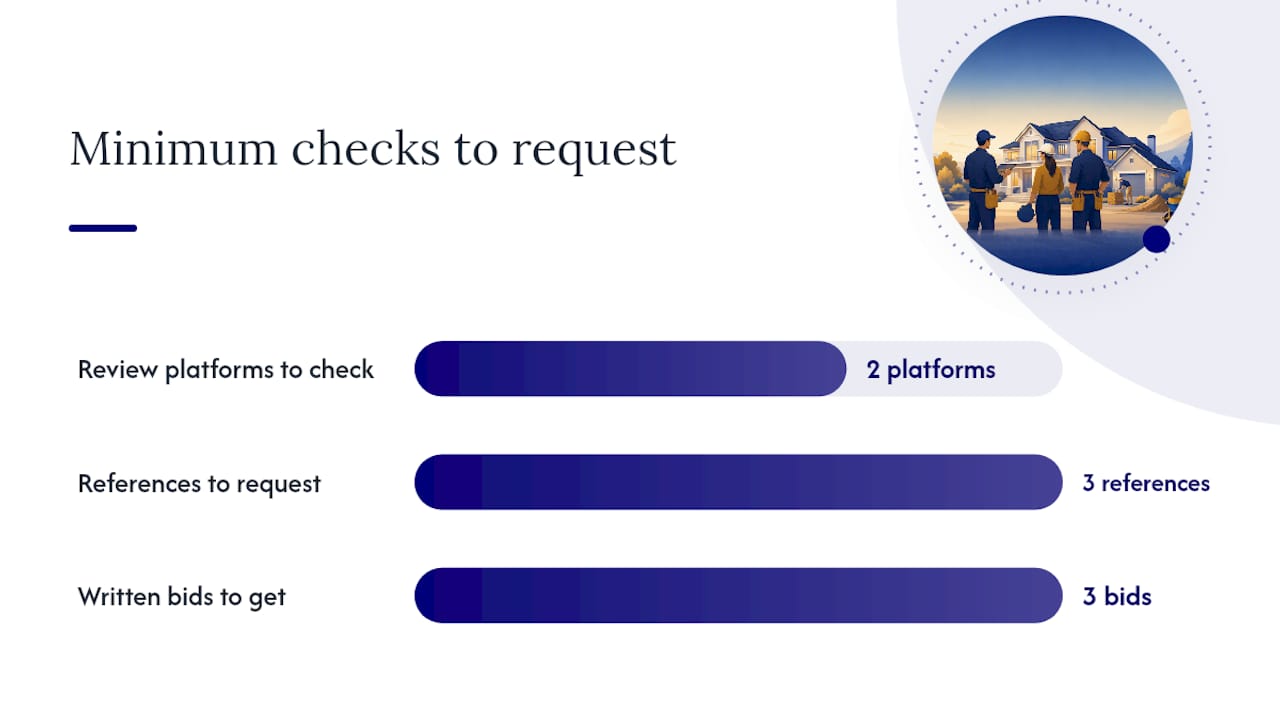
- Reviews checked across at least two platforms (Google and the Better Business Bureau at minimum)
- Any OSHA citations searched in the federal OSHA inspection database
Interview question list (initial phone screen):
- How long have you been in business under this name and license?
- Are you licensed for this specific type of work in this state?
- Who will be on-site daily, and will you use subcontractors?
- Who pulls the permits, and which inspections are required?
- What is your current project load, and can you start and finish within my timeline?
- How do you handle change orders?
- What warranty do you provide on labor, and how do manufacturer warranties transfer?
- Can you provide three references from comparable projects completed in the last 12 months?
In-person interview additions:
- Ask to see the physical license and insurance card.
- Request a written, itemized proposal, not a ballpark number.
- Confirm the site lead's name and direct contact information.
- Ask how they communicate progress: daily logs, weekly calls, or a project management app?
- Ask what typically goes wrong on a project like this and how they handle it. Redfin notes that how a contractor answers this question is one of the most honest litmus tests you will receive.
Pro Tip: Get written bids from at least three contractors using the same written scope. When you compare answers side by side, inconsistencies in pricing, permit responsibility, or subcontractor use become obvious fast.
How do you verify a contractor's license, insurance, and bond?
Every state maintains a licensing board, and most publish a searchable online database. The license class must match the scope of work. A general contractor license does not automatically authorize electrical or plumbing work in most states; those trades require separate specialty licenses. Search your state's contractor licensing board by name and license number, then confirm:
- The license is active, not expired or suspended.
- The license type matches the work being performed.
- The licensee name matches the person or company you are hiring.
- No disciplinary actions or complaints are attached to the record.
For insurance, never accept a COI handed to you by the contractor. Call the insurer listed on the certificate and ask them to confirm the policy is active, the limits are current, and your property address can be added as an additional insured for the project duration. Minimum general liability limits for residential work are typically $1 million per occurrence, though larger projects warrant higher limits. Confirm workers' comp separately. If the contractor claims an exemption (common for sole proprietors in some states), get that exemption in writing.
Bonding matters most on projects above $10,000 or any job where the contractor will handle significant deposits or materials purchases. A surety bond protects you if the contractor abandons the job or fails to pay subcontractors. Ask for the bonding company's name and call to confirm the bond is current and the coverage amount is adequate for your project value.
What to confirm on a valid COI:
- Policyholder name matches the contractor's business name exactly.
- Policy effective and expiration dates cover the full project period.
- General liability limit is appropriate for the project scope.
- Workers' compensation is listed, or a written exemption is on file.
- Your name and address appear as the certificate holder.
State license lookup portals to bookmark:
- Florida: Myfloridalicense
- California: Cslb
- Texas: Tdlr
- All other states: search "[state name] contractor license lookup" on the state government's official .gov domain.
Can a contractor's finances affect your project?
On jobs above $25,000, yes, and the risk is real. A contractor who is cash-strapped may use your deposit to cover another job's payroll, leaving your project stalled. For mid-to-large projects, ask for:
- A bank reference letter confirming the contractor maintains an active business account.
- A bonding letter from their surety showing current bonding capacity.
- Their annual project volume or a backlog statement (how many active jobs they are carrying).
- Audited or reviewed financials for projects above $100,000.
Red flags that suggest financial instability:
- Demands a deposit above a reasonable fraction before any work begins.
- Cannot name their surety or bonding company.
- Business has no physical address, only a P.O. box or cell number.
- Billing history is inconsistent or they cannot provide a list of recently completed projects.
- Pressure to pay in cash or outside a written contract.
Pro Tip: For large jobs, require a payment bond and structure draws tied to completed milestones. Each draw should be accompanied by a signed lien waiver from the contractor and any subcontractors paid in that period. This protects you from mechanics' liens even if the contractor fails to pay their subs.
How do you check a contractor's safety record and past work?
The federal OSHA inspection database is publicly searchable by company name. Look for citations, penalties, and repeat violations. A single minor citation is not disqualifying, but a pattern of serious or willful violations is. For Florida contractors, the Department of Business and Professional Regulation (DBPR) also maintains complaint and enforcement records tied to license numbers.
For references, do not accept a list of names without calling them. Ask:
- Was the project completed on time and within budget?
- How did the contractor handle problems or unexpected costs?
- Was the site kept clean and secure during construction?
- Would you hire them again?
- Were there any lien issues or disputes after the job?
Pro Tip: Ask specifically for references from projects completed in the last 12 months that are similar in scope and dollar value to yours. A contractor who did excellent tile work five years ago may not be the right fit for a full kitchen renovation today.
When reviewing past work photos, look for clean transitions, consistent material quality, and evidence of proper prep work (not just finished surfaces). If possible, request a site visit to a current or recently completed job. Walk the perimeter, check how materials are stored, and observe whether the crew is working safely and the site is organized.
Who is responsible for pulling permits?
The contractor should pull every permit required for the scope of work. When a homeowner pulls their own permit, they assume liability for code compliance and may void their homeowner's insurance coverage for that work. Permits also protect resale value: unpermitted work can surface during a buyer's inspection and create costly delays or required demolition.

Most residential projects follow the International Residential Code (IRC). Commercial and multi-family projects fall under the International Building Code (IBC). Your local municipality adopts and amends these codes, so the contractor must know the local amendments, not just the base code. Proven Pros recommends asking which specific inspections are required and whether the contractor has recent experience with your local building department.
Permit responsibilities to confirm:
- Contractor applies for and pays for all required permits.
- Contractor schedules all required inspections.
- Contractor provides copies of all approved permits and final inspection sign-offs.
- No work begins on permitted scope until the permit is posted on-site.
Sample contract clause:
Pro Tip: For coastal Florida properties, wind mitigation and flood zone compliance add layers to the permitting process. Confirm your contractor has pulled permits in your specific county before, not just in the state generally. Local building department relationships matter when inspections get backed up.
What should every construction contract include?
A verbal agreement is not a contract. Every project, regardless of size, needs a written document that covers scope, materials, schedule, payment, change orders, warranties, and lien releases. Modernize's printable checklist reinforces this: a written contract is one of the four non-negotiable items before any work begins.
Must-have contract elements:
- Detailed written scope of work (specific, not general)
- Material specifications: brand, grade, model number where applicable
- Project start date and substantial completion date
- Milestone approval points and acceptance criteria
- Payment schedule tied to milestones, not calendar dates
- Change-order process with written approval requirement before work proceeds
- Warranty terms for labor (typically one year minimum) and how manufacturer warranties transfer
- Dispute resolution process (mediation before litigation is standard)
- Lien waiver requirement with each draw payment
Payment schedule best practices:
- Initial deposit: 10–15% of total contract value, paid at contract signing.
- Draw 1: 25–30% at project mobilization or foundation completion.
- Draw 2: 25–30% at rough-in completion (framing, mechanical, electrical, plumbing).
- Draw 3: 20–25% at substantial completion.
- Final payment: 5–10% retainage held until punch list is complete and final inspection is passed.
Change-order sample wording:
Require a lien waiver from the contractor and each subcontractor with every draw. A conditional lien waiver is appropriate at draw time; an unconditional waiver is appropriate after payment clears.
How do you compare bids without getting misled by price?
The lowest bid is not always the best deal, and the highest is not always the safest. Price differences across bids usually trace back to differences in scope assumptions, material grades, or what the contractor left out. Before comparing numbers, confirm each bid covers the same items.
Bid comparison checklist:
- Scope: Does each bid describe the same work in the same detail?
- Allowances: Are allowances (for fixtures, tile, appliances) the same dollar amount across bids?
- Materials: Are brand, grade, and model specified, or is the bid open-ended?
- Permit responsibility: Does the bid include permit fees, or are they listed as "owner's responsibility"?
- Timeline: Does each bid commit to a start date and completion date?
- Warranty: Is the labor warranty period stated?
- Subcontractor use: Does the bid disclose which trades will be subcontracted?
A bid significantly above the others warrants a line-by-line conversation, not automatic rejection.
What are the biggest red flags before you sign?
The most common vetting failures are also the most avoidable. A 14-point vetting checklist recommends verifying the license, calling the insurer directly, checking business presence, comparing reviews across platforms, and keeping deposits within state-compliant limits. These are not optional extras; they are the baseline.
Top five red flags:
- No COI or expired coverage. A contractor who cannot produce a current certificate from their insurer is uninsured for your job.
- Refuses a written contract. Any contractor who insists on a handshake deal is not worth the risk.
- Demands a large upfront deposit. Deposits above 15–20% before work begins are a warning sign in most states. Some states cap deposits by law.
- Poor or unverifiable references. References who cannot recall project details, or who seem coached, are not useful references.
- No permit history. A contractor who has never pulled a permit in your municipality, or who suggests you pull it yourself, is shifting liability onto you.
Final verification checklist before signing:
- Re-verify the license is still active (licenses can lapse between your first check and contract signing).
- Re-confirm the COI covers the full project period.
- Call at least two references.
- Get the site lead's name and direct phone number in writing.
- Confirm the payment milestone schedule is in the contract, not just discussed verbally.
- Confirm the change-order process is in writing.
If any of these items is unresolved, pause the hire. An unresolved insurance or license issue is not a paperwork inconvenience; it is a liability that transfers to you the moment work begins.
What is a realistic vetting timeline for your project?
Vetting takes time, and compressing it creates risk. Here is a practical timeline by project size:
- Initial outreach and phone screen: 1–2 days. Send the same written scope to all bidders simultaneously.
- In-person interviews and site walk: 2–5 days after phone screen.
- Bid receipt and comparison: Allow 3–7 days for contractors to submit written proposals.
- License and COI verification: 1 day, done in parallel with bid review.
- Reference checks: 2–3 days. Call all references; do not rely on email.
- Contract negotiation and review: 2–5 days. Have an attorney review contracts above $50,000.
- Contract signature and permit application: 1–2 days.
Timeline by project scale:
- Small repairs (under $5,000): 2–4 days total vetting.
- Medium renovations ($5,000–$50,000): 2–3 weeks.
- Large projects ($50,000 and above): 4–8 weeks, sometimes longer for complex permitting.
Pro Tip: Build permit lead time into your project schedule from day one. In many Florida coastal counties, permit review alone can take 2–4 weeks. A contractor who promises a fast start without accounting for permit approval is either skipping permits or setting you up for a delay.
When should you hand vetting to a professional?
Some projects are too complex, too high-value, or too remote to manage solo. NIST-guided screening frameworks recommend tiered vetting tied to access level and risk, and the same logic applies to residential construction: the higher the asset value and the more contractors involved, the more structured the oversight needs to be.
Consider professional oversight when:
- You are an absentee owner and cannot be on-site to verify work or catch problems early. Estate care for absentee owners involves a different risk profile than owner-occupied renovation.
- The property is a luxury estate where a single contractor mistake can cause six-figure damage.
- The project involves multiple contractors or phased scopes requiring coordination.
- The permitting environment is complex (coastal flood zones, historic districts, HOA overlays).
- You lack time to manage weekly site visits, document review, and contractor communication.
Evaluation checklist for a vendor oversight partner:
- What is their scope of services? Do they handle license and COI verification, site visits, and payment authorization?
- What is their reporting cadence? Weekly written reports are the minimum for active construction.
- Are they insured and bonded for oversight services?
- Can they provide references from comparable oversight engagements?
- How do they handle disputes between owner and contractor?
The ROI on professional oversight is clearest in the downstream costs it prevents: unpermitted work, mechanics' liens, warranty disputes, and damage from unmonitored subcontractors. Vendor and contractor oversight for luxury estates is a specialized discipline, and the cost of getting it wrong is rarely just the repair bill.
How do you confirm a contractor's project management approach?
A contractor's project management approach tells you more about execution risk than their portfolio does. Ask directly: what software or system do they use to track schedule, materials, and subcontractor coordination? Contractors running mid-size or larger jobs without a scheduling tool (Buildertrend, CoConstruct, or even a shared Google Sheet) are managing by memory, and that creates gaps.
Confirm the following before signing:
- Who is the single point of contact for daily decisions on-site?
- How are schedule delays communicated, and what is the process for recovery?
- How are material deliveries tracked and confirmed against the contract specs?
- What is the process for daily or weekly progress documentation?
Ask for a preliminary project schedule in writing before you sign. A contractor who cannot produce a basic milestone schedule before the contract is signed will not produce one after. Weekly progress updates, whether a brief written log or a short call, should be written into the contract as a requirement, not left as a courtesy.
What should the contract say about disputes and warranties?
Dispute resolution language belongs in the contract before a dispute exists. The standard sequence is: written notice of the issue, a defined response period (typically 10–14 days), mediation, and then arbitration or litigation as a last resort. Skipping mediation and going straight to litigation is expensive for both parties and rarely necessary for residential disputes.
Warranty terms need to be specific. A blanket "one-year warranty on workmanship" is a starting point, but the contract should also state:
- What is covered and what is excluded (cosmetic wear, owner-caused damage).
- How warranty claims are submitted and the response timeline.
- How manufacturer warranties on materials are assigned to the owner at project completion.
- Whether the warranty is transferable if the property is sold.
For luxury estates, a two-year labor warranty is a reasonable ask on major renovation work. Get it in writing, and confirm the contractor will still be in business to honor it.
How do you evaluate a contractor's communication and professionalism?
Communication quality is a proxy for execution quality. A contractor who takes three days to return a call during the bid phase will not suddenly become responsive once they have your deposit. Watch for:
- Response time: Are they returning calls and emails within one business day?
- Clarity: Do they answer questions directly, or do they deflect and generalize?
- Documentation: Do they follow up verbal conversations with written confirmation?
- Attitude toward questions: A professional contractor welcomes detailed questions. Defensiveness or impatience is a signal.
Redfin's guide recommends setting a regular communication cadence at the start of the project, weekly at minimum, and putting it in the contract. A contractor who agrees to weekly updates in writing is accountable to that commitment in a way that a verbal agreement is not.
Professionalism also shows up in the bid itself. A written, itemized proposal with clear line items, material specs, and a defined scope is a sign of a contractor who runs an organized operation. A one-page quote with a single lump-sum number is not.
The part of vetting most homeowners skip
Most homeowners focus on price and portfolio. Those matter, but the single most predictive factor in a project going wrong is not the contractor's skill; it is the absence of a written, enforceable process for when things go sideways.
Every project hits a problem. Materials arrive late. A subcontractor underperforms. An inspection fails. What separates a good contractor from a bad experience is not whether problems occur; it is whether the contract gives you a clear path to resolution and whether the contractor's communication habits mean you hear about problems before they compound.
The vetting steps that homeowners most often skip are the ones that only matter when something goes wrong: calling the insurer directly instead of accepting the COI at face value, requiring lien waivers with every draw, and writing dispute resolution language into the contract. These feel like overkill on a smooth project. On a project that goes sideways, they are the only things standing between you and a mechanics' lien or an uninsured loss.
For luxury or absentee-owned properties, the stakes are higher still. A property that sits unoccupied for months while renovation work proceeds needs someone on-site with authority to stop work, document problems, and escalate to the owner. That is not a job for a neighbor or a property manager who checks in monthly.
Professional contractor oversight for your Emerald Coast estate
Vetting a contractor thoroughly takes 10–20 hours of focused work per project. For absentee owners and luxury estate holders along Florida's Emerald Coast, that time investment compounds across every vendor, every season, and every repair cycle.

30apropertycollective manages contractor and vendor oversight as part of its estate management services, handling license and COI verification, site visit documentation, milestone payment authorization, and written progress reporting on behalf of clients. The result is a fully documented project record and a single point of accountability, without the owner needing to be on-site or on-call. For estates where a single unvetted contractor can cause six-figure damage, professional oversight is not an added cost; it is risk management. To get started, review the service options or reach out directly for a customized proposal.
Sources
The following primary references were used to build this checklist. Each is publicly available and worth bookmarking for your own project files.
- PDF Checklist to Ask Your General Contractor
- Questions to ask general contractors
- Contractor Vetting Checklist: What to Verify Before Hiring