
Luxury property management is the specialized oversight of high-value residential estates, combining proactive maintenance, vendor coordination, financial administration, and concierge services to preserve asset value and operational excellence. For homeowners and investors with properties worth millions, passive ownership is not an option. The cost of a single missed inspection or a delayed repair can cascade into structural damage, security gaps, and significant financial loss. This guide covers what premium estate services actually include, how they differ from standard management, and what to look for when choosing a firm to protect your investment.
What services are included in luxury property management?
Professional luxury management covers far more than routine repairs. Weekly or monthly inspections with detailed digital reporting form the baseline of any credible service. Those reports track maintenance status, contractor activity, and financial transactions in one place.
The full scope of services typically includes:
- Property inspections: Weekly walkthroughs with photographic records and written condition reports
- Preventative maintenance: HVAC servicing, roof checks, plumbing inspections, and landscaping before problems develop
- Vendor coordination: Vetting, scheduling, and quality-controlling every contractor who enters the property
- Financial oversight: Bill payments, budget forecasting, and monthly financial reporting that gives owners full transparency
- Security management: Access control, alarm system monitoring, and coordination with private security providers
- Household staff: Recruitment, payroll, and performance oversight for housekeepers, groundskeepers, and estate managers
- Concierge services: Pre-arrival preparation, grocery stocking, transportation coordination, and lifestyle requests
Household staff management is one of the most underappreciated components of luxury home management. A property with a full-time housekeeper and groundskeeper requires HR-level oversight, not just a phone number on file.
Pro Tip: Insist that your management firm uses a single integrated system for contractor scheduling, financial reporting, and inspection logs. Fragmented records are the leading cause of missed maintenance and billing disputes.

How does luxury property management differ from standard property management?
Standard property management focuses on tenant placement, rent collection, and basic repairs. Luxury property management focuses on long-term asset preservation, operational complexity, and the specific lifestyle needs of high-net-worth owners. The difference is not a matter of degree. It is a different job entirely.
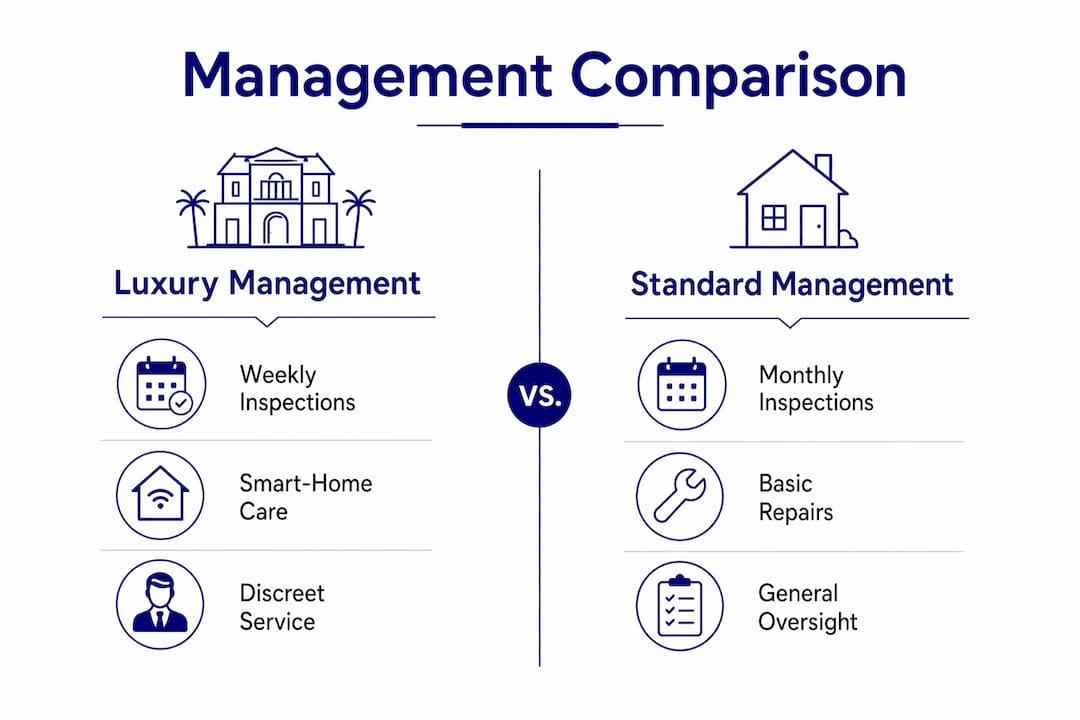
High-value estates often include smart-home systems, wine cellars, pools, home theaters, and guest quarters. Each system requires specialized vendors and scheduled maintenance. A standard property manager has neither the vendor network nor the technical knowledge to oversee these systems properly.
The rental dimension adds another layer. Luxury properties managed as elite hospitality micro-businesses use advanced pricing algorithms to optimize Average Daily Rate (ADR) and Revenue Per Available Room (RevPAR). Professional interior design and curated furnishings are not decorative choices. They are revenue tools.
| Feature | Luxury management | Standard management |
|---|---|---|
| Inspection frequency | Weekly or monthly with detailed reports | Periodic or complaint-driven |
| Vendor network | Pre-vetted specialists per system | General contractors |
| Financial reporting | Monthly budget forecasting and full transparency | Basic rent and expense tracking |
| Security coordination | Integrated with access control and private security | Basic alarm monitoring |
| Concierge services | Full lifestyle and arrival preparation | Not included |
| Staff oversight | Recruitment, payroll, and HR management | Not included |
Discretion is another defining factor. Luxury clients expect their property details, schedules, and personal preferences to remain strictly confidential. Standard management firms are not structured for that level of privacy.
Why is proactive management critical for luxury properties?
Anticipatory care is the practice of identifying and resolving issues before they become emergencies. For a $5 million estate, a slow roof leak discovered in week one costs a few hundred dollars to fix. The same leak discovered six months later can mean mold remediation, structural repairs, and interior replacement costing tens of thousands.
Proactive management covers several critical areas:
- HVAC inspections: Scheduled servicing prevents system failures during peak summer or winter months
- Leak detection: Regular plumbing checks catch slow leaks before they reach walls or flooring
- Storm preparedness: Pre-season checks on shutters, drainage, and outdoor furniture protect against weather damage
- Landscaping: Consistent care prevents overgrowth that can damage foundations and drainage systems
- Arrival readiness: Properties are inspected and prepared before every owner or guest visit
Reactive maintenance carries a premium cost that proactive care avoids entirely. Emergency plumber rates, after-hours contractor fees, and expedited material sourcing add up fast. Beyond the direct cost, deferred maintenance accelerates depreciation on finishes, systems, and structure.
Technology plays a direct role in early problem identification. Digital inspection logs, photo documentation, and condition-tracking software give management teams a baseline to measure against. Deviations from that baseline trigger action before a small issue becomes a large one.
Pro Tip: Ask any prospective management firm for a sample inspection report before signing. A strong report includes photos, timestamps, contractor notes, and a follow-up action log. A weak one is a paragraph of general observations.
How do luxury management firms support multi-property owners?
Multi-property ownership creates coordination challenges that most owners underestimate. The biggest mistake high-value owners make is managing each property through separate, disconnected systems. Different contractors, different reporting formats, and different billing cycles create gaps where problems hide.
A management firm acting as a single point of control solves this. One contact oversees all properties, maintains consistent standards, and delivers consolidated reporting across every location. For owners with estates in Florida, California, and internationally, that consistency is the product.
| Coordination feature | What it solves |
|---|---|
| Consolidated financial reporting | Eliminates scattered billing and missed payments |
| Unified vendor network | Maintains consistent quality standards across locations |
| Single point of contact | Reduces owner time spent on administrative coordination |
| Remote property monitoring | Keeps properties secure and ready when owners are away |
| Regulatory compliance tracking | Addresses local licensing and code requirements per jurisdiction |
Remote readiness is a specific concern for owners who visit properties seasonally. A property that sits vacant for months without oversight is a liability. Pipes can freeze, pests can enter, and security systems can fail without anyone noticing. A management firm with local presence and a defined inspection schedule prevents all of that.
30apropertycollective addresses this directly for Emerald Coast homeowners. Their estate management services include weekly inspections and year-round oversight, so properties are always ready regardless of how long the owner has been away.
What are best practices for luxury rental management?
Luxury rental management works best when the property is positioned as a boutique hospitality experience rather than a standard vacation rental. Guests paying premium rates expect premium service. That means pre-arrival concierge preparation, professional housekeeping, and a point of contact available throughout their stay.
Pricing strategy is where most owners leave money on the table. Dynamic pricing algorithms adjust nightly rates based on local demand, seasonality, and comparable inventory. A property priced at a flat rate year-round will underperform during peak season and overprice during slow periods. ADR and RevPAR metrics give owners a clear picture of financial performance relative to the market.
Best practices for maximizing rental income include:
- Professional photography and staging: First impressions drive booking decisions; high-quality visuals are non-negotiable
- Interior design consistency: Furnishings and finishes should match the property's price point and target guest profile
- Concierge integration: Offering restaurant reservations, transportation, and activity planning increases guest satisfaction and repeat bookings
- Regulatory compliance: Local on-the-ground expertise is required to navigate short-term rental licensing, tax collection, and occupancy rules
- Housekeeping standards: Post-stay cleaning and inspection protocols protect the property and maintain guest review scores
Pro Tip: Set a clear rental calendar that reserves owner-use periods before opening dates to guests. Last-minute owner requests during peak booking windows cost more in lost revenue than most owners realize.
Balancing rental income with asset protection requires clear policies. High-traffic rental use accelerates wear on finishes, appliances, and outdoor spaces. A management firm with strong housekeeping oversight and post-stay inspection protocols catches damage early and recovers costs from the responsible party.
Key takeaways
Luxury property management is the disciplined, proactive oversight of high-value estates, requiring integrated vendor coordination, financial transparency, and hospitality-grade service to preserve both asset value and owner experience.
| Point | Details |
|---|---|
| Proactive care prevents loss | Anticipatory maintenance stops small issues from becoming costly emergencies. |
| Integrated systems are non-negotiable | Fragmented contractor and financial management creates gaps that damage properties. |
| Rental management requires local expertise | On-the-ground presence drives regulatory compliance and revenue performance. |
| Multi-property owners need a single point of control | Consolidated oversight maintains consistent standards across all locations. |
| Inspections are the foundation | Weekly or monthly reports with digital records are the minimum standard for credible management. |
The uncomfortable truth about luxury property management
Most owners I speak with assume their property is being managed well because they haven't heard about any problems. That assumption is exactly the problem. No news is not good news in estate management. It is a sign that no one is looking closely enough.
The properties I've seen lose the most value are not the ones hit by storms or market downturns. They are the ones managed reactively, where the call only comes after something breaks. By that point, the damage is done, the contractor is charging emergency rates, and the owner is scrambling to coordinate repairs from three states away.
The shift toward technology-driven oversight is real and necessary. Digital inspection logs, condition-tracking software, and consolidated financial dashboards give owners visibility they simply didn't have before. But technology is only as good as the people using it. A weekly inspection report filed by someone who doesn't know what they're looking at is worthless.
My advice to any investor evaluating management partners is direct: ask for the last three inspection reports from a current client property. If those reports are detailed, photographic, and include follow-up action logs, you're talking to a serious firm. If they hand you a paragraph of general notes, keep looking. Local expertise and genuine accountability are what separate premium estate services from property management theater.
— Zackary
How 30apropertycollective protects your estate year-round
30apropertycollective was built specifically for luxury homeowners along Florida's Emerald Coast who need more than a property manager. They act as dedicated estate partners, with weekly inspections, storm preparedness protocols, and arrival-readiness checks built into every service tier.
Their concierge services cover everything from pre-arrival preparation to vendor coordination, giving owners a single point of accountability for every aspect of their estate. The team also provides digital financial reporting and contractor oversight through an integrated platform, so owners always know what is happening at their property. For homeowners who want their estate managed with the same care they would give it themselves, 30apropertycollective is the standard on the Emerald Coast.
FAQ
What does luxury property management include?
Luxury property management includes weekly or monthly inspections, preventative maintenance, vendor coordination, financial reporting, security management, household staff oversight, and concierge services. The scope goes well beyond standard property management in both depth and specialization.
How often should a luxury property be inspected?
Professional luxury management firms conduct inspections at minimum monthly, with many high-value estates requiring weekly walkthroughs and detailed digital condition reports.
Why is proactive maintenance important for high-end properties?
Proactive maintenance prevents small issues from becoming expensive emergencies. A slow leak or HVAC inefficiency caught early costs a fraction of what reactive repairs demand, and it protects the long-term value of the asset.
How do management firms handle multi-property owners?
Firms serving multi-property owners act as a single point of control, providing consolidated financial reporting, unified vendor networks, and consistent inspection standards across all locations regardless of geography.
What makes luxury rental management different from standard vacation rentals?
Luxury rental management uses dynamic pricing algorithms, professional interior design, and hospitality-grade concierge services to maximize ADR and RevPAR while maintaining the property's condition and prestige.